
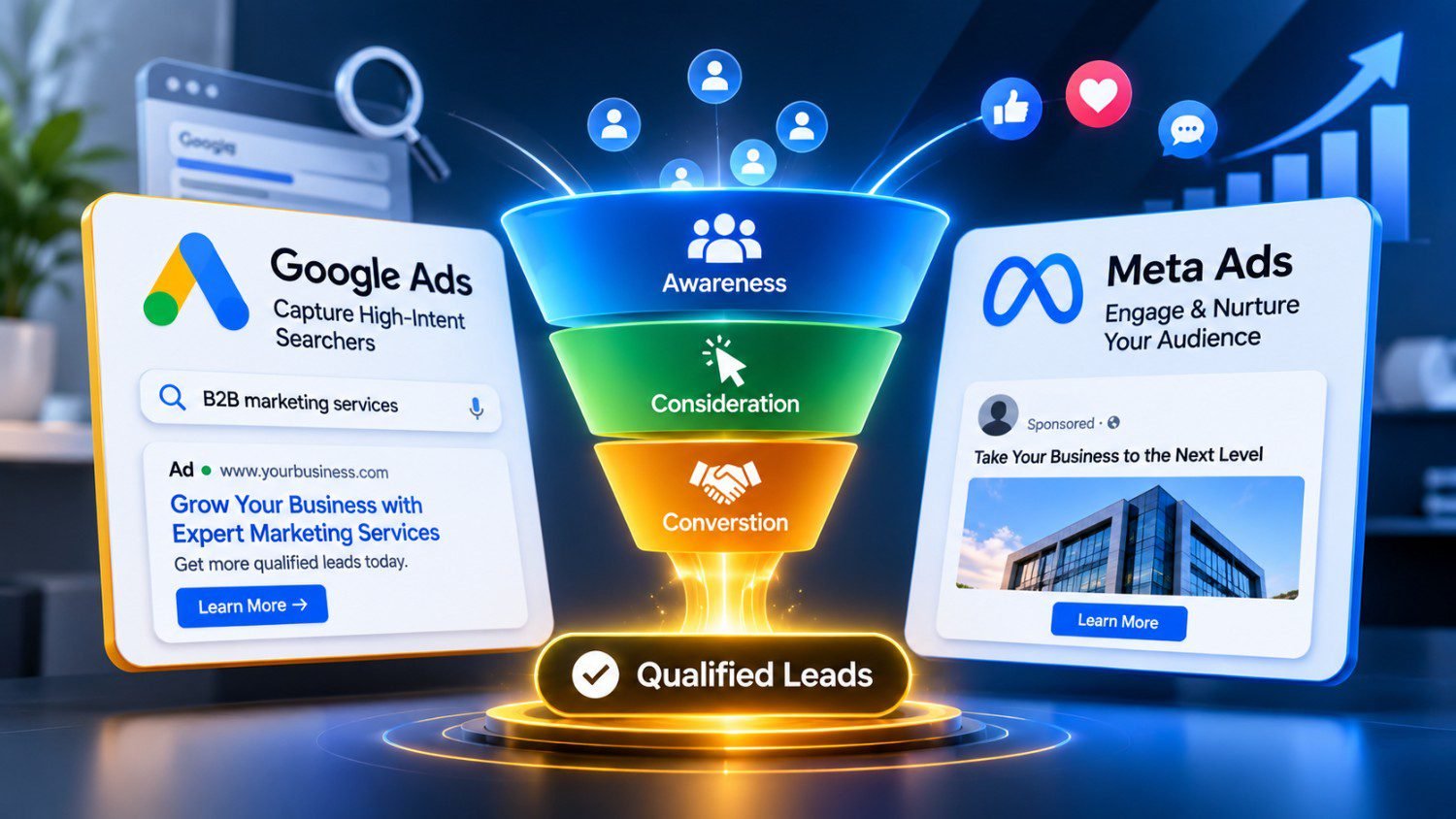
Google Ads wins when buyers already search for your solution. Meta Ads wins when you must build demand, retarget visitors, or reach decision-makers early. Google costs more per click but carries stronger intent. Meta looks cheaper but needs tighter lead qualification. For 2027, most B2B brands do best using Google to capture demand and Meta to retarget it.
You have a limited budget and a sales team waiting for leads. So which platform deserves your first dollar in 2027? That question splits marketing teams every planning cycle. One side says Google is the only serious B2B channel. The other says Meta is cheaper and underrated. Both are partly right. The 2025 and 2026 benchmark data in Metadata’s B2B advertising benchmarks shows why. Costs, click rates, and lead quality differ sharply by channel. And the cheapest channel is rarely the most profitable. This guide shows where each platform wins, what it costs, and how to avoid paying for junk leads next year.
What Is the Real Difference Between Google Ads and Meta Ads for B2B?
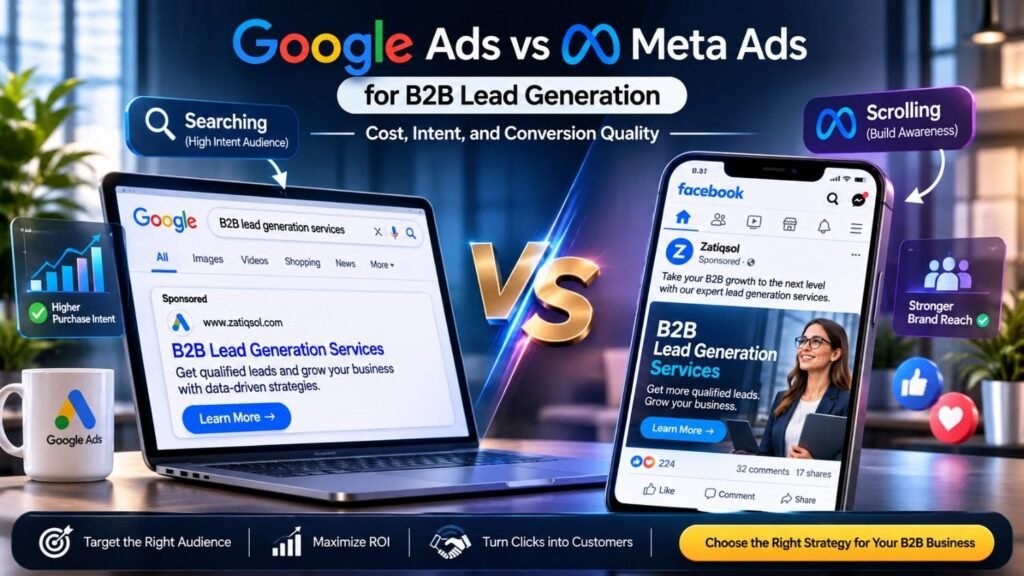
The core difference is intent versus interruption. On Google, a buyer types a problem into the search bar. Your ad answers it. They want a solution now. On Meta, a buyer scrolls Facebook or Instagram. Your ad interrupts them. They weren’t looking for you.
That shapes everything else:
- Google Ads captures existing demand.
- Meta Ads creates demand and nurtures it.
- Google targets keywords and search behaviour.
- Meta targets audiences, lookalikes, customer lists, and site visitors.
Neither model is better in the abstract. Your sales cycle, deal size, and market size decide the fit. Search volume matters. If only 300 people a month search for your niche product, Google can’t scale. Meta can reach the wider audience.
How Much Do Google Ads and Meta Ads Cost for B2B Lead Generation?
Meta usually wins on cost per lead. Google usually wins on cost per qualified lead. That gap trips up many marketers.
Let’s use 2025 and 2026 data as your baseline for 2027 budgets. A 2025 analysis of 153 B2B advertisers, covering $57.6M in spend and 211,000 leads, found Google Search averaging a 6.33% click-through rate. The reason is simple: the click follows stated intent. See the full dataset at Metadata.nAnother 2025 report put Google’s B2B CPC near $2.69 and CTR near 3.17% in Q3, while Meta’s cost per lead sat around $21.98. That comes from the Digital Bloom 2025 B2B PPC report. Now the catch. A 2026 review of B2B Meta accounts found that headline CPLs of $15–25 often become $75–150 once you measure cost per qualified lead. That’s from 27Five’s B2B Meta benchmarks. Cheap leads can quietly become expensive.
Cost Snapshot Based on 2025–2026 Data (Use as a 2027 Starting Point)
| Metric | Google Ads (Search) | Meta Ads (Lead/Traffic) |
|---|---|---|
| Typical B2B CPC | $2.50–$5.50 | $0.55–$3.50 |
| Typical B2B CPL | $70–$130 | $22–$95 |
| Cost per qualified lead | Close to headline CPL | Often 3–5x headline CPL |
| Minimum useful budget | ~$2,000/month | ~$3,000/month |
Ranges are compiled from the sources above. Auction costs shift every year, so add a 10–15% buffer to 2027 plans.
Pro tip: Never judge a platform by CPL alone. Track cost per sales-accepted lead. That’s the number your CFO cares about.
Which Platform Brings Higher Buyer Intent: Google or Facebook?
Google, almost every time.
Think about keywords. “Custom software development company UK” signals a buyer with budget. “CRM integration quote” signals one close to buying. Meta can’t read that mindset. It infers interest from behaviour, not from a typed problem.
But intent isn’t binary. Think of it in three layers:
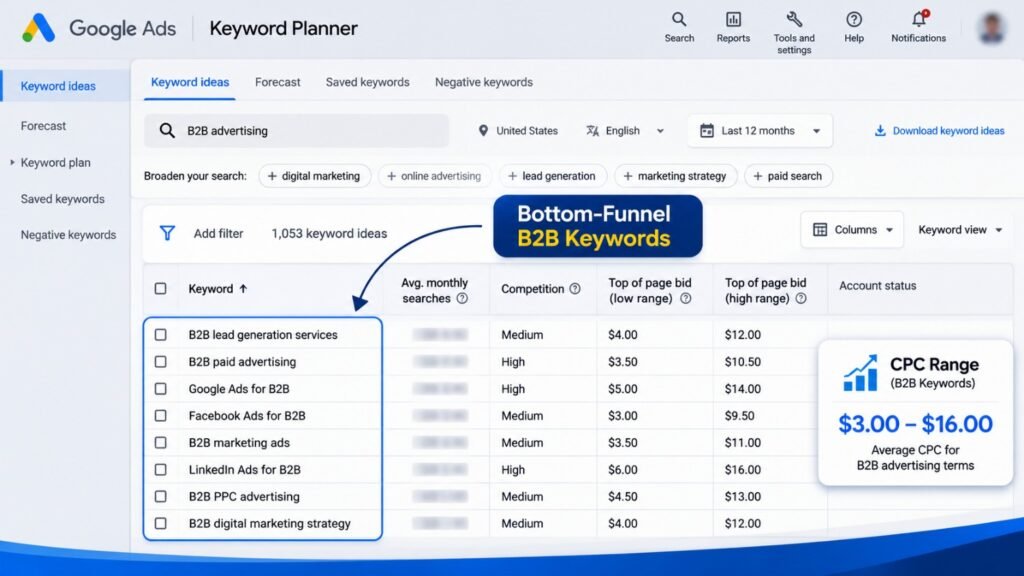
- High intent (Google): Bottom-funnel keywords like hire, pricing, agency, and vendor.
- Medium intent (Google + Meta retargeting): Comparison searches, webinar signups, case study downloads.
- Low intent (Meta): Cold prospecting, problem-awareness content, lookalike audiences.
If you sell a complex, high-ticket service, start with high-intent Google keywords. They convert faster and teach you which messaging works. One setup detail many teams skip is conversion definition. Google’s own Ads Help guidance explains how its conversion and lead tracking features work. Get this right before you spend, or your reporting will mislead you.
Google Ads vs Facebook Ads for B2B: Who Delivers Better Lead Quality?
Google usually delivers higher initial quality. Meta can match it, but only with the right setup. Here’s a case worth studying. A mid-sized IT services firm in the UK ran both platforms for 90 days in 2026 on an equal £4,000 monthly budget.
- Google Ads: 38 leads at roughly £105 each. Eleven became sales-accepted opportunities.
- Meta Ads: 112 leads at roughly £36 each. Only nine became opportunities.
Meta looked three times cheaper on paper. But cost per opportunity was £382 on Google and £444 on Meta. Meta wasn’t bad. It just needed more filtering. The fix came in month four. The firm added three qualifying questions to the Meta lead form. It also started uploading closed deals back to Meta. Opportunities from Meta rose to fourteen. Cost per opportunity dropped to around £290.
The lesson: Meta’s algorithm optimises for whatever you reward. Reward form fills, and you get form fills. Reward closed deals, and quality improves. Meta’s own training covers this approach. Their lesson on improving lead quality with Conversions API for CRM shows how to send CRM outcomes back to the platform.
Google Ads vs Meta Ads for B2B: Full Comparison Table
Here is the side-by-side view for 2027 planning. Benchmarks come from the Digital Bloom report, TripleDart’s 2026 SaaS PPC benchmarks, and 27Five’s B2B Meta data. Treat them as ranges, not promises.
| Factor | Google Ads (Search) | Meta Ads (Facebook + Instagram) | Better For |
|---|---|---|---|
| Buyer intent | High. People type a problem or vendor search | Low to medium. People scroll and get interrupted | |
| Average CTR | About 3%–6% | About 0.8%–1.2% | |
| Cost per click | $2.50–$5.50 | $0.55–$3.50 | Meta |
| Headline cost per lead | $70–$130 | $22–$95 | Meta |
| Lead conversion rate | About 4.2% (SaaS benchmark) | About 3.1% (SaaS benchmark) | |
| Cost per qualified lead | Close to headline CPL, more predictable | Often 3–5x headline CPL without filtering | |
| Audience targeting | Keywords, search terms, location, in-market audiences | Lookalikes, customer lists, interests, site visitors | Meta for audience building |
| Reach in small niches | Capped by monthly search volume | Large reach even in narrow markets | Meta |
| Retargeting | Good (search, display, YouTube) | Excellent (feed, stories, reels) | Meta |
| Time to first leads | Days to 2 weeks | 2–4 weeks, longer for cold audiences | |
| Creative workload | Low. Mostly text and extensions | High. Video, images, frequent refreshes | Google (less effort) |
| Lead quality control | Strong with tight keywords and negatives | Needs qualifying questions and CRM feedback | |
| Tracking setup | Conversion tracking and offline uploads | Pixel plus Conversions API for CRM | Equal. Both need CRM feedback |
| Minimum useful budget | About $2,000/month | About $3,000/month | |
| Best funnel stage | Middle and bottom | Top and retargeting | Use both |
| Best sales cycle fit | Short to medium (under ~90 days) | Long, multi-touch cycles | Depends on your cycle |
| Biggest risk | Rising CPCs and broad-match waste | Cheap leads that never buy | Manage both actively |
How to read this table: Don’t count wins. Look at your situation.
- Large search demand and a short sales cycle? Lean Google.
- Small niche or long, multi-step cycle? Lean Meta, with Google at the bottom of the funnel.
- Want predictable growth? Run Google for capture and Meta for retargeting. Shift budget by cost per sales-qualified lead.
What Are the Pros and Cons of Each Platform?
Google Ads
| Pros | Cons |
|---|---|
| Captures buyers actively searching | Expensive clicks in competitive niches |
| Fast feedback on what messaging works | Limited by search volume |
| Strong lead quality when keywords are tight | Needs ongoing negative keyword work |
| Easy to tie to revenue with offline conversions | Competitors can bid on your brand |
Meta Ads
| Pros | Cons |
|---|---|
| Lower CPCs and cheaper leads | Lower baseline intent |
| Powerful retargeting and lookalike audiences | Lead quality depends on setup |
| Reaches buyers before they start searching | Needs steady creative refreshes |
| Scales well for niche markets | Weak B2B job-title targeting vs LinkedIn |
Think of it this way. Google is a net you cast where fish already swim. Meta is a bait trail that draws them toward your boat.
Can Facebook Ads B2B Lead Generation Actually Work?
Yes. But only if you treat it as a nurturing channel rather than a quick-win machine. Here’s a second case from 2026. A B2B software company selling workflow tools to logistics firms had weak Google results. Their niche had only about 900 monthly searches in their target country. Google couldn’t deliver enough volume.
So they tried Meta with a three-step approach:
- Cold audience: A short video on a common logistics headache. Cost: about $18 per 1,000 views.
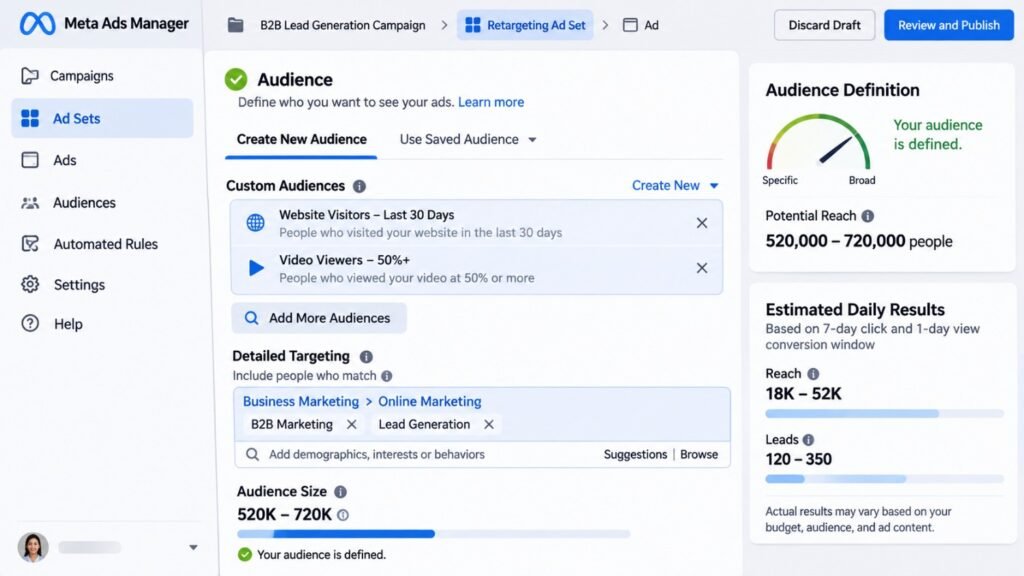
- Warm retargeting: Anyone who watched 50% or more saw a case study ad.
- Hot retargeting: Site visitors saw a free-audit offer.
Over 120 days, they spent $14,500. They generated 61 demo requests and closed 7 deals. Average deal value was $9,200. That’s $64,400 in revenue from $14,500, a return of roughly 4.4x. Notice what they didn’t do. They didn’t ask cold audiences to book a demo. They earned attention first. That’s the secret to Facebook Ads B2B lead generation. Warm people up. Then ask. Benchmarks back this up. 27Five’s B2B Meta data explains why CPC looks so low on this platform. Meta optimises for impressions and engagement first. Your job is to steer it toward buyers.
Real mistake to avoid: Many B2B brands run cold “Book a Demo” ads. Conversion rates collapse because the audience doesn’t know you yet.
What Are the Best B2B Paid Advertising Strategies for 2027?
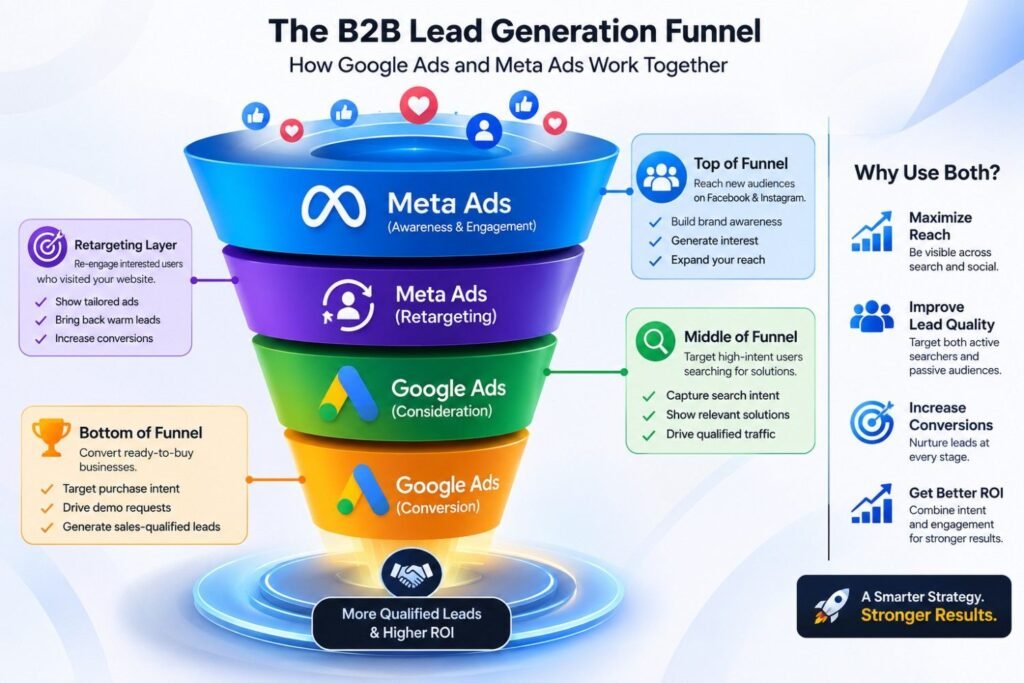
The best B2B paid advertising strategies combine platforms instead of choosing one. Here’s a practical framework for 2027.
1. Start with Google Search for Capture
Build tight campaigns around 15–30 bottom-funnel keywords. Use exact and phrase match. Add negative keywords weekly.
2. Layer Meta Retargeting Within 30 Days
Once your site gets traffic, retarget visitors on Meta. Warm audiences are where Meta shines for B2B. CPLs drop sharply here.
3. Feed Revenue Data Back to Both Platforms
Upload offline conversions to Google. Use Conversions API on Meta. This trains both algorithms to find buyers, not browsers.
4. Treat Creative as Your Targeting
Expect more automation in 2027. Both platforms increasingly choose audiences for you. Your message becomes the main lever. Say exactly who the ad is for, in the first line.
5. Test Lead Forms vs Landing Pages
Instant forms deliver volume. Landing pages deliver quality. Test both. Many teams find a hybrid works: instant forms with 3–4 qualifying questions.
6. Prepare for AI-Led Search
Buyers now research vendors inside AI assistants and AI search results. Expect fewer generic clicks and more comparison-driven ones. Publish clear proof, pricing signals, and case studies so both ads and organic results earn trust.
Suggested Budget Splits for 2027
| Stage | Google Ads | Meta Ads | Notes |
|---|---|---|---|
| Month 1–2 (testing) | 70% | 30% | Learn what converts |
| Month 3–4 (scaling) | 55% | 45% | Add retargeting |
| Month 5+ (optimising) | 50% | 50% | Shift by cost per opportunity |
Pro tip: Review your split monthly using pipeline data, not platform dashboards. Dashboards often over-credit themselves.
Want help building this mix? Our digital marketing services cover search, social, and reporting tied to pipeline.
How Do You Measure Lead Quality, Not Just Lead Volume?
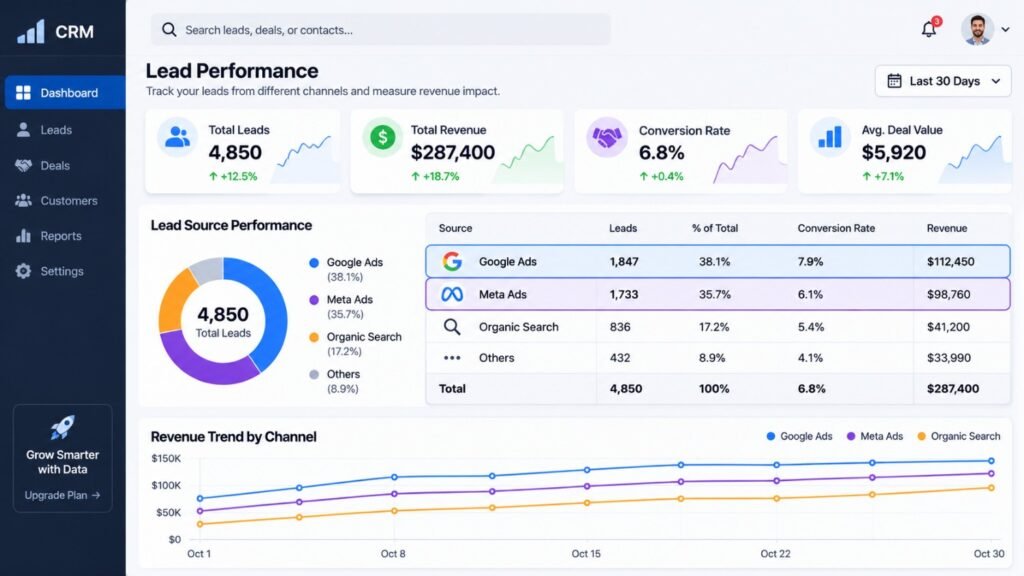
This is where most campaigns quietly fail. A lead is not a result. A sales-accepted lead is closer. A closed deal is the result.
Track these five metrics:
- Cost per lead (CPL): Your starting point.
- Cost per sales-qualified lead (SQL): Your real efficiency number.
- Lead-to-opportunity rate: Shows lead quality directly.
- Opportunity-to-close rate: Shows sales alignment.
- Customer acquisition cost (CAC): The full picture.
Then close the loop:
- Connect your CRM to both ad platforms.
- Tag every lead with its source and campaign.
- Hold a monthly meeting with sales to review lead quality.
- Feed good-lead and bad-lead labels back into the platforms.
That last step changes everything. When sales marks a lead as junk, tell the algorithm. Over a few weeks, junk volume falls. Meta’s CRM-based lead quality lesson walks through the setup. Google’s conversion documentation covers the equivalent on its side. You’ll also need a proper funnel behind the ads. Our B2B lead generation funnel guide breaks down each stage.
What Mistakes Do B2B Advertisers Make on Google and Meta?
The same errors show up repeatedly. Here are the big ones:
- Judging by CPL alone. Cheap leads that never buy cost more than expensive ones that do.
- Broad match without guardrails. Automation can burn budget on irrelevant searches fast.
- Sending all traffic to the homepage. Dedicated landing pages convert better.
- Ignoring creative fatigue on Meta. Refresh ads every 3–4 weeks.
- Giving up after 14 days. B2B learning phases take longer. Wait 30–45 days.
- Skipping sales feedback. Marketing and sales must share lead definitions.
- No negative keywords. Job seekers and students waste surprising amounts of budget.
One lesson stands out. A team paused Meta after two weeks in 2026 because CPL looked too high at $85. They never checked downstream. Later analysis showed those leads closed at nearly double the rate of their Google leads. They’d killed their best channel based on a shallow metric.
Benchmarks can mislead too. Metadata notes that CTR is a poor cross-channel scorecard, because a search click and a feed click mean very different things. Compare like with like.
How Can Zatiq Sol Services Support Paid B2B Campaigns?
Ads alone rarely solve lead generation. The best results come when ads connect to strong supporting assets.
Here are real-world ways each service plugs in:
- Digital Marketing: Full-funnel campaigns across Google and Meta, with reporting tied to pipeline.
- SEO: Organic content lowers your dependence on paid clicks. Over time, it cuts blended CAC. See our SEO services.
- AI Development: Custom AI scoring models can rank incoming leads by likelihood to close. Sales calls the best ones first.
- Custom Software Development: Build lightweight CRMs or lead-routing tools that connect ad platforms to sales workflows.
- UI/UX Design: Better landing pages lift conversion rates without raising ad spend.
- Mobile App Development: Useful for B2B companies with client portals or field teams that need lead capture on the go.
- IT Outsourcing: Extend your team for tracking setup, dashboards, and automation without hiring full-time.
Industry context matters too. Agricultural suppliers face seasonal demand and long relationships. We outline that in our guide to digital marketing for agriculture businesses. Property-related B2B firms can see how SEO and social work together in our real estate SEO and social media marketing guide.
Is LinkedIn better than both Google and Meta for B2B?
Not automatically. LinkedIn offers the best job-title targeting, but it’s often the most expensive. TripleDart’s 2026 SaaS benchmarks, summarised by Demand Gen Report, put LinkedIn at a $213 average CPL against $127 for Google and $94 for Meta. Use LinkedIn when deal sizes justify it. For most mid-sized budgets, Google plus Meta retargeting is more efficient.
How long before Google Ads or Meta Ads show real B2B results?
Expect 30–45 days for useful data and 90 days for reliable trends. Sales cycles longer than 60 days stretch this further. Judge early performance on leading indicators like cost per SQL, not closed revenue.
Should I use Performance Max or Advantage+ for B2B in 2027?
Be careful. These automated campaign types are built for volume and ecommerce-style signals. In B2B, they can flood you with low-quality leads. Use them only after you’ve fed enough CRM conversion data to guide the algorithm. Start with manual-control search and standard Meta campaigns.
How will AI search change B2B paid ads in 2027?
More buyers will research vendors inside AI assistants before clicking any ad. That means fewer top-of-funnel searches, but higher expectations when they do click. Strong brand presence, reviews, and educational content help you show up in both places.
What’s a good lead-to-opportunity rate for B2B paid leads?
Roughly 10–25% for Google and 5–15% for cold Meta traffic is a reasonable range. Retargeted Meta leads often land closer to Google. If you’re below these ranges, check form questions, offer clarity, and sales response time first.
Does response speed really affect paid lead quality?
Massively. Calling a lead within five to ten minutes can multiply contact rates compared with waiting a day. A fast-response workflow, even a simple automated one, often adds more value than another round of ad tweaks.
Best for the US and UK: Specific Considerations for 2027
The principles above work globally. But the US and UK differ in rules, costs, and buyer behaviour. Here’s what to adjust.
United States
- Costs: Competitive B2B keywords commonly run $3.50–$5.50 per click. Software and professional services sit at the high end. Budget at least $2,000–$3,000 per month per platform.
- Privacy rules: Follow CAN-SPAM for email follow-ups. State laws such as California’s CCPA/CPRA affect data collection and retargeting. Add clear privacy notices to every form.
- Calls and texts: The TCPA restricts automated calls and texts. Get explicit consent before using autodialers or SMS follow-up.
- Buyer behaviour: US buyers expect quick demos and clear pricing signals. Landing pages with transparent starting prices tend to convert better.
United Kingdom
- Costs: Expect CPCs slightly lower than the US in many sectors. A typical B2B CPL on Google may land around £80–£105 (roughly $100–$130). Meta lead costs often fall between £18–£75. Exchange rates move, so treat these as approximate.
- Privacy rules: UK GDPR and PECR apply. B2B email to corporate addresses is generally easier, but sole traders and some partnerships need consent. UK data law has been changing, so confirm current rules with your legal adviser before launch.
- Data handling: Be careful uploading customer lists to Meta. Make sure your privacy policy covers it and you have a lawful basis. Server-side tracking, as covered in Meta’s Conversions API training, helps here.
- Buyer behaviour: UK buyers often prefer understated, proof-led messaging. Heavy hype underperforms. Case studies, accreditation badges, and named client results help.
Local Challenges and Success Pattern
In both markets, rising CPCs and privacy-driven tracking loss are the biggest pain points heading into 2027. The winning response is the same: first-party data, accurate conversion setup per Google’s Ads Help guidance, and CRM feedback loops.
Consider the UK IT consultancy from earlier. Their jump in Meta quality came from tighter forms and CRM uploads. A US-based SaaS firm saw similar gains by refining search terms and shifting to value-based conversion tracking. Both succeeded by focusing on quality signals instead of raw volume.
Conclusion: Which Should You Choose in 2027?
There’s no single winner in Google Ads vs Meta Ads for B2B. The smartest answer depends on your market and sales cycle.
Here’s the short version:
- Choose Google first if buyers search for what you sell and you need leads quickly.
- Choose Meta first if your niche is small, your cycle is long, or you need to build awareness.
- Use both if you want the strongest, most resilient pipeline.
Remember the three rules that matter most. Measure cost per qualified lead, not cost per lead. Feed CRM data back to the platforms. And give each channel enough time to learn. Start small. Test one offer. Track it all the way to revenue. Then scale what works.
Ready to grow your business with custom AI, SEO, web development, or digital marketing? 👇