
TL;DR: Solidity development services help businesses build smart contracts and decentralized applications on blockchain networks like Ethereum. If you’re launching a DeFi platform, NFT project, DAO, or any Web3 product, you need a professional Solidity developer. This guide covers everything — from what these services include to when and how to hire the right team.
What Are Solidity Development Services?
Most people hear “Solidity” and think it’s just a programming language.
It is — but there’s much more to it.
Solidity is the primary language used to write smart contracts on Ethereum and EVM-compatible blockchains. It’s what powers DeFi protocols, NFT collections, DAOs, token systems, and blockchain-based business logic.
Solidity development services are professional services that cover the full lifecycle of smart contract and blockchain application development using Solidity.
This includes:
- Writing and deploying smart contracts
- Auditing and testing existing contracts
- Integrating contracts with front-end Web3 applications
- Building DeFi, NFT, and DAO platforms
- Token creation (ERC-20, ERC-721, ERC-1155)
- Custom blockchain business logic
In short — if your project runs on a blockchain and needs custom code, Solidity development services are what you need.
Why Is Solidity the Dominant Smart Contract Language?
There are a few smart contract languages out there — Vyper, Rust (for Solana), Move (for Aptos).
But Solidity dominates the space by a massive margin.
Here’s why:
- Ethereum is the #1 smart contract platform. It has the largest developer ecosystem globally.
- EVM compatibility is everywhere. BNB Chain, Polygon, Arbitrum, Optimism, Avalanche — all run Solidity.
- Developer community is massive. More documentation, more tools, more support.
- Industry adoption is proven. Uniswap, Aave, OpenSea — all built with Solidity.
According to the Electric Capital Developer Report 2024, Ethereum maintains over 32% of all active blockchain developers globally, with Solidity remaining the most-used smart contract language by a wide margin. (Source: Electric Capital)
That’s why businesses serious about blockchain go with Solidity. It’s not a trend — it’s the industry standard.
What Does a Solidity Development Service Actually Include?
This is where most clients get confused.
They think hiring a Solidity developer means someone just writes a few lines of code. In reality, professional Solidity smart contract development is a multi-layered process.
Here’s what a complete service package looks like:
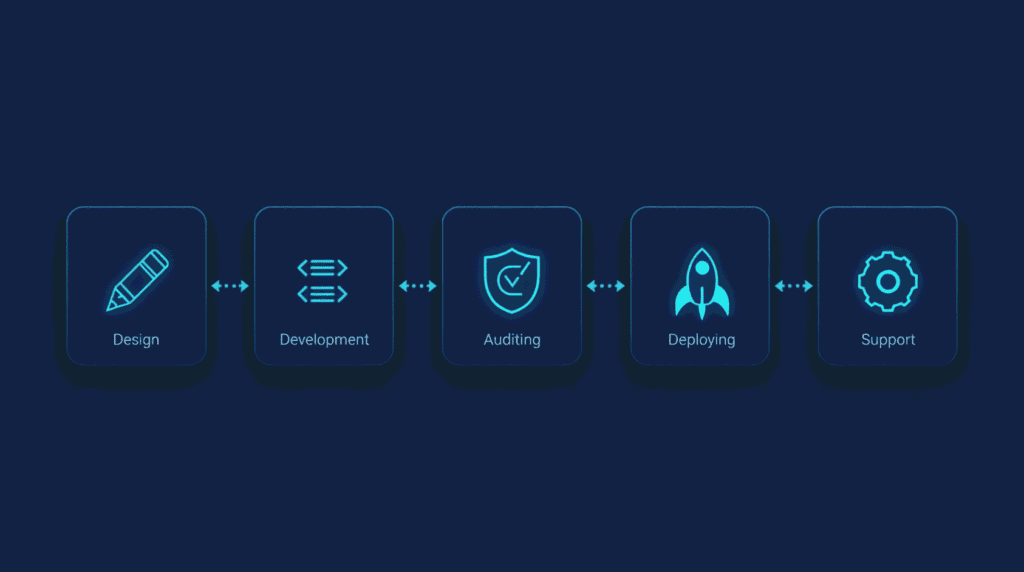
1. Smart Contract Architecture & Design
Before writing a single line of code, experienced developers plan the contract structure.
This includes:
- Defining contract logic and flow
- Choosing the right token standards
- Planning upgrade mechanisms (proxy patterns)
- Mapping out role-based access controls
2. Smart Contract Development
This is the core work — writing the actual Solidity code.
A good development team will:
- Follow Solidity best practices and design patterns
- Write clean, gas-optimized code
- Use OpenZeppelin libraries for security
- Build modular, maintainable contract systems
3. Smart Contract Testing
Every professional Solidity development company runs rigorous testing.
Testing includes:
- Unit testing (Hardhat, Foundry)
- Integration testing
- Edge case simulation
- Gas usage benchmarking
4. Smart Contract Auditing
This is non-negotiable for any serious project.
An audit identifies:
- Reentrancy vulnerabilities
- Integer overflow/underflow issues
- Access control flaws
- Logic errors that can drain funds
5. Deployment & Post-Launch Support
Deployment to mainnet is just the beginning.
Professional services also cover:
- Testnet deployment (Sepolia, Goerli)
- Mainnet deployment and verification
- Contract monitoring
- Upgrade management and bug fixes
When Do You Actually Need Solidity Development Services?
This is the question most businesses struggle with.
Not every project needs a blockchain. But when it does — Solidity is almost always the answer.
Here are the clear signals that you need professional Solidity development services:
You’re Building a DeFi Platform
Decentralized finance is the biggest driver of Solidity demand.
If you’re building:
- A decentralized exchange (DEX)
- A lending and borrowing protocol
- A yield farming or staking platform
- A liquidity pool system
You need Solidity. Full stop.
The global DeFi market was valued at $21.3 billion in 2024 and is projected to grow at a CAGR of 53.7% through 2030, according to Grand View Research. (Source: Grand View Research)
That growth means demand for Solidity developers isn’t slowing down.
You’re Launching an NFT Project
NFTs aren’t just digital art anymore.
Businesses use NFTs for:
- Digital ownership certificates
- Loyalty and membership programs
- Gaming assets and in-game economies
- Real estate tokenization
- Supply chain provenance
If your business model involves NFTs, you need a developer who can write secure ERC-721 or ERC-1155 contracts.
You’re Creating a Token
Launching a utility token, governance token, or payment token?
That requires a properly written ERC-20 smart contract — with correct supply logic, minting controls, burn mechanisms, and vesting schedules.
A poorly written token contract has cost projects millions. Professional Solidity contract development eliminates that risk.
You’re Building a DAO
Decentralized Autonomous Organizations are becoming a real business structure.
DAOs need:
- Governance contracts (voting logic)
- Treasury management contracts
- Proposal systems
- Multi-sig wallet integrations
All of this is Solidity work.
You Need to Automate Business Logic on Blockchain
Sometimes the use case is simpler — but still critical.
Examples include:
- Automated royalty splits for creators
- Escrow contracts for freelance payments
- Supply chain milestone-based payments
- Insurance payout triggers
Any time you need trustless, automated execution of business rules — smart contracts are the answer.
Who Needs Solidity Development Services? (Real Use Cases)
Let’s look at who actually hires Solidity developers for hire and what they build:
| Client Type | What They Build | Solidity Services Needed |
|---|---|---|
| Crypto Startups | DeFi protocols, DEXs | Full contract development + audit |
| Gaming Companies | Play-to-earn games, NFT assets | ERC-721/1155, game logic contracts |
| Enterprises | Supply chain, trade finance | Custom business logic contracts |
| Fintech Companies | Payment systems, lending | Token contracts, escrow systems |
| Media & Entertainment | Creator royalties, memberships | NFT contracts, revenue-split logic |
| Real Estate Firms | Property tokenization | Asset tokenization contracts |
| DAOs & Communities | Governance, treasury | Voting + treasury contracts |
Every one of these use cases requires a professional who understands both Solidity and the business domain.
What’s the Difference Between a Freelance Solidity Developer and a Solidity Development Agency?
This is one of the most common questions businesses ask.
Both can write smart contracts. But the experience is very different.
Freelance Solidity Developer
Pros:
- Lower upfront cost
- Direct communication
- Good for small, well-defined projects
Cons:
- Single point of failure (no backup)
- Limited availability
- No built-in audit or testing process
- Risk of abandoned projects
Solidity Development Agency / Company
Pros:
- Full team (developer, tester, auditor, project manager)
- Structured delivery process
- Ongoing support and maintenance
- Accountability and contracts
- Scalable for large projects
Cons:
- Higher cost than a solo freelancer
- Requires proper briefing and onboarding
For anything beyond a simple token contract — a Solidity development agency is the smarter investment. The cost of a single smart contract exploit far outweighs the cost of hiring a professional team.
How Much Do Solidity Development Services Cost?
Pricing varies significantly based on project complexity, team location, and scope.
Here’s a realistic breakdown:
| Service Type | Estimated Cost Range |
|---|---|
| Simple ERC-20 Token Contract | $1,500 – $5,000 |
| NFT Collection Contract (ERC-721) | $3,000 – $10,000 |
| DeFi Protocol (Basic) | $15,000 – $50,000 |
| Full DeFi Platform (Complex) | $50,000 – $200,000+ |
| Smart Contract Audit | $5,000 – $30,000 |
| DAO Governance System | $10,000 – $40,000 |
| Token + Vesting + Staking System | $8,000 – $25,000 |
| Ongoing Maintenance (Monthly) | $1,000 – $5,000/month |
Pro Tip: Never choose a Solidity developer based on price alone. A $500 smart contract that gets exploited can cost you millions. Quality and security always come first.
Offshore Solidity development outsourcing — working with companies in Pakistan, Eastern Europe, or Southeast Asia — can reduce costs by 40–60% without sacrificing quality, especially when working with an established agency with a proven track record.
What Should You Look for in a Solidity Development Company?
Not all providers are equal. Here’s a checklist for evaluating any Solidity development agency:
Technical Competence
- Demonstrated experience with Ethereum and EVM chains
- Uses Hardhat, Foundry, or Truffle for testing
- Familiar with OpenZeppelin, Chainlink, The Graph
- Writes gas-optimized code
- Has experience with upgradeable contracts (proxy patterns)
Security & Auditing
- Offers internal security review before delivery
- Works with third-party auditors for large projects
- Follows OWASP smart contract security guidelines
- Has experience handling contract incidents
Process & Communication
- Clear project scoping and milestone delivery
- Transparent pricing with no hidden fees
- Regular progress updates and demos
- Post-deployment support included
Portfolio & References
- Live deployed contracts on mainnet (verifiable on Etherscan)
- Client testimonials and case studies
- Experience in your specific domain (DeFi, NFT, DAO, etc.)
Common Mistakes to Avoid When Hiring Solidity Developers
Many projects fail not because of bad ideas — but because of bad execution.
Here are the most critical mistakes to avoid:
1. Skipping the audit This is the number one mistake. Never deploy to mainnet without a proper security audit. The DeFi space lost over $1.8 billion to hacks and exploits in 2023 alone, according to Chainalysis. Most of these were preventable with proper auditing.
2. Hiring based on price alone Smart contract bugs are permanent on the blockchain. You cannot patch a deployed contract easily. Cutting corners upfront creates catastrophic risk later.
3. Not defining project scope clearly Vague requirements lead to vague results. Before hiring anyone, document exactly what your contracts need to do, what standards they follow, and what edge cases need handling.
4. Ignoring gas optimization Poorly optimized contracts cost your users more in transaction fees. This directly impacts user experience and adoption. Always ask developers about their gas optimization approach.
5. Not planning for upgrades Smart contracts are immutable by default. If you don’t plan an upgrade mechanism upfront (like a proxy pattern), you cannot fix bugs without redeploying — which breaks everything.
6. Choosing a developer with no domain experience A Solidity developer who has never built DeFi protocols shouldn’t be your first call for a DeFi project. Domain-specific experience matters enormously in blockchain.
Solidity Development Services vs. General Blockchain Development
People often confuse these two.
General blockchain development can mean many things — building on Solana (Rust), Hyperledger (Go/Java), Cosmos (Go), or Cardano (Haskell).
Solidity development services specifically focus on:
- Ethereum mainnet
- EVM-compatible chains (Polygon, BNB Chain, Arbitrum, Optimism, Base, Avalanche)
- Smart contract-heavy applications
If your project lives in the Ethereum ecosystem — which most DeFi, NFT, and Web3 projects do — then Solidity is your language, and you need a team that specializes in it.
For a deeper understanding of blockchain development services and how they connect to Solidity, check out our full guide: Blockchain Development Services: A Complete Business Guide
How Does the Solidity Development Process Work?
Here’s what a professional engagement typically looks like, step by step:
Step 1 — Discovery & Requirements Gathering The team meets with you to understand your product, users, and business logic. They document all requirements before writing a single line of code.
Step 2 — Architecture Design The lead developer designs the contract architecture — deciding on standards, patterns, and interactions between contracts.
Step 3 — Development Sprints Code is written in structured sprints. Each sprint delivers a set of tested, documented contract functions.
Step 4 — Internal Testing Full test suites are run — unit tests, integration tests, and stress tests on a local blockchain environment.
Step 5 — Testnet Deployment The contracts are deployed to a public testnet. Your team can interact with them and provide feedback before mainnet.
Step 6 — Security Audit Either the internal security team or a third-party auditor reviews every line of code. Findings are resolved before launch.
Step 7 — Mainnet Deployment Contracts are deployed, verified on Etherscan, and handed over with full documentation.
Step 8 — Post-Launch Support The team monitors the contracts, handles any issues, and supports any upgrades or extensions.
Why Zatiq Sol for Solidity Development Services?
At Zatiq Sol, we’ve worked with blockchain projects across DeFi, NFT, gaming, and enterprise applications.
Our Solidity development team brings:
- Deep expertise in Ethereum and EVM-compatible chains
- Security-first development approach with thorough testing
- Full-cycle delivery — from architecture to post-launch support
- Transparent pricing and milestone-based delivery
- Experience across multiple blockchain domains
Whether you need a simple token contract or a full DeFi protocol — we build it the right way, the first time.
We also cover the broader blockchain space. If you’re still evaluating your options, our article on Blockchain Scalability Solutions in 2026 can help you understand the technical landscape before committing to a chain.
And if you’re thinking about building a larger Web3 product with a dedicated team, our guide on How to Choose a Reliable IT Outsourcing Partner in 2026 gives you a solid framework for making that decision.
Schedule a Free Consultation with Zatiq Sol →
Conclusion
Solidity development services are the foundation of every serious blockchain product built on Ethereum and EVM-compatible networks.
Whether you’re building DeFi, NFTs, a DAO, or tokenized business logic — you need developers who understand both the technical depth and the business context.
The risks of getting this wrong are real and permanent. The benefits of getting it right — trustless automation, global accessibility, and programmable finance — are transformational.
Don’t leave your smart contracts to chance.
Work with a team that has done this before, takes security seriously, and delivers on time.
Talk to Zatiq Sol’s Solidity Development Team Today →
Frequently Asked Questions (FAQ)
1. What are Solidity development services?
Solidity development services are professional services focused on building, auditing, deploying, and maintaining smart contracts and decentralized applications using the Solidity programming language on Ethereum and EVM-compatible blockchains.
2. When do I need to hire a Solidity developer?
You need a Solidity developer when you’re building anything that requires on-chain logic — DeFi protocols, NFT platforms, DAO governance systems, utility tokens, or any blockchain-based automation of business rules.
3. How much do Solidity development services cost?
Costs range from $1,500 for simple token contracts to $200,000+ for full DeFi platforms. The exact cost depends on complexity, security requirements, and the team’s location and experience level.
4. What's the difference between Solidity and other smart contract languages?
Solidity is specifically designed for Ethereum and EVM chains. Other languages like Rust (Solana) or Move (Aptos) work on different blockchains. Solidity has the largest developer community and the most battle-tested tooling.
5. Is a smart contract audit necessary?
Yes — always. Smart contract exploits have caused billions in losses. An audit identifies critical vulnerabilities before deployment. For any project involving real funds, an audit is non-negotiable.
6. Can smart contracts be changed after deployment?
Standard smart contracts are immutable. However, developers can implement upgradeable proxy patterns during development that allow controlled upgrades. This must be planned before the initial deployment.
7. How long does Solidity development take?
A simple token contract might take 1–2 weeks. A complete DeFi protocol can take 3–6 months. Timeline depends entirely on scope, complexity, and the number of contracts in the system.
8. What blockchains use Solidity besides Ethereum?
Solidity works on all EVM-compatible chains, including Polygon, BNB Smart Chain, Arbitrum, Optimism, Avalanche, Base, and Fantom. This gives your project multichain flexibility from day one.
9. What is the biggest risk in Solidity development?
Security vulnerabilities in smart contract code. Common risks include reentrancy attacks, integer overflow, access control flaws, and front-running. These are why professional development and auditing are essential.
10. How do I choose the right Solidity development company?
Look for verifiable mainnet deployments, domain-specific experience, a structured development process, built-in security practices, and transparent pricing. Always ask for references and review their audit history before committing.