

TL;DR: SaaS development services cover the full process of designing, building, and launching cloud-based software products on a subscription model. Costs range from $15,000 for a focused MVP to $500,000+ for enterprise platforms. This guide breaks down every stage, the real cost drivers, the best tech stacks, and what separates a great SaaS development company from an expensive disappointment.
Everyone wants recurring revenue. That’s why SaaS is still one of the most attractive business models in 2026.
But here’s what most founders and business owners underestimate: building a SaaS product is not the same as building a website. It requires multi-tenant architecture, subscription billing, user access management, uptime guarantees, and a development partner who has shipped these systems before — not one learning on your budget.
The global SaaS market is projected to reach $375.57 billion in 2026, growing from $315.68 billion in 2025, according to Fortune Business Insights. The U.S. alone is expected to generate $141.06 billion in SaaS revenue this year, with roughly 17,000 SaaS companies competing for that share. [Source: companieshistory.com/saas-industry-growth-statistics]
That’s a massive opportunity. But it also means the market is crowded, and building something users actually pay for requires the right development strategy from day one.
This guide gives you the full picture — from what SaaS development services actually involve, to real 2026 pricing, to the questions that separate a trustworthy development partner from one that burns your runway.
What Is SaaS Development Services?
SaaS development services cover the end-to-end process of building a software product delivered over the internet on a subscription basis.
That includes everything from the initial product strategy and architecture planning, through UI/UX design, development, cloud deployment, and post-launch maintenance.
The key difference between a SaaS product and a regular web app is the business model and the underlying architecture. SaaS platforms need to:
- Support multiple tenants (different companies or users) on shared infrastructure
- Handle subscription billing with plan tiers, trials, and upgrades
- Scale reliably without performance drops as the user base grows
- Maintain uptime and security at a level users trust enough to pay for monthly
Custom SaaS development services go further — building a product around your specific workflow, your data model, and your target customer’s exact pain point, rather than forcing your business into a generic tool’s limitations.
What Exactly Is SaaS?
SaaS stands for Software as a Service. Instead of software being installed on individual computers, it runs in the cloud and is accessed through a browser or app. Users pay a monthly or annual subscription rather than a one-time license fee.
Well-known examples include Salesforce, Slack, HubSpot, Zoom, and QuickBooks Online. Each replaced a traditional installed software model with a cloud-delivered, continuously updated product.
SaaS is not a coding language. It is a delivery and business model, built on standard web technologies like JavaScript, Python, Node.js, React, and cloud infrastructure from providers like AWS, Google Cloud, or Azure.
Is SaaS Being Replaced by AI?
You might be wondering whether all the AI momentum is making SaaS obsolete.
The short answer: no. But AI is fundamentally changing what SaaS products look like.
According to Gartner, more than 80% of companies are expected to deploy AI-enabled applications in their IT environments by end of 2026 — up from just 5% in 2023. The AI-created SaaS market alone is estimated to reach $770 billion by 2031, growing at a 40.2% CAGR. [Source: bettercloud.com/monitor/saas-statistics]
What this means in practice: the SaaS products winning in 2026 are not replacing AI — they are building AI into their core feature set. AI SaaS development is now a standard component of professional SaaS product development services, not a premium add-on.
The businesses at risk are those still building SaaS products without any AI layer. Not because AI replaces SaaS, but because products with intelligent features perform better and retain users longer.
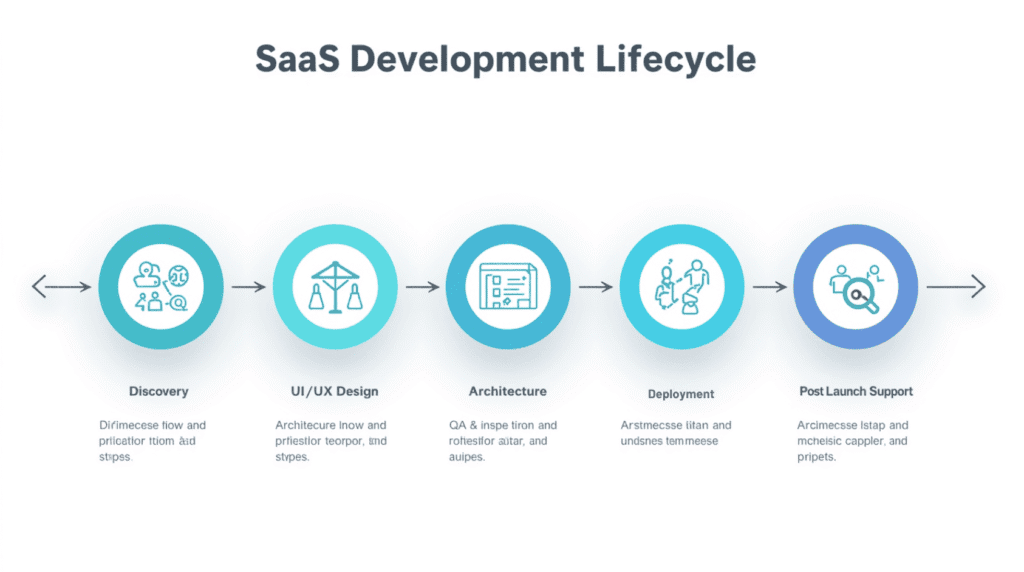
What Are the Key Stages in a Professional SaaS Development Lifecycle?
Most people get this wrong by treating SaaS development as purely a coding task. A well-run SaaS project follows a structured lifecycle where skipping any stage costs significantly more to fix later.
Here’s how professional SaaS development services approach it:
Stage 1 — Discovery & Product Strategy Defining the target user, the core problem being solved, the revenue model, and the feature scope. This stage prevents the single most expensive mistake in SaaS: building what the founder wants instead of what users will pay for.
Stage 2 — UI/UX Design Wireframes, user flows, and interface design before a single line of code is written. A polished, intuitive UI can require three to six weeks of design work. Skimping here is one of the most common reasons early SaaS products fail to convert trial users into paying customers.
Stage 3 — Architecture Planning Deciding on multi-tenancy structure, database design, authentication system, API architecture, and cloud infrastructure before development begins. Decisions made here compound for years.
Stage 4 — Core Development Building the authentication system, subscription billing, core feature set, admin panel, and integrations. This is where the majority of the budget goes.
Stage 5 — Quality Assurance & Security Testing Load testing, security audits, and user acceptance testing before launch. Skipping this stage means early customers become unpaid QA testers — and they churn fast.
Stage 6 — Deployment & Cloud Infrastructure Setup Setting up production environments, CI/CD pipelines, monitoring, and backup systems. A SaaS product running on poorly configured infrastructure costs far more to fix post-launch than to set up correctly from the start.
Stage 7 — Post-Launch Iteration & Support Monitoring performance, fixing bugs, releasing updates based on user feedback, and scaling infrastructure as the user base grows. Budget 15–20% of the initial build cost annually for this stage.
Which Tech Stacks Are Popular for Building Scalable SaaS Applications?
The right tech stack reduces development time, lowers costs, and makes a SaaS product easier to scale and maintain over time.
The most proven combinations for SaaS development in 2026:
| Layer | Popular Options | Why It Works |
|---|---|---|
| Frontend | Next.js, React | Fast rendering, strong ecosystem, great for SaaS dashboards. |
| Backend | Node.js, Python (FastAPI), Go | High performance, large talent pool, and clean API development. |
| Database | PostgreSQL, Supabase, MongoDB | Scalable, flexible, and reliable for multi-tenant applications. |
| Authentication | Clerk, Auth0, NextAuth | Pre-built authentication saves weeks of development time. |
| Payments | Stripe | Industry-standard platform for SaaS subscription billing. |
| Cloud Infrastructure | AWS, Google Cloud, Vercel | Reliable infrastructure with built-in auto-scaling capabilities. |
| AI Layer | OpenAI API, Anthropic API, LangChain | Adds intelligent features without training models from scratch. |
Our team at Zatiq Sol builds primarily with Next.js on the frontend and Node.js on the backend, connected to PostgreSQL databases and deployed on AWS — a stack that handles everything from early-stage MVPs to enterprise-scale platforms without requiring painful architectural rewrites as the product grows.
A quick clarification our clients frequently ask about: AWS is not a SaaS product. It is a cloud infrastructure platform classified as IaaS (Infrastructure as a Service). Many SaaS products run on AWS infrastructure, which is why the two names appear together so often.
How Much Does SaaS Development Actually Cost in 2026?
This is the question every founder and business owner asks first. Here is the honest breakdown.
A well-built SaaS MVP in 2026 typically costs between $15,000 and $80,000, depending on complexity, team structure, and technology choices. [Source: travlrd.com/post/saas-mvp-cost-2026] Enterprise-grade platforms and AI SaaS products can run significantly higher.
| Build Stage | Typical Cost (USD) | Timeline | What's Included |
|---|---|---|---|
| Proof of Concept | $5,000 – $15,000 | 2 – 4 Weeks | Core workflow only, without billing or an admin panel. |
| SaaS MVP | $15,000 – $80,000 | 6 – 16 Weeks | Authentication, billing, core features, admin panel, and deployment. |
| Production SaaS Platform | $80,000 – $250,000 | 4 – 9 Months | Complete feature set, third-party integrations, security audit, and scalable infrastructure. |
| Enterprise SaaS | $250,000 – $500,000+ | 9 – 18 Months | Compliance support, SSO, advanced analytics, and a dedicated development team. |
| AI SaaS Platform | $50,000 – $300,000+ | 3 – 12 Months | Everything in a SaaS platform plus LLM integration, vector databases, and AI-powered features. |
Hidden costs that consistently blow SaaS budgets:
- Cloud infrastructure: $100–$3,000/month depending on traffic and data volume
- Third-party services: Stripe, SendGrid, analytics tools, customer support platforms
- Post-launch maintenance: 15–20% of initial build cost per year
- Compliance: GDPR, HIPAA, or SOC 2 requirements add $10,000–$50,000
Does SaaS make money? The recurring revenue model is one of the most profitable in software — when the product retains users. A SaaS business with strong retention and low churn generates compounding revenue that outperforms almost every other software model over a five-year horizon.
Should You Outsource SaaS Development or Build In-House?
Pros & Cons: Outsourcing vs. In-House SaaS Development
| Factor | Outsource to Agency | Build In-House |
|---|---|---|
| Upfront Cost | Lower | Higher (Salaries + Benefits) |
| Speed to Launch | Faster (Team Ready Immediately) | Slower (3–6 Months to Hire) |
| Expertise | Proven Across Multiple Projects | Develops Over Time |
| Control | Less Day-to-Day | Full Control |
| Long-Term Cost | Higher if Ongoing | Lower per Feature Over Time |
| Risk | Wrong Agency = Significant Loss | Wrong First Hire = Bigger Loss |
| Best For | Startups, MVPs, and Defined Project Scopes | Funded Companies with 12+ Months of Runway |
SaaS development outsourcing makes the most sense for early-stage builds. Building in-house makes more sense once a product has revenue and a roadmap that justifies full-time engineering salaries.
Our team managed a SaaS MVP project for a B2B document workflow company based in New York. They had previously been quoted $310,000 by a large local agency for the same scope. Our team delivered the product — including multi-tenant architecture, subscription billing via Stripe, a full admin dashboard, and email automation — in 14 weeks for $58,000. The client closed their first three paying customers before the final invoice was even issued.
The lesson: scope discipline and the right development partner matter far more than geography or agency size.
Custom SaaS vs. Off-the-Shelf Software: What Should You Actually Build?
Most people get this decision wrong in both directions. Some build custom when a $99/month tool would solve the problem completely. Others buy off-the-shelf software and then spend years working around its limitations.
When off-the-shelf wins:
- Your needs are standard (CRM, email, scheduling, invoicing)
- You need to be live in days, not months
- You are validating whether the problem is real before committing to a build
When custom SaaS development services win:
- Your workflow is genuinely unique and no existing tool fits it accurately
- You want to sell the software itself as your business model
- You have proprietary data or processes that create a real competitive advantage
- The off-the-shelf tool is already costing you in manual workarounds, disconnected integrations, and staff time
The right starting question is not “should I build or buy?” but “what specific bottleneck am I solving, and is it unique enough to justify a custom build?”
What Makes a Great SaaS Development Company?
Here are the signals that actually matter when evaluating SaaS development service providers:
1. Discovery before quotes Any development partner who sends a price without first understanding your target user, revenue model, and core feature set is either guessing or padding the quote to cover unknowns.
2. Portfolio of shipped, live products Ask to see live SaaS products they have built — not design mockups. Can you create an account? Does the product actually work? Are real users paying for it?
3. Fixed-price options on scoped MVPs Agencies that only offer hourly billing on a defined scope are protecting their invoicing flexibility at your expense. A reputable SaaS development company can commit to a fixed price once the scope is clearly documented.
4. Post-launch support plan A SaaS product is not finished at launch. Confirm what ongoing support looks like before signing any agreement.
5. Transparent tech stack recommendations Great development partners recommend mainstream, well-supported technologies — not exotic stacks that create vendor lock-in or make it difficult to hire engineers later.
Our custom software and SaaS development services cover the full scope of what we build, including SaaS platforms, AI-powered products, and full-stack web applications with ongoing support built into every engagement.
SaaS Development Services by Industry
SaaS for Healthcare Healthcare SaaS in the US operates under HIPAA regulations, which govern how patient data is stored, transmitted, and accessed. A professional SaaS development company with healthcare experience builds HIPAA-compliant architecture from day one — not after a compliance incident forces the issue. Our team has delivered patient scheduling and telehealth coordination tools that handle protected health information under full HIPAA controls.
SaaS for Ecommerce & Retail Custom SaaS development services for ecommerce platforms typically focus on inventory management, order automation, dynamic pricing tools, and multi-channel integration. The highest-ROI projects in this category replace a patchwork of disconnected tools with a single platform, reducing operational overhead by 30–50%.
SaaS for Fintech Financial SaaS products carry the heaviest compliance requirements — PCI-DSS for payment processing, SOC 2 for data security, and in some cases state-specific licensing. Budget an additional $15,000–$50,000 for compliance infrastructure in fintech SaaS builds.
SaaS for Professional Services Law firms, marketing agencies, HR companies, and consulting firms are among the heaviest adopters of vertical SaaS. Vertical SaaS companies grew 31% versus 28% for horizontal SaaS providers in 2025, demonstrating the clear market advantage of industry-specific platforms. [Source: quantumrun.com/consulting/saas-industry-growth-statistics]
5 Mistakes That Derail SaaS Development Projects
1. Starting development before validating demand Building a full SaaS platform before confirming that users will pay for it is the most expensive mistake in this category. Validate first with a landing page, a manual process, or a no-code prototype.
2. Scope creep during development Every additional feature added mid-build extends the timeline and increases cost. Define the MVP scope before development starts, put it in writing, and hold the line until the product is live.
3. Ignoring churn from day one Monthly churn for SMB SaaS runs 3–5%, while best-in-class annual logo churn stays under 5%. [Source: colorlib.com/wp/saas-statistics] Building retention mechanics — onboarding flows, in-app guidance, usage alerts — from the start is far cheaper than adding them after churn becomes a visible problem.
4. Underestimating post-launch costs The development invoice is not the total cost of your SaaS product. Cloud infrastructure, customer support tooling, payment processing fees, and ongoing development add 20–40% of your initial build cost every year.
5. Choosing a development partner based on price alone A $12,000 build that requires a $60,000 rewrite in six months is not a bargain. Evaluate development partners on portfolio quality, process maturity, and communication transparency — not just the bottom line of their proposal.
USA Specific Considerations for SaaS Development
The US is the world’s largest SaaS market. That means the opportunity is enormous, the competition is intense, and the compliance requirements are substantial.
HIPAA (Healthcare) Any SaaS product handling protected health information must implement HIPAA-compliant infrastructure. This includes encrypted data storage, access logging, Business Associate Agreements with third-party vendors, and breach notification procedures. The penalties for non-compliance start at $100 per violation and can reach $1.9 million per category, per year.
SOC 2 Compliance Enterprise buyers in the US increasingly require SOC 2 Type II certification before signing SaaS contracts. If your target customer is a mid-size or large US company, budget for a SOC 2 audit ($15,000–$50,000) as part of your go-to-market plan.
State-Level Data Privacy Laws The California Consumer Privacy Act (CCPA) and similar laws in Colorado, Virginia, and Texas create specific data handling obligations. Your privacy policy, data deletion workflow, and user consent mechanisms need to reflect these requirements from day one.
USD Pricing Benchmarks US enterprise SaaS typically prices on a per-seat model, ranging from $15–$500/user/month depending on category and feature depth. SMB-focused SaaS products commonly use flat-rate tiers starting at $29–$99/month. Price based on the value delivered to your target customer, not what the competition charges.
Real US Client Result Our team built a custom SaaS platform for a staffing agency in Chicago, Illinois. They were managing contractor placements through spreadsheets and email chains, losing hours daily to manual tracking and communication. We delivered a custom SaaS platform — including contractor onboarding, assignment tracking, automated billing, and client dashboards — in 16 weeks for $72,000. Within four months of launch, the agency reduced administrative overhead by 40% and successfully onboarded six enterprise clients who had previously declined to work with them because of the lack of a professional digital platform.
Final Verdict: Is SaaS Development Worth the Investment?
For businesses with a unique process worth productizing, or founders with a genuine insight into an underserved market, professional SaaS product development services remain one of the highest-ROI technology investments available in 2026.
The key is starting with a focused scope, choosing a development partner with a proven track record of shipping production SaaS products, and budgeting honestly for the full lifecycle — not just the initial build.
If you are evaluating whether to build in-house or outsource, our IT outsourcing and team extension services break down the real cost comparison. For SaaS products that need organic search traffic as a customer acquisition channel, our SEO services for software businesses are built specifically for SaaS companies competing for high-intent keywords.
“The SaaS products that win long-term are not built fastest or cheapest — they are built with clarity on who they serve and why those users will never leave.”
Frequently Asked Questions About SaaS Development Services
What is SaaS development services?
SaaS development services cover the end-to-end process of designing, building, deploying, and maintaining cloud-based software products delivered over the internet on a subscription model. This includes product strategy, UI/UX design, backend and frontend development, subscription billing integration, cloud infrastructure setup, and ongoing post-launch support.
Is SaaS a coding language?
No. SaaS is a software delivery model, not a programming language. SaaS products are built using standard programming languages like JavaScript, Python, Node.js, and React, then hosted on cloud infrastructure so users can access them through a browser or app without installing anything locally.
Do you need coding for SaaS?
If you are the founder, no — you do not need to write code yourself. You need a skilled development partner who understands SaaS architecture. If you are building the product yourself, then yes, strong backend and frontend development skills are essential.
Is it difficult to migrate to SaaS?
Migration complexity depends on what you are migrating from. Moving from on-premise legacy software to a cloud SaaS platform typically involves data migration, user retraining, and integration reconfiguration. A well-planned migration handled by experienced developers takes three to twelve weeks depending on data volume and system complexity. Poorly planned migrations are where the real difficulty comes from — not the technology itself.
What are the disadvantages of SaaS?
The main disadvantages of SaaS include:
- Ongoing subscription costs that can exceed one-time license fees over a long period
- Limited customization compared to software built specifically for your workflow
- Vendor dependency — if the provider changes pricing or shuts down, your operations are affected
- Data control concerns — your data lives on someone else’s infrastructure
- Internet dependency — SaaS products typically require a stable internet connection to function
These disadvantages are exactly why many businesses choose custom SaaS development services over buying off-the-shelf tools — you own the product, control the data, and are not subject to another company’s pricing decisions.
What is the best example of SaaS?
The most widely recognized SaaS examples include Salesforce (CRM), Slack (team communication), HubSpot (marketing and sales), Zoom (video conferencing), Shopify (ecommerce), and QuickBooks Online (accounting). Each replaced a traditional installed software product with a cloud-delivered subscription model that updates automatically and scales with the user.
Is AWS a SaaS or PaaS?
AWS (Amazon Web Services) is primarily an IaaS — Infrastructure as a Service — provider. It offers raw cloud computing power: servers, storage, databases, and networking. Some specific AWS products (like Amazon Chime or Amazon Connect) operate as SaaS, but AWS as a whole is the infrastructure layer on top of which SaaS products are built, not a SaaS product itself.
What SaaS makes the most money?
The highest-revenue SaaS companies globally include Microsoft (Office 365 and Azure), Salesforce, ServiceNow, Workday, Adobe Creative Cloud, and Snowflake. In terms of category, enterprise SaaS — HR software, ERP, CRM, and financial management — generates the highest revenue per customer. Vertical SaaS products (built for specific industries like healthcare, legal, or logistics) command premium pricing and stronger retention than horizontal tools.
What is the 3 3 2 2 2 rule of SaaS?
The 3 3 2 2 2 rule (also called T2D3) is a SaaS growth benchmark used by investors. It suggests that a high-growth SaaS company should triple its annual recurring revenue (ARR) for two consecutive years, then double it for three consecutive years. For example: $1M → $3M → $9M → $18M → $36M → $72M. It is used to assess whether a SaaS company is on a venture-scale trajectory and is often referenced during Series A and B fundraising evaluations.
What is replacing SaaS?
Nothing is replacing SaaS outright in 2026 — but the category is being transformed by AI. The emerging model is AI-native SaaS: products where the core value is delivered by an intelligent system, not just a data management interface. Some analysts refer to this as “Agents as a Service” or “AI Workflows as a Service,” where software completes multi-step tasks autonomously rather than just organizing information for a human to act on. The underlying SaaS subscription model and cloud delivery remain the same. The product experience is becoming far more intelligent.
What 3 jobs will not be replaced by AI in the SaaS industry?
While AI automates significant portions of repetitive work, three roles that remain highly human-dependent in SaaS are:
- Enterprise sales and account management — trust, relationship nuance, and complex negotiation require human judgment
- Product strategy and vision — identifying which problems are worth solving and why still requires human insight and market empathy
- Customer success for complex deployments — helping enterprise clients navigate organizational change around new software requires human communication and adaptability
Is SaaS under threat from AI?
SaaS is not under threat from AI — it is being upgraded by it. The companies at risk are those building SaaS products without any AI layer, where a competitor can replicate the same functionality with more intelligence and automation baked in. The business model (recurring revenue, cloud delivery, subscription pricing) is not threatened. The feature expectations have simply risen.
How to choose SaaS development services for my business?
Evaluate providers on five criteria: portfolio of shipped SaaS products (not mockups), a structured discovery process before any quote, fixed-price contracts on defined MVP scopes, post-launch support included in the engagement, and transparent technology stack recommendations. Request two to three client references in your industry and ask specifically about communication quality and delivery against the original timeline.
What is the typical cost structure for outsourced SaaS development projects?
Outsourced SaaS development typically structures costs in three phases: a discovery and design phase ($3,000–$15,000), a core development phase (the majority of the budget, ranging from $15,000 to $250,000+ depending on scope), and a post-launch support retainer ($1,000–$8,000/month). Fixed-price contracts are available for scoped MVPs; larger enterprise engagements often use a milestone-based payment structure tied to delivery checkpoints.
Ready to grow your business with custom AI, SEO, web development, or digital marketing? 👇


Great content! Keep up the good work!