

TL;DR: AI solutions for healthcare businesses are no longer optional — they are the primary lever for reducing administrative overhead, accelerating billing and coding, and improving operational efficiency across clinics, hospitals, and diagnostic centers. The global AI in healthcare market is projected to reach $56 billion in 2026 alone. This guide breaks down the real use cases, proven cost savings, HIPAA compliance requirements, and implementation costs so healthcare organizations can make informed decisions today.
Most healthcare businesses are quietly drowning in administrative work.
In 2023, U.S. hospitals spent $687 billion on administration — compared to just $346 billion on direct patient care. That’s a roughly 2:1 ratio of paperwork to patients. [Source: sully.ai/blog/reduce-administrative-costs-healthcare]
The same pattern plays out globally. Clinics in the UK, hospitals in the UAE, and diagnostic centers across Asia are all losing enormous operational capacity to manual billing, scheduling, documentation, and claims processing — tasks that AI can handle faster, more accurately, and at a fraction of the cost.
The ROI on AI in healthcare averages $3.20 for every $1 invested, with a typical return realized within 14 months. That’s not a theoretical projection. That’s the average return organizations are reporting after real deployments.
This guide is written for healthcare businesses — clinics, hospitals, diagnostic centers, and health-tech companies — that want a clear, practical understanding of what AI solutions actually do, what they cost, and how to implement them without compliance risk.
What Are AI Solutions for Healthcare Businesses?
AI solutions for healthcare businesses are software systems that use machine learning, natural language processing, and predictive analytics to automate or augment clinical and administrative processes.
This is not patient-facing consumer technology. This is the operational layer that sits behind your staff, your EHR system, and your billing department — handling the volume, speed, and accuracy of work that humans cannot sustainably deliver at scale.
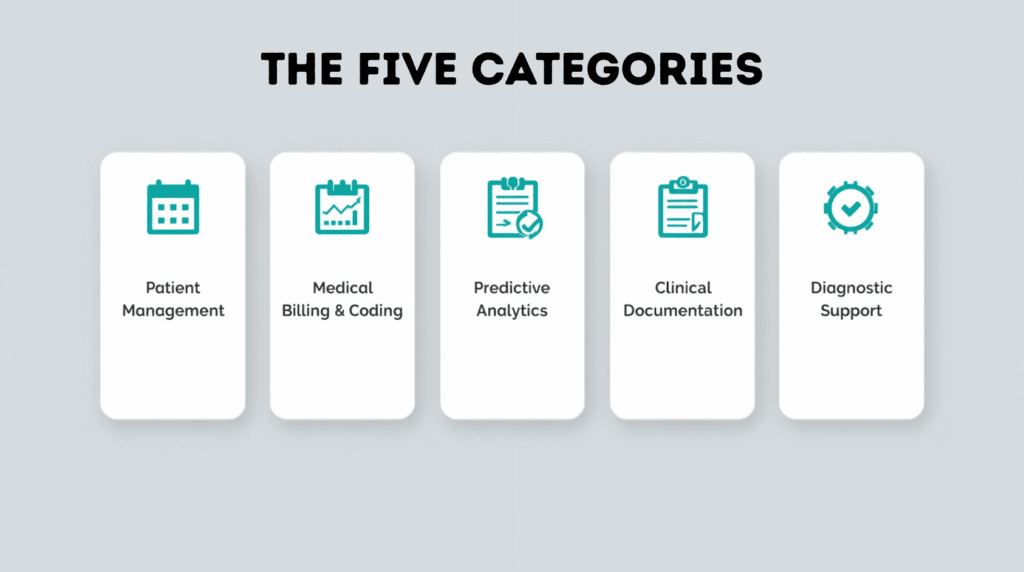
In practice, AI solutions for healthcare businesses fall into five main categories:
- Healthcare workflow automation — automating scheduling, prior authorizations, documentation, and staff communication
- AI for medical billing and coding — auto-generating accurate medical codes, catching claim errors before submission, and reducing denial rates
- AI-powered patient management systems — intelligent appointment booking, no-show prediction, and patient follow-up automation
- Predictive analytics for healthcare — forecasting patient demand, readmission risk, and operational bottlenecks
- AI diagnostic tools for clinics — supporting radiologists and clinicians with image analysis, lab result interpretation, and decision support
Each of these addresses a specific operational bottleneck. The most successful implementations focus on one area first, measure the result, and then expand — rather than attempting to automate everything simultaneously.
What Are the Key Benefits of AI in Healthcare Business Operations?
The benefits of implementing AI in healthcare business operations are measurable and well-documented across a wide range of facilities and geographies.
1. Reduced Administrative Burden Around 80% of hospitals are now using AI in at least one clinical or operational function, and data-driven analyses report an average 40–45% reduction in physician documentation time using AI scribes. For a typical 300-bed hospital, this translates to thousands of clinician hours redirected from paperwork to patient care annually.
2. Lower Claim Denial Rates AI for medical billing and coding catches errors before claims are submitted. Facilities using intelligent prior authorization systems report an 89% reduction in authorization processing time and a 34% improvement in first-pass claim approval rates. [Source: appitsoftware.com/blog/ai-reduces-healthcare-administrative-burden]
3. Improved Patient Flow AI-powered scheduling systems analyze historical patient data, seasonal patterns, and clinician availability to optimize appointment flow. Reduced no-shows and better capacity utilization directly impact revenue without adding staff.
4. Earlier and More Accurate Diagnostics AI diagnostic tools for clinics are now FDA-cleared across over 1,250 medical device applications. AI-assisted analysis supports radiologists and clinicians with pattern recognition at a speed and consistency no human team can replicate at volume.
5. Predictive Cost Management Predictive analytics in healthcare allows hospital operations teams to anticipate high-demand periods, identify patients at risk of readmission, and allocate resources before bottlenecks develop — rather than responding to them after the fact.
Can AI Reduce Hospital Administrative Costs? The Real Numbers
This is where the business case becomes impossible to ignore.
The 2025 CAQH Index reports that the U.S. healthcare industry has already avoided $258 billion in administrative costs through electronic transactions and emerging AI adoption. Despite this, $90 billion in annual spending on routine administrative transactions — eligibility checks, prior authorizations, claims submissions, and remittance processing — remains largely automatable.
McKinsey research projects a 30% operational cost reduction potential through targeted AI automation in healthcare. [Source: msdynamicsworld.com/blog-post/ai-healthcare-how-hospitals-can-cut-operational-costs-30]
Here’s where those savings actually come from across a typical mid-size facility:
| Administrative Function | Current Cost Burden | AI Impact |
|---|---|---|
| Medical Coding & Billing | $8–$15 per claim processed manually | 60–80% faster processing with lower claim denial rates. |
| Prior Authorization Processing | 2–4 hours per case | Up to 89% reduction in processing time. |
| Clinical Documentation (Scribing) | 2–3 hours per physician each day | 40–45% reduction in documentation time. |
| Appointment Scheduling | High no-show rates and manual rescheduling | 20–35% reduction in missed appointments. |
| Claims Denial Management | Average 15–20% initial denial rate | 30–50% improvement in first-pass approval rates. |
| Patient Follow-Up Communications | Largely manual and inconsistent | Fully automated with consistent patient engagement. |
For most healthcare organizations with 100+ staff, the payback period on a well-scoped AI implementation runs one to three months. Not years.
What AI Tools Do Clinics Use for Patient Management?
AI-powered patient management systems are one of the highest-ROI entry points for clinics and smaller healthcare practices.
The core tools clinics are deploying in 2026 include:
Intelligent Scheduling Systems These platforms analyze appointment history, patient behavior patterns, provider availability, and seasonal demand to optimize scheduling automatically. They send reminders, predict no-shows, and trigger rescheduling workflows before a slot goes empty.
AI Chatbots and Patient Communication Platforms HIPAA-compliant AI chatbots handle routine patient inquiries — appointment confirmation, prescription refill requests, post-visit instructions, and basic symptom triage — without consuming front-desk staff time.
AI Scribe Tools Ambient clinical intelligence tools listen to patient-physician conversations and auto-generate SOAP notes, referral letters, and documentation directly into the EHR. This is currently the fastest-growing AI application in clinical settings, projected to grow at the highest CAGR among all healthcare AI segments through 2031. [Source: marketsandmarkets.com]
Automated Eligibility Verification AI tools verify patient insurance eligibility in real time before appointments, eliminating the manual call-and-confirm workflow that currently occupies significant front-desk hours in most practices.
Our team built a custom AI-powered patient management system for a multi-location physiotherapy group with six clinics across two countries. They were managing 1,400+ appointments weekly through a combination of phone calls, spreadsheets, and a legacy booking system that had no automation. The new system — integrating AI scheduling, automated reminders, and a HIPAA-compliant chatbot for post-treatment follow-up — reduced no-shows by 31% within the first 60 days. Front-desk time spent on scheduling dropped by 44%, freeing staff to focus on in-clinic patient experience rather than phone coordination.
How Can AI Solutions Improve Revenue Cycle Management for Healthcare Providers?
Revenue cycle management (RCM) is one of the most financially impactful areas for AI deployment in healthcare businesses.
The problems it solves are well-defined: inaccurate coding, delayed claim submissions, high denial rates, slow reimbursement cycles, and undercaptured charges all represent direct revenue loss that most organizations never fully quantify.
AI solutions for healthcare RCM address each of these systematically:
Automated Medical Coding AI coding tools analyze clinical documentation and assign ICD-10 and CPT codes automatically. They catch undercoding (missed charges), overcoding (compliance risk), and sequencing errors that trigger denials — all before the claim leaves the facility.
Claim Scrubbing and Pre-Submission Auditing Machine learning models trained on payer-specific denial patterns review claims before submission and flag issues that a human biller would likely miss under time pressure.
Denial Prediction and Prevention Predictive analytics models score each claim for denial likelihood before submission, allowing RCM teams to focus manual review time on the cases where it will have the most impact.
Accounts Receivable Prioritization AI tools rank outstanding AR by probability of collection, allowing follow-up teams to work the highest-value, most-recoverable accounts first rather than working the list chronologically.
Our team worked with a diagnostic imaging center that was experiencing a 22% first-pass claim denial rate — nearly double the industry benchmark. The problem was a combination of inconsistent documentation templates and a billing team handling too many claims manually to catch payer-specific errors. We implemented an AI-assisted coding and pre-submission audit layer connected to their existing practice management software. Within three months, first-pass denial rate dropped to 9%, and the center recovered an estimated $180,000 in previously written-off claims that the AI flagged as incorrectly denied and appealable.
Top AI Platforms for Healthcare Analytics and Decision Support
Predictive analytics in healthcare is the layer that turns operational data into forward-looking decisions. Instead of reviewing last month’s performance, hospital administrators and clinic managers can act on predictions about next week.
What top healthcare analytics platforms deliver:
- Demand forecasting: predict patient volumes by department, day, and hour based on historical patterns and external variables
- Readmission risk scoring: identify patients at high risk of 30-day readmission so care teams can intervene before discharge gaps become costly readmissions
- Staff and resource optimization: match staffing levels to predicted demand rather than relying on static rosters that over- or under-staff consistently
- Supply chain prediction: forecast consumable and medication demand to reduce both waste and stock-outs
The best implementations connect analytics directly to operational workflows — so a prediction about tomorrow’s patient volume automatically adjusts staffing notifications, not just a dashboard no one checks.
Comparison: Off-the-Shelf vs Custom Healthcare AI Analytics
| Factor | Off-the-Shelf Platform | Custom AI Development |
|---|---|---|
| Time to Deploy | Days to Weeks | Weeks to Months |
| Cost | $500 – $10,000/month | $5,000 – $15,000 Build |
| Fits Your Workflow | Partially — Requires Adaptation | Built to Exact Specifications |
| EHR Integration Depth | Standard Connectors Only | Deep, Custom Integration |
| HIPAA Compliance | Vendor-Managed (Verify BAA) | Architected from Day One |
| Scalability | Limited by Vendor Roadmap | Scales on Your Terms |
| Best For | Standard Use Cases & Fast Deployment | Complex, Unique Healthcare Workflows |
Is AI in Healthcare HIPAA Compliant?
This is the most common concern healthcare organizations raise before any AI implementation discussion — and it is the right question to ask.
The short answer: AI in healthcare can be fully HIPAA compliant, but compliance is the responsibility of the implementing organization and its development partners — not assumed by default.
Key compliance requirements for any HIPAA compliant AI solution:
- Business Associate Agreement (BAA): Any vendor or development partner who processes protected health information (PHI) on your behalf must sign a BAA. This is non-negotiable under HIPAA.
- Data encryption: PHI must be encrypted both in transit and at rest. Any AI system processing clinical data must implement AES-256 encryption or equivalent.
- Access logging and audit trails: All access to PHI by AI systems must be logged and auditable. This includes model queries, outputs, and any human review steps.
- Minimum necessary principle: AI systems should only access the minimum PHI required to perform their function. Over-permissioned data access is one of the most common HIPAA violations in AI implementations.
- De-identification for model training: If PHI is used to train or fine-tune AI models, it must be properly de-identified per HIPAA Safe Harbor standards before any training occurs.
Our custom healthcare AI development services include HIPAA compliance architecture as a standard component — not an optional add-on. Every system we build for healthcare clients includes a signed BAA, encrypted data pipelines, access audit logging, and a documented compliance framework.
How Much Does AI Healthcare Software Cost?
Cost depends entirely on scope, whether you are buying a platform subscription or commissioning custom development, and the complexity of your existing systems.
Pricing Overview: AI Solutions for Healthcare Businesses
| Solution Type | Monthly Subscription | Custom Build Cost |
|---|---|---|
| AI Scheduling & Patient Management | $300 – $3,000/month | $2,000 – $6,000 |
| AI Medical Coding & Billing | $500 – $8,000/month | $5,000 – $8,000 |
| AI Scribe / Clinical Documentation | $100 – $500/user/month | $4,000 – $6,000 |
| Predictive Analytics Platform | $1,000 – $15,000/month | $10,000 – $15,000 |
| Full Custom Healthcare AI System | N/A | $15,000 – $20,000 |
| HIPAA Compliance Architecture Add-On | Included in Reputable Vendors | $6,000 – $15,000 |
Pro tip: For most clinics and mid-size practices, starting with a targeted subscription tool for the highest-cost bottleneck (usually billing or scheduling) delivers faster ROI than commissioning a full custom build. Custom development makes the most business sense when your workflow is genuinely unique, you have proprietary data that provides competitive advantage, or you are building a health-tech product for other organizations to use.
What AI Applications Are Transforming Patient Care Delivery?
Beyond administration and billing, AI solutions are beginning to transform the clinical quality layer of healthcare delivery — specifically for B2B health-tech companies and hospital systems investing in differentiated care models.
AI Diagnostic Tools for Clinics and Imaging Centers AI-assisted medical imaging analysis supports radiologists with pattern detection in X-rays, CT scans, MRIs, and pathology slides. Over 1,250 AI/ML-enabled medical devices have been cleared or approved by the U.S. FDA as of May 2025. [Source: uvik.net/blog/ai-in-healthcare-statistics-2026]
AI for Telemedicine Platforms Custom AI-powered telemedicine solutions integrate symptom triage, risk scoring, and clinical decision support directly into virtual consultation workflows — reducing the cognitive load on clinicians handling high patient volumes through digital channels.
Predictive Readmission and Risk Stratification AI-enabled risk stratification models can reduce hospital admissions by nearly 30% by identifying high-risk patients earlier and enabling proactive intervention before a preventable readmission occurs. [Source: pearlhealth.com/blog/the-coming-ai-share-of-medicare-spend]
Global Considerations for Healthcare AI Adoption
Healthcare organizations worldwide face similar administrative inefficiencies, but the regulatory environment varies significantly by region. Here’s what healthcare businesses in key markets need to account for.
United States HIPAA governs all PHI handling. Any AI vendor or development partner must sign a Business Associate Agreement. SOC 2 Type II certification is increasingly required by hospital procurement teams before approving new software vendors.
European Union The EU AI Act (fully applicable from 2026) classifies AI systems used in clinical settings as high-risk, requiring conformity assessments, transparency documentation, and human oversight mechanisms before deployment. GDPR applies to all patient data processing, with specific provisions for sensitive health data under Article 9.
United Kingdom NHS Digital provides guidance on AI deployment within NHS settings, including the NHS AI Lab’s assurance framework. Private healthcare providers follow CQC oversight and must demonstrate that AI tools support — not replace — clinical judgment.
Middle East (UAE, Saudi Arabia) HAAD (Health Authority Abu Dhabi) and DHA (Dubai Health Authority) are actively publishing AI governance frameworks. The UAE National AI Strategy 2031 prioritizes healthcare as a key sector, and government-backed health networks are early adopters of predictive analytics and workflow automation.
Asia-Pacific Australia’s TGA, Singapore’s HSA, and India’s CDSCO each have distinct approval pathways for AI medical devices. Cloud-based AI deployments must account for data residency regulations that vary by country, with some markets requiring health data to be stored on servers within national borders.
For health-tech companies building AI products for global markets, compliance-first architecture is non-negotiable from day one. Our custom AI development team has built healthcare AI systems for clients across the US, UK, and the Gulf region, each with region-specific compliance frameworks built into the core architecture.
Frequently Asked Questions: AI Solutions for Healthcare Businesses
What are the benefits of AI in healthcare business operations?
The primary benefits are reduced administrative costs, faster and more accurate billing and coding, improved patient scheduling and flow, lower claim denial rates, and better resource allocation through predictive analytics. Organizations consistently report ROI within 14 months of deployment.
How much does AI healthcare software cost?
Off-the-shelf AI tools for healthcare range from $300 to $15,000 per month depending on the function and facility size. Custom healthcare AI development costs range from $5,000 for a focused module to $20,000+ for a full enterprise platform. HIPAA compliance architecture adds $10,000–$50,000 to custom builds.
Is AI in healthcare HIPAA compliant?
AI can be HIPAA compliant, but compliance requires proper implementation. Every healthcare AI deployment must include a signed BAA with all vendors, encrypted data pipelines, access audit logging, and minimum-necessary data access controls. Compliance is an architecture decision, not a checkbox.
Can AI reduce hospital administrative costs?
Yes, and the data is well-established. The 2025 CAQH Index confirms $258 billion already avoided in administrative costs through electronic and AI adoption. McKinsey projects a 30% cost reduction potential through targeted automation. Specific tools like AI scribes reduce physician documentation time by 40–45%, while AI coding tools dramatically reduce claim denial rates.
What AI tools do clinics use for patient management?
Clinics typically deploy AI scheduling systems, HIPAA-compliant patient communication chatbots, AI scribe tools for clinical documentation, automated eligibility verification systems, and predictive no-show management tools. The highest-ROI starting point for most clinics is automated scheduling combined with AI-assisted billing.
Best AI software for healthcare businesses to improve patient management?
The best-fit software depends on facility size and workflow. For small to mid-size clinics, off-the-shelf platforms like Nabla (AI scribe), Availity (eligibility and claims), and Suki (clinical documentation) are well-regarded. For organizations with complex or unique workflows — or health-tech companies building their own products — custom healthcare AI development delivers better long-term ROI and full compliance ownership.
How to choose AI solutions for small healthcare clinics?
Start by identifying the single biggest operational bottleneck: is it no-shows, documentation time, billing denials, or staff scheduling? Then evaluate tools specifically built for that function. For small clinics, subscription tools are usually faster and cheaper to start with than custom builds. Ensure any vendor will sign a BAA and has healthcare-specific implementation experience before contracting.
What are the key benefits of implementing AI in electronic health record systems?
AI embedded in EHR systems reduces documentation burden through ambient scribing, improves coding accuracy through automated code suggestion, surfaces clinical decision support alerts based on patient history, and enables population health analytics across the full patient cohort — all without requiring staff to use a separate system.
Final Verdict: Is Healthcare AI Worth the Investment?
The question is no longer whether AI solutions for healthcare businesses deliver value. The data on that is settled.
The real question in 2026 is: which bottleneck do you fix first, and who builds it right?
The global AI in healthcare market is projected to grow from $36.67 billion in 2026 to $194.79 billion by 2031 — driven by rising provider demand for automation, nationwide labor shortages, and strong investment in predictive analytics and EHR AI integration. Healthcare organizations that delay implementation are not saving money. They are falling further behind competitors who are already recapturing margin through automation.
The organizations winning with healthcare AI in 2026 are not the largest or the best-funded. They are the ones who identified one specific, high-cost operational problem, implemented the right AI solution with the right compliance architecture, measured the result, and then scaled what worked.
For healthcare businesses ready to take that step — whether a clinic automating patient management, a hospital optimizing RCM, or a health-tech company building an AI-powered platform — our custom AI development and healthcare software services are designed to deliver compliant, production-ready systems that solve real operational problems.
If your team is also thinking about organic search as a patient and client acquisition channel, our SEO services for healthcare and health-tech businesses are built for the specific competitive landscape healthcare organizations face online.
“The healthcare organizations saving the most in 2026 are not cutting staff — they are automating the work that never should have required a human in the first place.“
Ready to grow your business with custom AI, SEO, web development, or digital marketing? 👇