
TL;DR: AI tools for e-commerce growth are no longer an advantage reserved for enterprise retailers. In 2026, 91% of retailers are using or actively assessing AI capabilities. The global e-commerce market is approaching $7.9 trillion, but 70.22% of carts are still abandoned before checkout. This guide shows how AI and SEO work together to fix conversion leaks, rank higher, and turn traffic into revenue — for stores on Shopify, WooCommerce, Magento, and custom platforms worldwide.
Seven out of every ten customers who add something to their cart never buy it.
That is not a rounding error. That is the average cart abandonment rate across all e-commerce industries in 2026 — 70.22%, according to Baymard Institute’s meta-analysis of 49 independent studies. Globally, this translates to over $4 trillion in abandoned merchandise annually, with an estimated $260 billion in recoverable revenue in the US and EU markets alone.
AI influenced $229 billion in global online holiday sales through product recommendations, targeted offers, and conversational support in 2025, demonstrating measurable revenue impact at massive scale. The technology is not experimental anymore. The gap between stores using AI solutions for e-commerce businesses and those still running on manual processes and static merchandising is widening every quarter.
This guide is for online store owners and retail brands who want a clear, practical view of how AI tools for e-commerce growth actually work — what they cost, which platforms support them, and what results to realistically expect in 2026.
How Does AI Improve E-Commerce Sales?
The honest answer is: in several distinct ways simultaneously — and the stores achieving the biggest revenue lifts are usually combining at least three.
Here are the six primary mechanisms through which AI tools for e-commerce growth deliver measurable results:
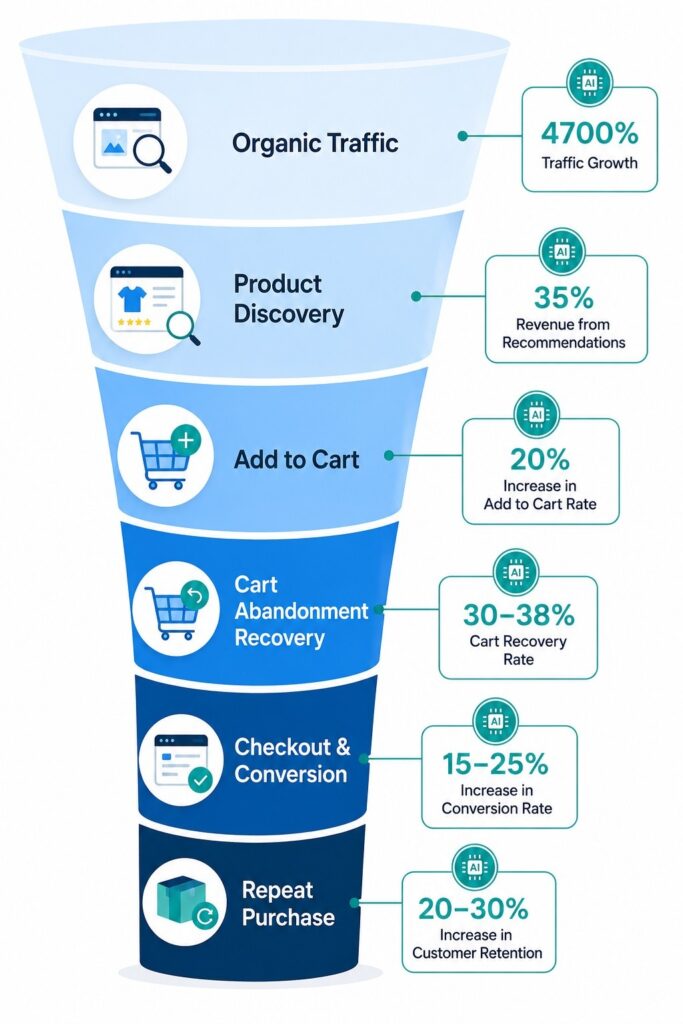
1. AI Product Recommendation Engines AI-powered product recommendations now drive an average of 35% of total revenue for stores that implement them, up from around 26% in 2023. Collaborative filtering, content-based filtering, and hybrid deep-learning models identify the right product for the right customer at the right moment — upselling and cross-selling automatically at every stage of the buying journey.
2. Personalization AI for E-Commerce Personalization AI e-commerce systems tailor every touchpoint — homepage layout, product grid, email content, and checkout offers — to each individual shopper’s behavior and preferences. AI-powered personalization boosts conversion rates by up to 23%, with product recommendation engines increasing average order value by up to 50% and revenue by up to 300% when fully deployed. 70% of retailers that invested in personalizing their customer experience saw ROI of at least 400%.
3. Cart Abandonment Recovery AI-powered pre-abandonment intervention — exit-intent detection, personalized retargeting, and dynamic discount triggers — achieves a 30–38% cart recovery rate. That outperforms standard email follow-up sequences by a significant margin.
4. AI Chatbots for Customer Support and Conversion E-commerce brands deploying effective chatbots see 7–25% sales lift, with shoppers who chat converting at 12.3% versus 3.1% for non-chatters — a 4x higher conversion rate.
5. Dynamic Pricing Optimization AI pricing engines monitor competitor pricing, inventory levels, demand signals, and conversion data to adjust product prices in real time — maximizing margin without manually monitoring thousands of SKUs.
6. Automated Inventory Management AI Automated inventory management AI uses demand forecasting models to predict stock needs by SKU, season, and geography — reducing both overstock write-offs and out-of-stock revenue losses. Demand forecasting accuracy typically improves 20–30% versus manual reordering, directly protecting margin and fulfillment speed.
What SEO Strategy Works Best for Online Stores in 2026?
E-commerce SEO in 2026 is not just about ranking product pages for generic keywords anymore. The game has three distinct layers, and most stores are only playing one.
Layer 1: Technical SEO for E-Commerce Sites
Technical foundations determine whether Google and other search engines can even crawl and index your product catalog properly. For large e-commerce stores, this is frequently where the biggest quick wins hide.
Key technical issues affecting most e-commerce stores today:
- Duplicate content from product variants, filter URLs, and pagination
- Crawl budget waste on thin pages, session IDs, and faceted navigation
- Core Web Vitals failures on product image-heavy pages — particularly on mobile
- Missing or incorrect structured data that prevents rich snippets for products, prices, and reviews
- Poor internal linking that isolates high-value category pages from PageRank flow
Our SEO team identified a crawl efficiency problem for a mid-size fashion retailer running WooCommerce on a catalog of 18,000 SKUs. Over 60% of the crawl budget was being spent on faceted navigation URLs that generated no unique content. After restructuring canonical tags and implementing noindex on filtered variants, organic impressions for core category pages increased 41% within 90 days.
Layer 2: AI-Assisted Content Strategy
AI content tools are now core to competitive e-commerce SEO strategy — not because they write content without human oversight, but because they dramatically accelerate the research and structural work.
How online stores are using AI for SEO content:
- Keyword clustering at scale: AI tools group thousands of product and category keywords by intent, so each page targets a defined cluster rather than one generic term
- Automated product description generation: for large catalogs, AI generates structured, SEO-optimized product descriptions that human writers review and enhance
- Programmatic SEO for category pages: AI generates location-specific, comparison-based, and long-tail category pages at volume — pages that collectively capture enormous amounts of low-competition search traffic
- Search intent mapping: AI analyzes SERP features, People Also Ask boxes, and featured snippets to identify exactly what format and content depth each target query demands
Layer 3: AI for On-Site Search Optimization
On-site search is one of the most underinvested conversion levers in e-commerce. Shoppers who use on-site search convert at 2–3 times the rate of those who browse, but most search implementations return literal keyword matches rather than intent-aware results.
AI-powered intelligent search uses natural language understanding to return relevant results even when customers search informally, misspell products, or describe what they want rather than naming it exactly. Intelligent search is one of the highest-leverage tools in AI for online store optimization — particularly for stores with catalogs over 500 SKUs. For large catalogs, this single improvement commonly delivers a 10–15% conversion rate lift for search-initiated sessions.
Can AI Reduce Cart Abandonment?
This is the most commercially urgent question for most online retailers. The short answer: yes, and it is one of the highest-ROI applications of AI tools for e-commerce growth.
The primary causes of cart abandonment in 2026 are surprise costs at checkout (cited by 39% of shoppers), mandatory account creation, and complicated checkout processes. Mobile abandonment reaches 80.02% — compared to 66.41% on desktop — because fragmented checkout flows create disproportionate friction on smaller screens.
AI Cart Recovery Strategies That Work in 2026:
1. Exit-Intent Detection and Intervention AI models analyze mouse behavior, scroll patterns, and session velocity to predict abandonment 15–45 seconds before it happens. This enables real-time interventions — a personalized discount offer, a free shipping trigger, or a live chat prompt — that appear before the customer leaves rather than chasing them afterward.
2. Personalized Abandonment Email Sequences Automated, personalized email flows achieve open rates of 42–48%, click-through rates of 5.4–5.8%, and conversion rates of 12% — roughly 6x the performance of broadcast campaigns. AI determines the optimal send timing, subject line variant, and product image personalization for each abandoned cart.
3. SMS and Push Notification Recovery For markets where SMS marketing is well-established (UK, US, Australia, the Gulf) and app-enabled stores, AI-triggered SMS sequences consistently outperform email on speed-to-open and first-touch recovery rates.
4. Dynamic Retargeting with Personalized Ads AI connects abandoned cart data with advertising platforms to serve personalized product ads across social media and the open web. The best implementations dynamically adjust creative and offer based on the specific items abandoned and the customer’s historical behavior.
5. AI-Powered Checkout Optimization AI analyzes checkout funnel drop-off data by device, geography, and payment method to identify exactly where friction is highest. This data drives specific checkout design improvements — removing form fields, enabling local payment methods (PayPal, Stripe, regional wallets like GCash, Paytm, or KNET), and offering one-click options for returning customers.
Our team built a custom cart abandonment recovery system for a multi-brand fashion marketplace operating across Southeast Asia. They had three recovery touchpoints — a generic email, a generic SMS, and a static retargeting campaign — none of which were personalized to the specific product or customer segment. After implementing AI-driven personalization across all three touchpoints and adding an exit-intent intervention layer, cart recovery rate improved from 6.3% to 19.7% within 90 days. On a monthly cart volume of approximately $2.1 million in abandoned orders, this translated to an additional $280,000 in recovered monthly revenue.
Best AI Tools for Online Stores in 2026
Here’s how the main categories of AI tools for e-commerce growth stack up by function, cost, and best-fit platform.
| AI Tool Category | What It Does | Cost Range (USD/month) | Best Platforms |
|---|---|---|---|
| Product Recommendation Engine | Upsell, cross-sell, personalized product grids | $50 – $2,000 | Shopify, WooCommerce, Magento |
| AI Site Search | Intent-aware on-site product search | $200 – $5,000 | All major platforms + custom |
| Cart Abandonment Recovery | Exit intent, email, SMS recovery sequences | $50 – $1,500 | Shopify, WooCommerce, custom |
| AI Chatbot / Live Support | Conversational support, product guidance, checkout assist | $50 – $3,000 | All platforms |
| Dynamic Pricing Engine | Real-time price optimization across catalog | $500 – $10,000 | Magento, Custom, Shopify Plus |
| AI Inventory Forecasting | Demand prediction, reorder automation | $200 – $5,000 | All platforms with ERP integration |
| Personalization Platform | Full behavioral personalization across all touchpoints | $500 – $20,000 | Shopify Plus, Magento, custom |
| AI SEO Content Tools | Category page optimization, keyword clustering, PDP content | $100 – $2,000 | Platform-agnostic |
Pro tip: Start with the category that addresses your largest single revenue leak. For most stores, that is cart abandonment recovery or on-site search — not the most expensive tools. Prove ROI on a smaller investment before committing to a full personalization platform.
How Much Does E-Commerce AI Software Cost?
This depends heavily on whether you are buying a subscription tool or commissioning custom development.
Subscription tools (Shopify apps, WooCommerce plugins, SaaS platforms) range from $50/month for a basic recommendation or chatbot tool to $20,000/month for enterprise-grade full personalization suites.
Custom e-commerce AI development costs:
| Scope | Cost (USD) | Timeline |
|---|---|---|
| Single AI Feature (Chatbot, Recommendations) | $15,000 – $50,000 | 4 – 10 Weeks |
| AI Cart Recovery System | $20,000 – $70,000 | 6 – 12 Weeks |
| Full AI Personalization Engine | $60,000 – $200,000 | 3 – 6 Months |
| Custom E-commerce AI Platform (Full) | $150,000 – $500,000+ | 6 – 12 Months |
Currency note: These ranges reflect USD pricing for offshore development. In-market agency rates in the UK, EU, and Australia will typically run 40–80% higher. For businesses in the GCC or South Asia, offshore development rates are generally lower, while the same platform subscription tools remain USD-priced globally.
Custom development makes sense when off-the-shelf tools cannot integrate cleanly with your existing systems, when your catalog or workflow is complex enough that generic tools generate noise rather than signal, or when you are building a platform for other retailers to use.
Our e-commerce technology solutions and AI development services are designed for both: straightforward integrations for growth-stage stores and full custom AI platform development for retail brands with complex, multi-market operations.
E-Commerce SEO + AI: How They Work Together
Most e-commerce teams treat SEO and AI as separate workstreams. The stores generating the most consistent organic revenue are running them as one integrated strategy.
Here’s how the two connect in practice:
AI Generates Product Content → SEO Amplifies Reach AI content tools generate structured, keyword-optimized product descriptions and category page content at scale. SEO strategy determines which queries to target, which format signals Google favors, and which internal link architecture supports ranking. Neither is effective without the other.
SEO Drives Organic Traffic → AI Converts It Organic traffic that lands on a poorly personalized storefront with generic category pages and no behavioral engagement produces low conversion rates. AI personalization ensures that the traffic SEO delivers sees a relevant, adaptive experience rather than a one-size-fits-all page.
AI Analyzes Search Behavior → SEO Strategy Adapts AI tools analyze on-site search queries your customers actually use — often revealing product terminology, comparison intent, and problem-based queries that don’t appear in standard keyword research tools. This data drives SEO content that matches how your actual customers think and search.
Our team worked with a health supplement brand running Shopify Plus across the US, UK, and Australia. They had strong paid traffic but weak organic. The issue was their category pages were thin, their product descriptions were duplicate manufacturer copy, and their on-site search returned zero results for around 18% of queries. We implemented an AI content strategy that generated SEO-optimized category content for 140 pages, combined with an AI site search upgrade. Organic sessions increased 67% over five months. The on-site search improvement alone lifted conversion rate for search-initiated sessions from 2.1% to 4.8%.
Global Considerations for E-Commerce AI Adoption
Online retailers worldwide face the same core conversion challenges but operate under different regulatory environments, payment landscapes, and consumer behavior patterns. Here’s what matters by region:
North America (US, Canada) The most mature e-commerce AI market. Shopify, WooCommerce, and Magento all have extensive AI app ecosystems. Cart abandonment recovery is well-established; the competition is in personalization depth and SEO sophistication. Primary payment tools: Stripe, PayPal, Shop Pay, Apple Pay. AI pricing tools must account for US-specific promotional regulations around drip pricing disclosures.
Europe (UK, EU) GDPR applies to all behavioral data used for AI personalization. Cookie consent must be properly implemented before any personalization can fire for new visitors. UK retailers are among the heaviest adopters of AI-powered loyalty and retention tools. WooCommerce and Magento (Adobe Commerce) are the dominant platforms outside of Shopify. Payment variety is high — SEPA, iDEAL, Klarna, and regional debit networks must be supported alongside Stripe and PayPal for minimizing checkout abandonment.
Middle East (UAE, Saudi Arabia, Egypt) Social commerce integration is critical — Instagram Shopping and TikTok Shop drive significant discovery, so AI tools must connect recommendation and personalization logic across both on-site and social touchpoints. Cash on delivery remains a significant payment preference in Egypt and parts of the broader MENA region. KNET (Kuwait), mada (Saudi Arabia), and Tabby (BNPL) are essential payment options for reducing checkout abandonment in these markets. Shopify and custom builds on Magento are common at the enterprise level.
Asia-Pacific (India, Southeast Asia, Australia) Mobile-first commerce is the default — mobile abandonment rates reaching 85%+ in some APAC markets make mobile checkout optimization the single highest-impact AI investment for most brands. Regional payment methods (GCash in the Philippines, GoPay in Indonesia, UPI in India, Paytm) are non-negotiable for minimizing payment-related abandonment. Shopify is growing but WooCommerce and custom platforms remain dominant due to localization flexibility.
Frequently Asked Questions: AI Tools for E-Commerce Growth
What are the best AI tools for small online retailers?
For small retailers on Shopify or WooCommerce, the highest-ROI starting points are AI-powered product recommendations (built-in Shopify recommendations or apps like Rebuy and LimeSpot), abandoned cart email automation (Klaviyo with behavioral triggers), and AI chatbots for support (Tidio, Gorgias). Total monthly cost for this stack runs $150–$800 — well within reach for growth-stage stores.
How does AI improve e-commerce sales for existing stores?
AI improves e-commerce sales through four proven levers: higher average order value via personalized recommendations, improved conversion rates via behavioral personalization and friction reduction, recovered revenue from abandoned carts, and more targeted SEO content that attracts higher-intent organic traffic. Most stores see measurable improvement within 30–60 days of the first AI tool deployment.
Can AI tools replace an SEO agency for online stores?
AI tools dramatically accelerate SEO workflows but cannot replace strategic expertise. AI generates content at scale, clusters keywords, and identifies technical issues — but strategic decisions about which markets to target, how to structure site architecture, and how to interpret algorithm changes still require experienced human judgment. The most effective approach combines AI tools with SEO strategy from professionals who understand e-commerce specifically.
Which e-commerce platforms have the best AI tool ecosystems?
Shopify has the most extensive AI app marketplace. WooCommerce offers the widest customization flexibility for AI integrations. Magento (Adobe Commerce) supports the deepest enterprise-level AI personalization through native modules and API integrations. Custom platforms give full control but require dedicated AI development investment.
Is e-commerce AI software worth it for stores under $1M revenue?
Yes — specifically for cart recovery, email automation, and basic recommendations. These tools consistently deliver 5–15x ROI at the growth stage because the baseline (manual or no recovery, generic emails, static merchandising) is so far below optimized. The mistake is starting with enterprise-level personalization platforms before the foundational tools are in place.
Final Verdict: Where to Start With AI Tools for E-Commerce Growth
91% of retailers are now using or actively assessing AI capabilities, with approximately 90% planning to increase their AI budgets in 2026. The question for most online stores is not whether to adopt AI — it is which problem to fix first.
The answer is almost always the same: start with your biggest revenue leak. For most stores, that is cart abandonment recovery. For stores with strong traffic but low conversion, it is personalization and on-site search. For stores that are strong on-site but weak on organic acquisition, it is AI-assisted SEO content at scale.
The brands building durable competitive advantage are not the ones with the most AI tools. They are the ones who combine AI and SEO into one integrated growth strategy — using organic traffic to fuel personalization data, and using personalization data to refine what content gets created and ranked.
“The e-commerce stores winning in 2026 are not chasing every AI tool — they are using AI to fix the one bottleneck costing them the most, then expanding from there.”
Ready to grow your business with custom AI, SEO, web development, or digital marketing? 👇