

TL;DR: Custom e-learning platform development gives education businesses, universities, and corporate training providers full control over their learning experience — something no generic LMS can match. The global e-learning market is projected to hit $417 billion in 2026, with custom e-learning leading at 29.5% market share. This guide covers every feature, real pricing, development timelines, and the mistakes that derail most builds.
The global e-learning services market was valued at $352.98 billion in 2025 and is projected to reach $417.05 billion in 2026, growing at a 19.9% CAGR through 2033, according to Grand View Research. [Source: grandviewresearch.com/industry-analysis/e-learning-services-market]
That’s not a niche trend. That’s the fastest-growing segment in the entire education industry — and the custom e-learning segment alone already accounts for 29.5% of that market.
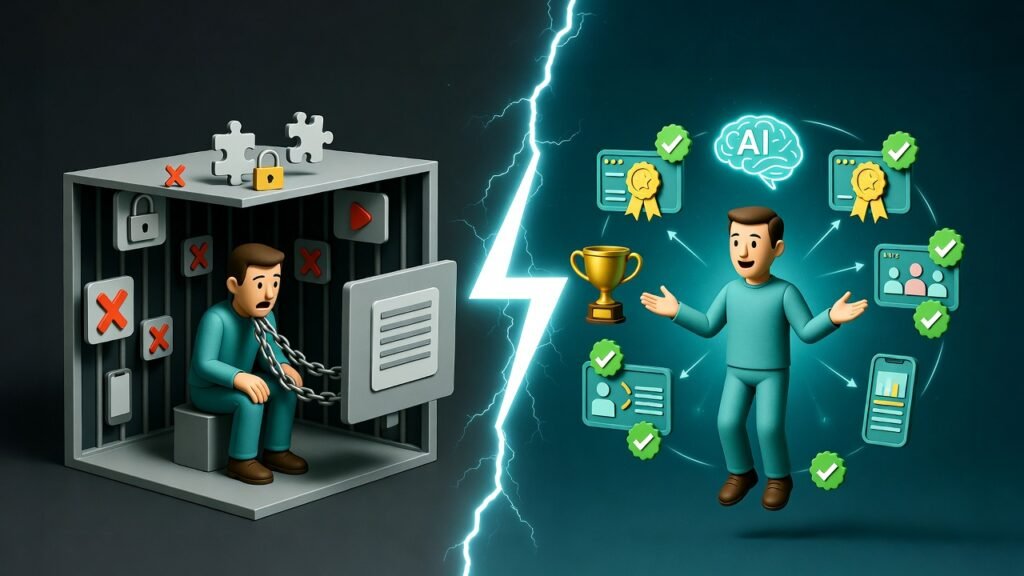
Here’s the challenge: most education businesses, EdTech startups, and corporate training providers start by buying an off-the-shelf LMS. Moodle, Canvas, Blackboard, TalentLMS. They customize it, work around its limitations, add plugins, and eventually hit a wall — a feature they need that the platform will never build, or a branding requirement it cannot meet, or a scaling problem it was never designed to solve.
That’s the moment custom e-learning platform development stops being a “nice to have” and becomes the only path forward.
This guide is for the education businesses ready to build something that actually fits — not adapt endlessly to something that doesn’t.
What Is Custom E-Learning Platform Development?
Custom e-learning platform development is the process of designing and building a digital learning environment from scratch — or significantly extending an existing platform — to match the exact needs of a specific educational institution, EdTech company, or corporate training organization.
This is different from buying a SaaS LMS subscription. A custom-built platform belongs to the organization that commissioned it. The code, the data, the architecture, and the user experience are all designed around the actual learners and instructors who will use it — not a generic template adapted to fit.
Custom e-learning platform development typically covers one or more of these deliverables:
- Learning Management System (LMS) development — the core platform managing courses, enrollments, assignments, grades, and progress tracking
- Virtual classroom software development — live video sessions, breakout rooms, whiteboards, and real-time collaboration tools
- Student portals — personalized dashboards, course libraries, certificates, and progress visualizations
- Corporate training platform development — onboarding workflows, compliance training, skills assessments, and reporting for HR teams
- EdTech app development — mobile-first learning applications for iOS and Android
- Online course platform development — marketplace-style platforms where educators publish and sell courses
The right scope depends on the organization’s size, learner base, content type, and existing technology infrastructure.
Why Choose Custom E-Learning Software Over Off-the-Shelf LMS?
Most people get this decision backwards. They calculate the upfront cost of custom development, compare it to an annual SaaS subscription, and choose the subscription. Then two years later, they’re paying for the subscription, a developer to maintain their plugins, and a content team working around the features the platform doesn’t have.
Here’s what actually matters in this comparison:
| Factor | Off-the-Shelf LMS | Custom E-Learning Platform |
|---|---|---|
| Time to Launch | Days to weeks | 8–24 weeks depending on scope |
| Upfront Cost | Low ($0–$1,000/month) | Higher ($20,000–$300,000+ build) |
| 5-Year Total Cost | $30,000–$500,000+ (licensing + customization) | Build cost + hosting ($500–$3,000/month) |
| Feature Control | Vendor roadmap decides | You decide |
| Branding and UX | Limited templates | Fully custom to your brand |
| Data Ownership | Vendor-controlled | Fully owned by your organization |
| Scalability | Vendor infrastructure limits | Scales on your terms |
| Integration Depth | Standard connectors only | Deep integration with any system |
| AI Personalization | Available on premium tiers only | Built to your exact specification |
| Best For | Quick starts, standard use cases | Unique workflows, scale, proprietary content |
Only 22% of LMS platforms had integrated AI personalization as of 2025, despite the technology being widely available. [Source: companieshistory.com/elearning-industry-growth] For organizations that want adaptive learning, intelligent content recommendations, or AI-powered progress coaching built into their platform — custom development is often the only realistic path.
When off-the-shelf LMS wins:
- You need to be live within days for a time-sensitive training rollout
- Your content is standard and your workflows are generic
- Your learner base is under 500 and unlikely to grow significantly
When custom e-learning platform development wins:
- You have proprietary content, unique certification workflows, or compliance-specific requirements
- You want to sell or license the platform to other organizations
- You need deep integration with existing ERP, HR, or student information systems
- Your learner base is large, geographically distributed, or growing rapidly
What Features Should a Good LMS Have?
The features that separate a platform learners actually use from one they abandon after the first week:
Core Learning Features
- Course builder — drag-and-drop content creation supporting video, audio, SCORM, PDFs, interactive quizzes, and live sessions
- Progress tracking — granular learner progress visibility for instructors and administrators, not just completion percentages
- Assessments and grading — automated grading for objective assessments, rubric-based grading tools for subjective work
- Certificates and credentialing — auto-generated certificates on completion, with verifiable credential links for professional development programs
- Gamification — points, badges, leaderboards, and streaks — learning management system development with gamification consistently delivers higher course completion rates
Communication and Collaboration
- Discussion forums — threaded conversations at course and lesson level
- Live virtual classroom — integrated video conferencing with recording, breakout rooms, screen sharing, and interactive whiteboard
- Direct messaging — learner-to-instructor and peer-to-peer communication within the platform
- Announcement system — instructor and admin broadcast tools for cohort-wide communications
Administration and Reporting
- Role-based access control — separate admin, instructor, and learner permission layers
- Enrollment management — manual, self-enrollment, and automated enrollment via SSO or HR system integration
- Analytics dashboard — course completion rates, time-on-task, assessment performance, and cohort comparison reporting
- Compliance reporting — audit-ready completion logs for industries with mandatory training requirements
Technical Essentials
- Mobile-first responsive design — mobile learning raises productivity by 43%, training speed by 45%, and retention by 45% versus desktop delivery [Source: companieshistory.com/elearning-industry-growth]
- Offline access — critical for learners in regions with unreliable internet connectivity
- SCORM and xAPI support — for importing and tracking existing content libraries
- SSO integration — single sign-on via Google, Microsoft, or institutional identity providers
- Multi-language support — essential for global organizations and international universities
AI-Powered Features (2026 Standard)
- Adaptive learning paths — content sequencing that adjusts based on learner performance
- AI content recommendations — surfacing relevant supplementary material based on learner behavior
- Automated feedback — AI-generated formative feedback on written assignments and assessments
- Predictive dropout alerts — identifying at-risk learners before they disengage
How Much Does It Cost to Build an E-Learning Platform?
This is the question every education business asks first — and the answer depends entirely on the scope and technical complexity of what’s being built.
Off-the-Shelf LMS Comparison
| Platform | Pricing | Limitations |
|---|---|---|
| Moodle (Open Source) | Free + hosting + customization | High maintenance, technical debt |
| TalentLMS | From $69/month (up to 40 users) | Feature ceiling, vendor lock-in |
| Canvas (Instructure) | Custom enterprise pricing | Expensive at scale, limited customization |
| Blackboard | Custom enterprise pricing | Legacy UX, high switching cost |
| LearnDash (WordPress) | From $199/year | Plugin-dependent, scalability limits |
Custom E-Learning Platform Development Pricing
| Build Type | Cost Range | Timeline | Best For |
|---|---|---|---|
| MVP / Proof of Concept | $10,000 – $30,000 | 6 – 10 weeks | EdTech startups validating a concept |
| Standard Custom LMS | $30,000 – $100,000 | 10 – 20 weeks | Schools, training providers, small universities |
| Full-Featured LMS + Virtual Classroom | $80,000 – $200,000 | 16 – 28 weeks | Universities, mid-size corporate training |
| Enterprise EdTech Platform | $150,000 – $500,000+ | 6 – 14 months | Large institutions, SaaS EdTech products |
| AI-Powered Adaptive LMS | $100,000 – $400,000+ | 5 – 12 months | Organizations prioritizing personalization |
| Mobile EdTech App (iOS + Android) | $40,000 – $150,000 | 12 – 24 weeks | Mobile-first learning organizations globally |
What drives cost upward:
- AI personalization and adaptive learning features
- Live virtual classroom with recording and playback
- Deep ERP or student information system (SIS) integration
- Multi-language and multi-currency support for global platforms
- Compliance and accessibility requirements (WCAG 2.1, FERPA, GDPR)
What keeps cost manageable:
- Clear scope definition before development starts
- Phased delivery — launch core LMS first, add virtual classroom in phase two
- Using proven frameworks (Next.js, Node.js, PostgreSQL) rather than niche stacks
- Working with an education software development company that has shipped production LMS products before
All pricing above is in USD as a reference range. Organizations in the UK, UAE, Southeast Asia, and South Asia typically find offshore development partners with comparable technical quality at 30–50% lower cost than US or Western European agencies — without compromising the compliance architecture or mobile-first design that global learner bases require.
How Long Does It Take to Build a Custom E-Learning Platform?
Timeline depends on scope, feature complexity, and how clearly the requirements are defined before development starts. Vague requirements are the single most common cause of delayed e-learning platform builds.
Typical phase-by-phase timeline for a standard custom LMS:
- Discovery and architecture planning — 2–3 weeks
- UI/UX design — 3–5 weeks (runs parallel with architecture)
- Core LMS development — 6–12 weeks (course builder, progress tracking, admin, roles)
- Integrations — 2–4 weeks (SSO, payment gateway, video hosting, SIS)
- Virtual classroom module — 3–6 weeks if included in scope
- QA, testing, and accessibility review — 2–4 weeks
- Deployment and launch — 1–2 weeks
For a well-scoped standard custom LMS, the total timeline from kickoff to live launch runs 18–24 weeks. AI-powered features, complex integrations, or a full marketplace platform add 8–16 weeks.
Pro tip: The biggest timeline risk is not development speed — it’s content readiness. Organizations that start development before their course content is structured and ready consistently delay launches by 4–8 weeks while content is being finalized. Start content preparation on day one, not after the platform is built.
Can E-Learning Platforms Be Built for Corporate Training Too?
Absolutely — and the corporate segment is actually the fastest-growing part of the entire e-learning market, projected to grow at a 22.5% CAGR through 2033. [Source: grandviewresearch.com]
Corporate training platform development has distinct requirements from academic LMS development:
Compliance Training Management Organizations in regulated industries (healthcare, finance, manufacturing, construction) need platforms that track mandatory training completion, issue time-stamped certificates, send renewal reminders, and produce audit-ready compliance reports. This is not a feature most off-the-shelf tools handle elegantly at enterprise scale.
Onboarding Workflows Custom onboarding modules that assign role-specific learning paths automatically when a new employee joins — integrated with HRIS systems (Workday, BambooHR, SAP) — eliminate the manual onboarding coordination that wastes HR team time.
Skills Gap Analysis and Reporting Senior leadership in large organizations needs reporting that goes beyond completion rates: skills coverage maps, department-level performance benchmarks, and learning ROI calculations that connect training data to business outcomes.
White-Labeled Corporate Training Platforms Training providers who sell to multiple corporate clients need a multi-tenant platform architecture that gives each client their own branded environment while sharing the underlying infrastructure — this is a common use case that off-the-shelf tools either cannot support or charge enterprise-tier pricing to enable.
Our team built a corporate training platform for a compliance training provider serving financial services firms across five countries. Their existing setup was a patched-together combination of a generic LMS, a third-party video hosting service, and manual certificate distribution via email. We delivered a unified custom corporate training platform — with automated compliance certificate issuance, HRIS integration via API, multi-tenant white-label architecture, and a detailed compliance audit reporting module — in 22 weeks. The provider onboarded 11 new corporate clients in the following six months, crediting the platform’s professional presentation and audit reporting capability as the primary reason clients chose them over competitors.
What Tech Stack Is Best for Custom E-Learning Platform Development?
The right technology stack determines how fast your platform loads, how well it scales, and how maintainable it is as your learner base grows.
Recommended stack for 2026 custom LMS development:
- Frontend: Next.js or React — fast rendering, excellent for content-heavy dashboards, strong SEO for course marketplace platforms
- Backend: Node.js or Python (Django/FastAPI) — high performance, excellent for real-time features like live classrooms and notifications
- Database: PostgreSQL for structured learner data, Redis for session management and caching
- Video hosting: AWS MediaConvert + CloudFront, or Mux — for reliable, scalable course video delivery globally
- Real-time communication: WebRTC for virtual classrooms, Socket.io for live notifications
- Cloud hosting: AWS or Google Cloud — auto-scaling infrastructure that handles peak load during exam periods or live sessions
- Authentication: Auth0 or Clerk — pre-built SSO support saves weeks of development time
Mobile-first is non-negotiable in 2026. Mobile learning raises productivity by 43%, training completion speed by 45%, and knowledge retention by 45% compared to desktop delivery. India alone is projected to have 309.1 million online learners by 2029, the vast majority accessing on mobile devices. Any EdTech app development or LMS build that is not fully optimized for mobile is leaving a significant portion of its potential audience underserved.
Multi-Region Considerations for E-Learning Platform Development
United States and Canada
US educational institutions handling student data must comply with FERPA (Family Educational Rights and Privacy Act), which governs access to and disclosure of student education records. Corporate training platforms processing health-related compliance training may also intersect with HIPAA requirements. Accessibility compliance under Section 508 and WCAG 2.1 is mandatory for any platform used in federally funded educational programs.
Our team developed a custom student portal and LMS extension for a US-based community college in Florida serving 22,000 students across three campuses. Their existing Blackboard implementation had become expensive and inflexible — a plugin update had broken their gradebook integration, and the vendor support resolution time was running at 11 business days. We rebuilt their student portal as a standalone Next.js application integrated with their existing SIS via API, maintaining Blackboard for the legacy courses while the new portal handled course discovery, student communications, and progress visualization. Migration took 16 weeks. Student portal satisfaction scores increased from 3.1/5 to 4.6/5 in the first semester post-launch.
United Kingdom
UK universities and training providers must comply with the Data Protection Act 2018 (UK GDPR post-Brexit). The Quality Assurance Agency (QAA) sets standards for digital delivery in higher education. Corporate training providers with government contracts face additional Ofsted and Ofqual requirements for digital qualification delivery. E-learning revenue in the UK is expected to reach £14.6 billion by 2028, with 15.1 million online learners by the end of the decade.
Middle East and Asia
The Middle East — particularly the UAE, Saudi Arabia, and Qatar — is seeing significant government investment in EdTech as part of national digital transformation strategies. Saudi Vision 2030 and UAE National Innovation Strategy both prioritize digital education infrastructure, creating significant opportunities for e-learning software development companies in the region. Arabic-language support, right-to-left interface design, and prayer time-aware scheduling features are platform requirements that no generic Western LMS addresses well.
India records the highest e-learning national CAGR at 25.76%, with 309.1 million online learners projected by 2029. The market for online education in India is projected to reach $6.20 billion — driven by edupreneurs, skill development platforms, and corporate training providers all requiring mobile-first, low-bandwidth-optimized platforms that serve learners across varying connectivity conditions.
Frequently Asked Questions: Custom E-Learning Platform Development
Why choose custom e-learning software over off-the-shelf LMS?
Custom e-learning platform development gives organizations full control over features, branding, data, and scalability. Off-the-shelf tools limit customization to what the vendor has built, charge premium pricing for advanced features, and force data into vendor-controlled infrastructure. For organizations with unique workflows, proprietary content, or plans to license the platform commercially, custom development delivers better long-term ROI.
How much does it cost to build an e-learning platform?
Custom LMS development ranges from $5000 for a basic MVP to $50,000+ for an enterprise AI-powered platform. A standard custom LMS for a school or training provider typically runs $3000–$10,000. Virtual classroom integration adds $5000–$80,000. A full EdTech app (iOS + Android) adds $8000–$150,000. Offshore development teams typically offer 30–50% cost savings versus Western agencies with comparable output quality.
What features should a good LMS have in 2026?
Core requirements: course builder with multi-format support, progress tracking, assessments and auto-grading, certificates, gamification, discussion forums, role-based access, and compliance reporting. Advanced requirements for 2026: live virtual classroom, AI-powered adaptive learning paths, mobile-first design, offline access, multi-language support, and SCORM/xAPI compatibility.
How long does it take to build a custom e-learning platform?
A well-scoped standard custom LMS takes 18–24 weeks from kickoff to live launch. Adding a virtual classroom module extends this by 3–6 weeks. An enterprise EdTech platform with AI features and complex integrations runs 5–14 months. The most common delay factor is content readiness — organizations that finalize their course content after development starts consistently push launch by 4–8 weeks.
Can e-learning platforms be built for corporate training?
Yes — and corporate training is the fastest-growing e-learning segment at 22.5% CAGR. Corporate training platform development focuses on compliance tracking, automated onboarding workflows, HRIS integration (Workday, BambooHR, SAP), skills gap reporting, and white-label multi-tenant architecture for training providers serving multiple corporate clients.
What is the best tech stack for LMS development in 2026?
The most maintainable and scalable stack in 2026: Next.js or React frontend, Node.js or Python backend, PostgreSQL database, AWS or Google Cloud hosting, Mux or AWS MediaConvert for video, WebRTC for live classrooms, and Auth0 or Clerk for SSO. This stack handles global scale, mobile-first delivery, and AI feature integration without requiring architectural rewrites as the platform grows.
Which e-learning software development company should I choose?
Evaluate providers on four criteria: portfolio of live, shipped LMS products (not mockups), a structured discovery process before quoting, fixed-price options for defined MVP scopes, and post-launch support included in the engagement. Request references from education or training clients specifically — e-learning platforms have unique UX, compliance, and scalability requirements that general-purpose software agencies often underestimate.
How do I choose between building a mobile app and a responsive web platform?
For most organizations, a mobile-first responsive web platform delivers 80% of the value of a native app at 40–60% of the cost. Native iOS and Android apps make more sense when offline content access is a core requirement, when push notifications are critical to learner engagement, or when the platform will be distributed through the App Store and Google Play as a commercial product.
Final Verdict: Should You Build a Custom E-Learning Platform?
The custom e-learning segment already leads the market at 29.5% share and is growing faster than the generic LMS category. The organizations capturing that growth are not the largest or the best-funded — they’re the ones who identified one specific limitation their off-the-shelf tool could not solve and built a focused custom solution around it.
Start with a clear MVP scope. Define what your learners need in the first three months on the platform — not everything you might eventually want. Build that, launch it, measure engagement, and extend from there. The organizations that try to build everything at once consistently overrun budgets and timelines. The ones who build one thing well consistently ship on time and see ROI faster.
For education businesses, universities, EdTech startups, and corporate training providers ready to move beyond the limitations of generic tools, our custom software and web development services cover the full stack — from MVP LMS builds to enterprise EdTech platforms with AI personalization and virtual classroom integration.
For organizations that also need organic learner acquisition through search, our SEO services for education and EdTech businesses are built around the specific competitive dynamics of education search in 2026.
“The best e-learning platform is not the most feature-rich one. It is the one learners actually open, complete, and return to — and that starts with a design built around how they learn, not how the vendor built their template.”