
TL;DR: Travel and tourism app development in 2027 covers building custom mobile apps for travel agencies, tour operators, hotels, and event businesses. The global travel app market is valued at $16.23 billion in 2026, growing to $63.87 billion by 2035. Development costs range from $5,000 for an MVP to $250,000+ for a full-featured platform. Over 80% of global travelers now expect to book trips entirely through mobile apps.
Mobile devices now capture 62% of all global travel website traffic. Yet the average mobile travel booking converts at just 2.7% — compared to 5.9% on desktop. [Source: teacode.io/blog/travel-app-development]
That conversion gap is not a mobile problem. It is a design and functionality problem. Websites adapted for mobile screens are not the same as apps built for mobile behavior. Travelers expect instant booking confirmation, saved payment methods, offline itinerary access, real-time alerts, and one-tap communication — features a responsive website cannot deliver at the experience level a purpose-built app can.
The travel and tourism app market reflects this demand clearly. Valued at $16.23 billion in 2026 and projected to reach $63.87 billion by 2035 at a 15.6% CAGR, it represents one of the fastest-growing categories in mobile application development. [Source: businessresearchinsights.com/market-reports/travel-application-market-116262]
This guide is written for travel agencies, tour operators, event management companies, hospitality businesses, and ticketing platforms evaluating whether to build a custom app, what it should include, and what it will realistically cost.
Why Do Travel and Tourism Businesses Need a Custom App in 2027?
A custom travel app gives tourism businesses direct booking capability, customer data ownership, and a branded experience that third-party platforms cannot provide.
Over 65% of travelers now prefer a travel booking app over a website for reservations and itinerary management. More than 70% use at least one dedicated travel app when planning or managing a trip. And 40% complete bookings exclusively on mobile. [Source: hotelagio.com/travel-app-market-statistics]
For travel businesses still relying solely on OTA listings (Booking.com, Expedia, Airbnb) or responsive websites, the commercial cost is measurable:
- Commission dependency: OTAs charge 15–25% commission per booking. A direct booking through a proprietary app eliminates that cost entirely.
- No customer data ownership: OTA bookings deliver a transaction, not a customer relationship. Businesses receive minimal data and no ability to market directly to past guests or attendees.
- No loyalty mechanics: Loyalty programs, personalized offers, and repeat booking incentives require direct digital relationships that OTA platforms do not support.
- Generic experience: Travelers increasingly expect personalized, branded experiences from the companies they book with — not a generic listing on a platform shared with thousands of competitors.
The calculation for most established travel businesses is straightforward: the cost of building a custom travel booking app is recovered within 12–18 months for businesses converting even a modest portion of bookings from OTA channels to direct.
What Types of Travel and Tourism Apps Are There?
Travel and tourism app development covers several distinct categories, each with different feature requirements and development scope:
Travel Booking Apps Flight, hotel, and multi-service booking platforms where users search, compare, and confirm reservations with integrated payment processing. Examples: custom OTA-style platforms, airline direct booking apps, hotel chain apps.
Tour and Activity Booking Apps Platforms specifically for tour operators, activity providers, and experience-based travel businesses. Features include availability calendars, group booking, guide assignment, and customer communication tools.
Itinerary Planning Apps Apps that consolidate bookings, schedules, maps, and travel documents into a unified itinerary accessible offline. Particularly valuable for travel agencies managing complex multi-destination trips.
Event Management Apps (Mobile App for Event Management) Apps covering event registration, ticketing, check-in (QR code scanning), attendee communication, agenda management, and post-event feedback. Used by event management companies, conference organizers, exhibition hosts, and festival operators.
Event Ticketing App Development Platforms specifically for ticket sales, seat selection, access control, and resale management. Technical requirements include fraud prevention, high-volume transaction handling, and real-time seat availability.
Destination and Tourism Guide Apps Apps providing local attraction recommendations, maps, audio guides, and curated experiences for a specific destination. Frequently commissioned by tourism boards, destination management organizations, and hospitality groups.
Hotel and Hospitality Apps Property-specific apps covering mobile check-in and checkout, room service ordering, concierge requests, and loyalty account management.
What Features Should a Travel Booking App Include?
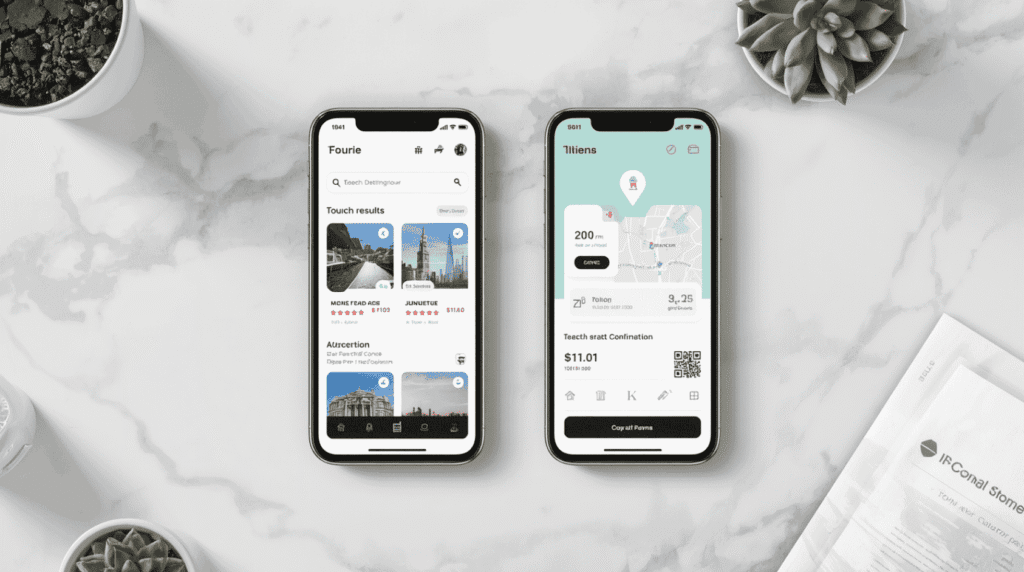
The features that separate booking apps travelers use regularly from ones they open once and delete:
Core Booking Features
- Real-time availability and pricing — live inventory updates for flights, hotels, activities, and event seats without page refresh delays
- Multi-service search and comparison — allowing users to compare options side-by-side within the app rather than switching between platforms
- Secure payment gateway integration — support for cards, digital wallets (Apple Pay, Google Pay, PayPal), and regional payment methods (KNET in Kuwait, Mada in Saudi Arabia, Paytm in India)
- Instant booking confirmation — automated confirmation delivered immediately by push notification and email, with booking reference and summary
- Booking management — modification, cancellation, and rebooking within the app without requiring a phone call
- Guest checkout and account creation — forcing account creation before booking is a leading cause of checkout abandonment
User Experience Features
- Offline itinerary access — boarding passes, hotel confirmations, and day-by-day itineraries accessible without mobile data — critical for international travelers roaming on foreign networks
- Push notifications — real-time alerts for flight status changes, check-in reminders, price drops, and personalized offers
- In-app maps and navigation — integrated mapping for property locations, tour meeting points, and event venues
- Multi-language and multi-currency support — essential for apps targeting international travelers or operating across multiple markets
- User reviews and ratings — in-app review functionality adds social proof and keeps users within the platform rather than redirecting to TripAdvisor or Google
Personalization and Retention
- User profiles with saved preferences — past bookings, saved destinations, payment methods, and travel preferences stored for one-tap rebooking
- Loyalty and rewards program — points accumulation, tier progression, and redemption mechanics that incentivize repeat bookings
- AI-powered recommendations — personalized destination and activity suggestions based on past booking behavior and stated preferences
- Wishlist and price alerts — allowing users to save properties or experiences and receive notifications when prices drop to their target range
Admin and Operator Features
- Booking management dashboard — real-time visibility of all active bookings, availability, revenue, and cancellations
- Channel management — for businesses also listing on OTAs, synchronization of availability across all channels from a single admin interface
- CRM and customer communication — direct messaging to guests, automated pre-arrival and post-stay communications, and group communication for tours or events
- Analytics and reporting — booking conversion rates, revenue by product, seasonal demand patterns, and customer acquisition source tracking
What Features Does an Event Management App Need?
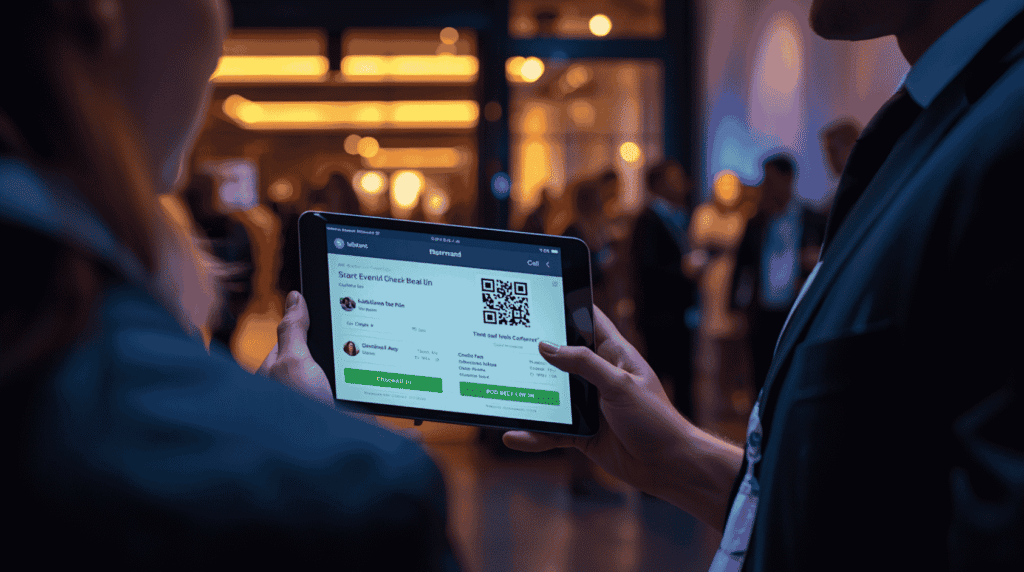
Event management app development serves a distinct operational context from travel booking — the primary users are both event organizers managing logistics and attendees managing their participation.
Core features for a well-built event management app:
For Attendees
- Digital ticket with QR code for entry
- Personal agenda builder from the event programme
- Session or workshop booking and seat reservation
- Venue map with interactive session locations
- Speaker profiles and networking directory
- Live updates on schedule changes, session additions, and announcements
- In-app networking — attendee matching and direct messaging
For Organizers and Event Staff
- QR code check-in scanning (offline-capable for venues with poor connectivity)
- Real-time attendee check-in tracking and capacity management
- Sponsor and exhibitor management — booth assignments, digital profiles, lead capture
- Session feedback and live polling
- Push notification broadcast to all attendees or specific segments
- Post-event analytics — attendance rates, session popularity, feedback scores, revenue
For Event Ticketing Apps Specifically
- Multiple ticket types with dynamic pricing (early bird, VIP, group)
- Seat map selection for seated events
- Resale and transfer controls
- Anti-fraud measures — unique QR code generation, one-scan invalidation
- High-volume transaction infrastructure — capable of handling peak sales volumes during ticket release without performance degradation
How Much Does It Cost to Develop a Travel App?
Development cost depends on app type, feature scope, platform choice (iOS only, Android only, or both), and whether you build with a cross-platform framework or native development.
Cost by App Type
| App Type | Cost Range (USD) | Timeline |
|---|---|---|
| Basic tourism guide app | $5,000 – $10,000 | 6 – 10 weeks |
| Tour and activity booking MVP | $15,000 – $25,000 | 10 – 16 weeks |
| Hotel booking app | $10,000 – $50,000 | 12 – 20 weeks |
| Flight booking app | $15,000 – $50,000 | 16 – 28 weeks |
| Itinerary planning app | $10,000 – $30,000 | 10 – 20 weeks |
| Event management app | $10,000 – $40,000 | 12 – 20 weeks |
| Event ticketing platform | $10,000 – $50,000 | 16 – 28 weeks |
| Full OTA-style multi-service platform | $20,000 – $80,000+ | 6 – 14 months |
| AI-powered travel super-app | $50,000 – $100,000+ | 8 – 18 months |
Cost by Platform and Development Approach
| Approach | Cost Impact | Best For | Trade-Off |
|---|---|---|---|
| Cross-platform (Flutter / React Native) | Base cost | Most travel and event apps | Slightly lower native performance |
| Native iOS only | +0% (single platform) | Markets with dominant iOS usage | Excludes Android users |
| Native Android only | +0% (single platform) | Southeast Asia, India, MENA | Excludes iOS users |
| Native iOS + Android | +40–60% over cross-platform | Enterprise, high-performance apps | Higher cost, longer timeline |
Key Cost Drivers
The factors that push a travel app development project toward the upper end of any cost range:
- Third-party API integrations: GDS connections (Amadeus, Sabre), Skyscanner, Google Maps, and payment gateway integrations each add $5,000–$20,000 to the base build cost
- Real-time data requirements: Live pricing, availability, and flight status feeds require infrastructure design that handles API rate limits and data freshness — more complex than static content delivery
- AI personalization features: Recommendation engines, AI trip planning assistants, and dynamic pricing models add $20,000–$80,000 depending on complexity
- Offline functionality: Implementing reliable offline access for itineraries, maps, and documents requires additional engineering beyond standard app architecture
- High-volume transaction infrastructure: Event ticketing apps handling peak sales volumes (major concerts, sports events) need load-tested backend architecture designed for concurrent transaction spikes
Is Owning a Travel App Profitable?
Yes — when the booking volume and revenue model align with build and maintenance costs.
A travel app is profitable when it generates more revenue than it costs to build, maintain, and market. The primary revenue models for travel and tourism apps:
- Commission per booking — typically 5–15% for tour and activity platforms
- Subscription — monthly or annual fees for premium features (the dominant model, accounting for 40.6% of travel app revenue in 2024)
- Listing fees — paid placement for hotels, tours, or experiences within a marketplace app
- Advertising — destination-relevant ads and sponsored content
- White-label licensing — licensing the platform to other travel operators
Apps with multi-utility features — combining itineraries, loyalty, payments, and real-time alerts — correlate strongly with higher user retention and therefore higher lifetime revenue per user. [Source: hotelagio.com]
How much does it cost to build a travel app compared to what it generates? How much does it cost to develop a booking app at scale? And how much is an app with 100,000 users worth? The question of how much an app with 100,000 users is worth depends on monetization model, engagement depth, and booking conversion rate. A travel booking app with 100,000 monthly active users generating even $12 average monthly booking revenue per user represents a $1.2 million monthly GMV platform — commercially significant for any travel business at that scale.
How to Develop a Travel App: The Full Process
How to develop a travel app — whether a basic tourism guide or a full booking platform — follows eight structured stages:
- Discovery and requirements definition — scoping features, booking workflows, third-party integrations, and user personas before any design or code begins
- UI/UX design — wireframes, user flows, and high-fidelity interface design for all booking, account, and management screens
- Backend architecture — API design, database structure, payment processing integration, and real-time data feed connections
- Frontend development — building the iOS and Android interfaces using the agreed framework (Flutter, React Native, or native)
- Third-party integrations — connecting GDS providers, payment gateways, mapping services, push notification systems, and analytics platforms
- QA and performance testing — device compatibility testing, load testing for booking peak scenarios, offline functionality verification
- App store submission — Apple App Store and Google Play listing, metadata optimization, and review submission
- Post-launch monitoring and iteration — crash reporting, booking funnel analytics, user feedback collection, and regular feature updates
The discovery phase is where most travel app projects succeed or fail. Poorly defined booking workflows, unclear integration requirements, and underestimated third-party API complexity are the most common causes of timeline overruns and budget exhaustion in travel app projects.
What Tech Stack Works Best for Travel App Development?
The most maintainable and commercially proven stack for travel and tourism app development in 2026:
- Mobile framework: Flutter (Google) or React Native (Meta) — both deliver iOS and Android from a shared codebase at 30–40% lower cost than separate native builds, with performance adequate for all standard travel app requirements
- Backend: Node.js or Python (FastAPI/Django) — high concurrency handling for booking request volumes, strong API ecosystem
- Database: PostgreSQL for booking and user data, Redis for session management and real-time availability caching
- Cloud hosting: AWS or Google Cloud — auto-scaling infrastructure handles seasonal demand spikes (summer peaks, holiday periods) without manual capacity planning
- Payment: Stripe for international markets, with regional gateway integrations (Checkout.com for MENA, Razorpay for India, 2C2P for Southeast Asia)
- Maps: Google Maps Platform or Mapbox, with offline tile support for itinerary apps
- Push notifications: Firebase Cloud Messaging — the standard for cross-platform push delivery
- Real-time features: WebSockets for live booking updates, seat availability, and event check-in synchronization
For apps requiring scalable cloud infrastructure to handle peak booking loads — particularly event ticketing apps during major release windows — our cloud infrastructure for scalable apps covers the architecture decisions that prevent performance failures at the moments when they would cause the most commercial damage.
UAE-Specific Considerations for Travel and Tourism App Development

How Much Does It Cost to Develop a Travel App in Dubai or the UAE?
Development costs for travel apps commissioned through UAE-based agencies typically run 20–40% higher than equivalent projects built with offshore development partners, reflecting local market rates for mobile development talent in Dubai and Abu Dhabi.
Realistic UAE market cost ranges:
- Basic tourism guide app: AED 40,000–90,000 (~$11,000–$25,000)
- Custom hotel or tour booking app: AED 80,000–250,000 (~$22,000–$68,000)
- Full event management platform: AED 120,000–350,000 (~$33,000–$95,000)
- Enterprise multi-service OTA platform: AED 400,000–1,000,000+ (~$109,000–$272,000+)
Many UAE tourism and hospitality businesses achieve equivalent technical quality by working with offshore development teams while maintaining project management and client-side oversight locally — a model that reduces build cost by 30–50% without meaningful quality trade-offs for well-scoped projects.
Regulatory and Market Considerations
- Payment gateway compliance: UAE-based payment processing for travel apps typically uses Checkout.com, PayTabs, or Telr — all of which comply with UAE Central Bank regulations for digital payment processing. International gateways including Stripe now support UAE merchant accounts directly.
- Arabic language support: Apps targeting UAE and wider GCC markets require right-to-left (RTL) interface support for Arabic. This affects layout design, text rendering, and input handling — and needs to be planned from the design phase, not retrofitted after development.
- Dubai Tourism DTCM compliance: Travel and tour operators in Dubai operating under DTCM licensing should ensure their app’s booking and review functionality aligns with DTCM content and rating guidelines.
- Expo-legacy infrastructure: Dubai’s technology infrastructure — particularly its 5G coverage and smart city connectivity — supports real-time app features more reliably than many other regional markets, reducing the engineering complexity of offline-fallback requirements for apps deployed primarily within the UAE.
UAE Tourism Market Context
The UAE’s tourism sector is one of the most digitally progressive in the Middle East. International arrivals into Dubai have consistently exceeded pre-2020 levels, with Dubai Tourism targeting 25 million visitors annually by 2025. This volume creates commercial conditions where purpose-built travel apps — whether for incoming tour operators, hotel groups, experience providers, or MICE event companies — have a large, tech-savvy, mobile-native visitor base to serve.
For tourism app development services and event and tourism technology solutions tailored to the UAE and wider MENA market, our event and tourism technology solutions page covers the specific capabilities and regional considerations relevant to hospitality, tourism, and event businesses in this market.
Key Takeaways
- The global travel app market is valued at $16.23 billion in 2026 and projected to reach $63.87 billion by 2035 — businesses investing in custom apps now are entering a rapidly expanding market
- Mobile accounts for 62% of travel traffic but converts at 2.7% versus 5.9% on desktop — purpose-built apps close this gap where responsive websites cannot
- Over 80% of global travelers expect to book trips entirely through mobile apps — direct booking capability through a proprietary app eliminates OTA commission costs of 15–25% per booking
- Custom travel app development costs range from $15,000 for a focused MVP to $250,000+ for a full multi-service platform — scope definition is the single biggest cost driver
- Cross-platform frameworks (Flutter, React Native) deliver iOS and Android from a shared codebase at 30–40% lower cost than native development — the right choice for most travel and event apps
- Third-party API integrations (GDS, payment gateways, maps) add $5,000–$20,000 each to base development cost and should be scoped explicitly before any pricing is finalized
- UAE development costs run 20–40% above offshore equivalents — most UAE hospitality and tourism businesses achieve comparable quality through managed offshore partnerships at significantly lower cost
- Event management apps require distinct feature sets from booking apps — offline check-in capability, high-volume ticketing infrastructure, and real-time attendee management are non-negotiable for serious event operators
Frequently Asked Questions
How much does it cost to develop a travel app in 2027?
Travel app development costs range from $5,000–$15,000 for a basic tourism guide app to $100,000+ for a full-featured multi-service booking platform. Most travel agencies and tour operators building their first custom booking app spend $50,000–$15,000 for a well-featured MVP covering availability search, booking, payments, and basic itinerary management. Costs depend on platform choice, third-party integrations, and feature scope.
How do you develop a travel app?
Travel app development follows eight stages: discovery and requirements definition, UI/UX design, backend architecture, frontend development, third-party API integration (GDS, payments, maps), QA and performance testing, app store submission, and post-launch monitoring. The discovery phase — defining booking workflows and integration requirements before development begins — is the most commercially important stage and the most commonly under-resourced.
How much does it cost to develop an app in the UAE or Dubai?
UAE-based agency development typically costs AED 19000–55000 ($5,000–$15,000) for a standard travel or event management app. Enterprise multi-service OTA platforms run AED 40,000–1,000,000+. Many UAE tourism and hospitality businesses achieve equivalent quality through offshore development partners at 30–50% lower cost, with local project oversight maintained.
Is owning a travel app profitable?
Travel apps are profitable when booking volume generates commission or subscription revenue that exceeds build and maintenance costs. For businesses converting OTA bookings to direct app bookings, the 15–25% commission saving typically covers development costs within 12–18 months at moderate booking volumes. Apps with multi-utility features (itineraries, loyalty, payments, real-time alerts) retain users longer, increasing lifetime revenue per customer.
What is the best tech stack for travel app development?
Flutter or React Native for cross-platform mobile development, Node.js or Python for the backend, PostgreSQL for booking data, Redis for availability caching, AWS or Google Cloud for hosting, Stripe or regional equivalents for payments, and Firebase for push notifications. This stack handles seasonal demand spikes reliably, supports offline functionality, and integrates cleanly with major travel API providers including Amadeus and Google Maps.
What features should a travel booking app have?
Core features include: real-time availability search and comparison, secure multi-method payment processing, instant booking confirmation, offline itinerary access, push notifications for trip alerts, user profiles with saved bookings and payment methods, in-app maps, multi-language and multi-currency support, loyalty program mechanics, and an admin dashboard for operators to manage bookings and availability.
How is event management app development different from a travel booking app?
Event management apps prioritize real-time check-in (QR scanning, offline-capable), attendee communication, agenda and session management, sponsor and exhibitor tools, and post-event analytics — distinct from travel apps focused on search, booking, and itinerary delivery. Event ticketing apps add high-volume transaction infrastructure, anti-fraud QR generation, and seat map selection. Most businesses building both need them as separate applications or clearly separated modules within a unified platform.
How long does travel app development take?
A focused travel booking MVP takes 10–20 weeks from project kickoff to App Store submission. Full-featured multi-service platforms run 6–14 months. Timeline is primarily driven by integration complexity — each third-party API connection (GDS, payment gateway, mapping service) adds 1–4 weeks of integration and testing work. Clear scope definition at the start of the project is the most effective way to control timeline.
Which platform should a travel app be built for — iOS, Android, or both?
Both iOS and Android are typically required for travel and tourism apps operating in international markets. Cross-platform development using Flutter or React Native builds both from a shared codebase at 30–40% lower cost than separate native builds — the right choice for most travel and event businesses. Native development is worth the additional cost for apps with complex real-time animation requirements or those integrating deeply with platform-specific hardware features.
What are good examples of apps for travel and tourism?
Well-known examples include Booking.com (multi-service booking), Airbnb (accommodation with experience booking), TripIt (itinerary planning), Viator (tour and activity booking), Eventbrite (event ticketing and management), Hopper (AI-powered price prediction and booking), and Klook (Asia-Pacific activity booking). These represent the feature benchmarks travelers compare custom apps against — purpose-built apps compete by offering a more focused, branded, and commission-free experience.
Planning to build a travel booking app, event management platform, or tourism mobile app? Our team can help scope, design, and develop it — from MVP to full-featured platform.
Explore our mobile app development services or book a call to discuss your project directly.