

TL;DR: Real estate SEO drives 53% of agent website traffic. Social media generates leads for 46% of top-performing realtors. Agents using both consistently earn four times more than those who don’t. This guide covers what works on each platform, how to rank property listings in local and international search, and how Dubai, US, and UK markets require different approaches.
Eighty-seven percent of property buyers start their search online before they ever contact an agent. That is not a trend — it is the baseline buyer behavior every real estate business now competes within. [Source: NAR 2025 Report via tgcdigitalservices.com]
And yet, most real estate agencies still treat digital marketing as a secondary channel — something handled reactively, with inconsistent posting and no SEO structure behind their listings. The agencies winning buyer inquiries at volume in Dubai, Miami, London, and emerging markets like Lisbon and Ho Chi Minh City are doing something different: they are treating organic search and social media as coordinated, always-on channels with the same strategic priority as sales.
The numbers make the commercial case clearly. Real estate companies with active content and SEO programmes generate 5.4 times more leads than those without. Video property listings generate 403% more inquiries than text-only alternatives. Listings with keyword-rich, descriptive copy sell 23% faster. [Source: searchlab.nl, NAR/Zillow Research, REsimpli 2025]
This guide is for real estate agents, agencies, property developers, and PropTech platforms that want to understand and build a digital marketing engine — not just run sporadic campaigns.
What Is SEO in Real Estate Marketing?
Real estate SEO is the process of optimizing property listings, agency websites, and content so that buyers searching online find your business before your competitors. It covers technical website performance, keyword targeting for property searches, local search visibility, and content that matches how buyers actually research property purchases.
SEO accounts for 53% of website traffic for real estate agents — making it the single largest source of inbound traffic by channel. Long-tail keywords (specific searches such as “2-bedroom apartment for sale in Dubai Marina” or “detached houses for sale in Austin TX under $600k”) drive 70% of all real estate search traffic. [Source: REsimpli 2025 via searchlab.nl]
The four types of SEO relevant to real estate businesses:
- Technical SEO — site speed, mobile optimization, crawlability, structured data for property listings (schema markup)
- On-page SEO — keyword-rich property descriptions, optimized page titles, meta descriptions, and heading structure
- Local SEO — Google Business Profile, location-specific landing pages, and citation consistency across property portals
- Off-page SEO — backlinks from property media, portals, and local business directories that build domain authority
Is SEO paid or free? The organic traffic generated by SEO is not paid per click — but achieving strong rankings requires investment in technical work, content creation, and link building. SEO is a compounding investment: a well-structured property website with consistent content continues generating leads months and years after the initial work, unlike paid advertising that stops the moment the budget runs out.
Is SEO still worth it? Search and SEO remain the highest-ROI marketing channel across industries, including real estate. Website, blog, and SEO efforts rank as the number one ROI-generating channel in HubSpot’s State of Marketing Report — ahead of every paid format. For real estate businesses in competitive markets, SEO is not optional; it determines whether buyers find you or your competitor first. [Source: placester.com]
What Type of Marketing Is Best for Real Estate?
The most effective real estate marketing combines SEO for inbound discovery, social media for brand visibility and engagement, and video content for inquiry generation — with email nurturing handling the longer sales cycle from initial inquiry to transaction.
No single channel delivers everything. The data shows:
| Marketing Channel | Primary Strength | Conversion Rate | Cost Model | Best For |
|---|---|---|---|---|
| SEO / Organic Search | High-intent buyer discovery | Higher than social; top performers 4.7%+ | Time + content investment | Long-term inbound lead generation |
| Social Media (organic) | Brand visibility, community building | 4.7% industry avg; 12%+ top performers | Time + content creation | Brand awareness, referral relationships |
| Social Media (paid) | Targeted reach, retargeting | Retargeting: 76% higher than display ads | Per click / impression | Listing promotion, audience targeting |
| Video Marketing | Listing engagement, 403% more inquiries | Listing pages with video convert 2.3x better | Production + distribution | Luxury, international buyer markets |
| Email Marketing | Long-cycle nurturing, repeat business | Doubled 2021–2025 per channel data | Low — automation-driven | Database reactivation, investor clients |
| Google Ads (PPC) | Immediate search visibility | 50% higher than organic search | Per click — competitive CPCs | New market entry, high-value listings |
The strategic sequence for most real estate businesses: build SEO infrastructure first for compounding long-term returns, run paid social for immediate listing visibility and audience building, and use email to close the long gap between first inquiry and transaction.
How to Do Social Media Marketing for Real Estate?
Social media marketing for real estate agencies means consistent content across platforms that surfaces listings, builds agent credibility, and creates enough trust that buyers contact you rather than your competitor when they are ready to transact.
What Is Social Media Marketing in Real Estate?
Social media marketing in real estate is the use of organic posts, paid advertising, Stories, Reels, and direct engagement on platforms like Instagram, Facebook, LinkedIn, and TikTok to generate buyer and seller inquiries, build a recognizable brand, and maintain visibility with past clients and referral networks.
Eighty-two percent of real estate businesses already use social media for marketing. Agents who invest consistently in social media earn four times more than those who do not — a gap that reflects the compounding value of sustained digital presence over time. [Source: revenuememo.com]
Which Platforms Work Best for Real Estate?
Facebook — used by 90% of real estate agents and the top platform for lead generation among US realtors. Facebook’s targeting capabilities — age, income, location, life event (recently married, new parent, recently moved) — make paid campaigns highly specific for buyer acquisition.
Instagram — used by 52% of agents and the fastest-growing platform for property visual content. Real estate Instagram marketing works best through a combination of polished listing photos, Reels showing property walkthroughs, Stories for market updates, and local area content that positions the agent as a neighborhood expert.
LinkedIn — used by 48% of agents and the primary platform for commercial property, PropTech partnerships, investor relations, and corporate relocation leads. For agencies serving corporate or institutional clients, LinkedIn generates the highest-value leads of any social platform.
TikTok / Reels — rapidly growing in markets with younger buyer demographics. Property videos under 60 seconds generate 2.5 times more social shares than longer-form content. Vertical video on Reels and TikTok outperforms horizontal format consistently for reach. [Source: HubSpot State of Marketing Report 2025 via reel-e.ai]
WhatsApp and Telegram — critical in the UAE, Southeast Asia, and emerging European markets where buyers expect direct communication on messaging platforms rather than form submissions. Agencies in Dubai, Jakarta, and Lisbon that integrate WhatsApp Business into their social strategy see significantly higher inquiry-to-viewing conversion than those relying solely on email follow-up.
What Are Common Social Media Marketing Mistakes in Real Estate?
The mistakes that consistently reduce ROI for real estate social media:
- Posting listings exclusively — buyers follow accounts for inspiration, market insight, and neighborhood knowledge, not for a continuous stream of listing notifications
- Inconsistent posting cadence — algorithm visibility on Instagram and Facebook rewards consistency; agencies that post in bursts and go quiet lose organic reach that takes weeks to rebuild
- No video content — 67% of homebuyers watch property videos before contacting an agent; agencies without video content are invisible in the most engaged content format in real estate
- No local content — neighborhood guides, local business features, school catchment breakdowns, and commute-time content generate significantly higher engagement from genuinely interested local buyers than generic property posts
- No paid amplification on strong organic posts — identifying high-performing organic content and putting modest paid budget behind it is one of the most cost-effective moves in real estate social media
Property Listing SEO: What Actually Moves Rankings
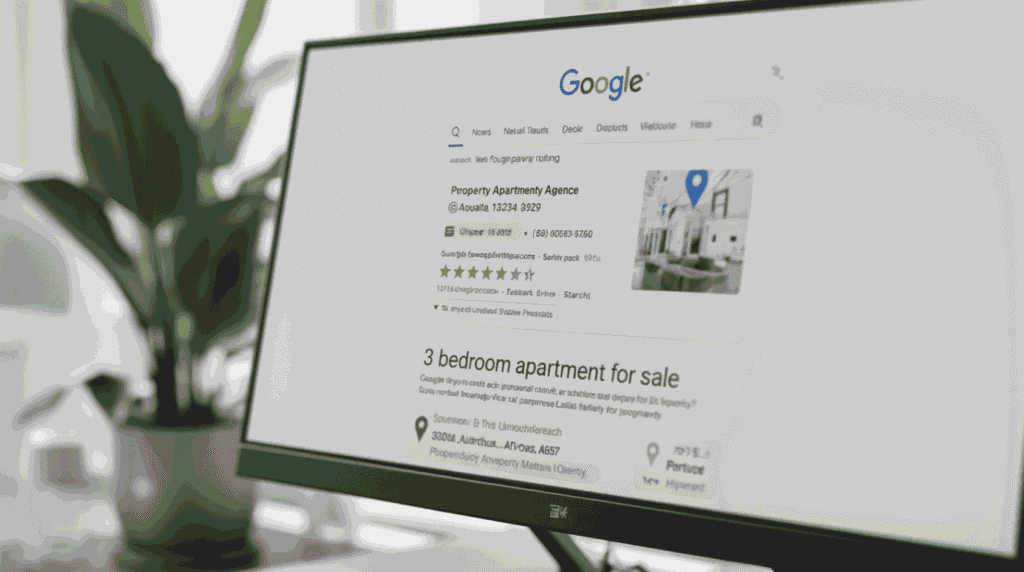
Property listing SEO is the practice of optimizing individual listing pages so they rank in local search results and attract organic traffic from buyers actively searching for properties in specific areas.
Most real estate websites have hundreds or thousands of listing pages — each one a potential organic traffic asset, or a wasted opportunity. The gap between agencies that rank and those that do not comes down to a handful of consistently applied practices.
Keyword-rich property descriptions. Listings with descriptive, keyword-optimized descriptions sell 23% faster. [Source: REsimpli 2025] A listing description that includes the property type, bedroom count, key features, neighborhood name, and proximity to relevant amenities (transport links, schools, landmarks) performs significantly better in both search rankings and buyer engagement than a generic four-line summary.
Structured data markup (Schema). Adding RealEstateListing schema markup to property pages allows Google to display rich information — price, location, property type, availability — directly in search results. This improves click-through rates from search without requiring higher rankings.
Neighborhood and location content. Seventy-eight percent of local real estate searches lead to a phone call, email, or in-person visit within 24 hours. [Source: Google/BrightLocal via searchlab.nl] Agencies that publish dedicated neighborhood guide pages — covering local amenities, transport, schools, and lifestyle — rank for the local intent searches that convert directly to buyer inquiries.
Fast page loading. Fast-loading pages deliver a 30% higher conversion rate for real estate websites. Mobile-first design influences 80% of real estate website traffic. Both are direct technical SEO factors — and both are areas where most agency websites underperform. [Source: REsimpli 2025]
Searches for “real estate agent near me” have increased 41-fold since 2015 — a signal that local search intent has never been more commercially significant for real estate businesses. [Source: Taboola 2025 via taylorscherseo.com]
Our SEO experts can help your listings rank higher in local and international searches through structured technical optimization, keyword-targeted content, and listing page architecture built for both search engines and buyer conversion. Explore our SEO services for more detail on how this applies to real estate businesses specifically.
Real Estate Content Marketing: What to Publish and Why
Real estate content marketing is the creation of genuinely useful content — market reports, neighborhood guides, buyer and seller guides, investment analysis — that builds search visibility and positions your agency as the most credible source of information in your target market.
Real estate companies with active content programmes generate 5.4 times more leads than those without. Content marketing is not a branding exercise — it is a direct commercial channel when executed around buyer search intent. [Source: HubSpot via searchlab.nl]
The content types that generate the strongest results in real estate:
Market reports — monthly or quarterly analysis of price trends, transaction volumes, and days-on-market in your target area. Market reports attract buyers and sellers at the earliest research stage, generate backlinks from property media, and rank well for competitive local search terms.
Neighborhood guides — comprehensive pages covering lifestyle, amenities, schools, transport, and typical price ranges for specific areas. These pages capture the local informational searches that precede property viewing decisions — and convert at a higher rate than generic listing pages because they reach buyers earlier and build more trust.
Buyer and seller guides — step-by-step content covering the purchase or sale process in your specific market, including legal requirements, financing, and typical timelines. In markets like Dubai (where foreign buyers navigate UAE property law) and the UK (where stamp duty and solicitor processes are unfamiliar to international buyers), these guides generate significant search traffic and establish expertise credibility.
Investment analysis content — for markets like Dubai, Lisbon, and Southeast Asia where a high proportion of buyers are investors rather than owner-occupiers, content covering rental yields, capital growth projections, and investment visa requirements attracts a commercially valuable audience that generic listing pages do not reach.
Dubai Real Estate SEO: What the UAE Market Requires

Dubai’s property market has specific digital marketing characteristics that distinguish it from US and UK markets — and require strategy adjustments that generic real estate marketing approaches miss.
Multilingual SEO is commercially significant. Dubai’s buyer base is genuinely international — Russian, Chinese, Indian, and European buyers representing large transaction volumes alongside Gulf national buyers. Arabic-language SEO is essential for reaching UAE national and GCC buyers, but Russian and Chinese-language search optimization delivers material ROI for agencies targeting investor buyers from those markets.
RERA compliance in content. The Real Estate Regulatory Authority (RERA) in Dubai governs how properties are marketed, including requirements for verified permit numbers on listing advertisements. Real estate content and paid social campaigns targeting Dubai properties must incorporate RERA permit numbers to comply with DLD and RERA regulations — a compliance element that affects what can be published on social media and in online listings.
WhatsApp-first buyer communication. Dubai’s real estate market operates with a buyer communication expectation that is notably different from Western markets: WhatsApp Business is the primary channel for inquiry follow-up, viewing scheduling, and document exchange. Social media campaigns that direct to a WhatsApp contact point rather than a website form consistently generate higher inquiry-to-viewing conversion in the UAE market.
Portal optimization alongside direct SEO. Property Finder, Bayut, and Dubizzle dominate property search in the UAE the way Rightmove and Zoopla dominate UK search. Strong Dubai real estate SEO requires both portal listing optimization (titles, descriptions, quality of photos, and response rate) and direct website SEO — the two channels serve different buyer segments and complement each other rather than competing.
Off-plan project marketing. A significant proportion of Dubai property transactions involve off-plan developments. Off-plan marketing has distinct digital requirements: developer-specific landing pages, payment plan content, handover timeline information, and ROI projection content that investor buyers specifically search for.
US Real Estate Digital Marketing: Miami and Austin Markets

US real estate markets are the most competitive in the world for digital marketing — but the structure of what works is well-documented.
Local SEO is the primary organic opportunity. Ninety-three percent of homebuyers use local search to find properties. Google Business Profile optimization, consistent NAP (name, address, phone) citations, and review volume are the three most directly actionable local SEO factors for US agents. Agents in competitive markets like Miami and Austin who rank in the local pack for “real estate agent [city]” type searches generate a disproportionate share of inbound inquiry volume.
Facebook and Instagram dominate US real estate social. Ninety-two percent of US realtors use Facebook for lead generation — the highest platform adoption of any market. Facebook’s real estate advertising capabilities (geographic radius targeting, income and life-event targeting) remain unmatched for US property buyer acquisition.
Video touring expectations are high. The US buyer demographic that emerged post-2020 expects virtual tours, drone footage, and short-form Reels walkthroughs as standard — not premium. Listings in Miami’s luxury condo market and Austin’s tech-sector buyer market without video content underperform measurably against those that include it.
UK Real Estate Digital Marketing: Rightmove, Zoopla, and Beyond
The UK property market’s search behavior is dominated by property portals in a way that differs from most international markets. Rightmove and Zoopla together capture the significant majority of UK property search traffic — and portal presence is effectively non-negotiable for UK agents.
However, portal presence alone is not a digital marketing strategy. The agencies generating qualified buyer inquiries beyond portal traffic are those building:
- Direct website SEO targeting location and property-type searches that portal listing pages do not rank for
- Content covering area guides, buying process explanation, and market analysis that builds direct search traffic independently of portal dependence
- Social media presence (particularly Instagram for lifestyle and property visual content, LinkedIn for commercial property) that generates buyer and investor relationships that portal listings do not create
- Email marketing to past clients and registered buyers — UK property’s typical 6–18 month search cycle makes email nurturing a particularly high-value channel for converting registered interest into transactions
A strong social presence turns property listings into consistent buyer inquiries — and for UK agencies looking to reduce dependence on portal leads, our social media marketing services cover both organic and paid strategy across platforms most relevant to UK property buyer demographics.
Secondary Markets: Portugal, Spain, and Southeast Asia
A real estate digital marketing strategy for emerging markets like Lisbon, Madrid, Vietnam, and Indonesia are attracting significant international buyer interest — and digital marketing for agencies in these markets requires awareness of the specific buyer demographics generating that demand.
Portugal and Spain attract primarily Northern European (UK, German, Dutch, Scandinavian) buyers alongside North American buyers pursuing golden visa or NHR tax regime properties. English-language SEO targeting investment visa, non-habitual resident, and “property for sale [city]” searches in English captures a buyer segment that local-language-only digital marketing misses entirely.
Vietnam and Indonesia are the fastest-growing international property markets in Southeast Asia. Foreign buyer interest in Ho Chi Minh City, Bali, and Batam is driven primarily through social media — Instagram and Facebook — with WhatsApp and WeChat as the primary inquiry channels. Portal infrastructure is less mature than in Western markets, making direct agency social media presence proportionally more important for international buyer acquisition.
Real estate businesses looking to expand digitally in these or other international markets can explore our real estate technology solutions for context on how digital marketing connects with broader PropTech and property platform development.
Key Takeaways
- SEO drives 53% of real estate website traffic — the single highest-volume inbound channel, outperforming paid advertising on ROI over a 12–24 month horizon
- Long-tail keywords drive 70% of real estate search traffic — specific location and property-type searches convert at significantly higher rates than generic terms
- Real estate companies with active content programmes generate 5.4x more leads than those without
- Agents using social media earn four times more than those who do not — 82% of real estate businesses already use it; the gap is in consistency and strategy, not adoption
- Video listings generate 403% more inquiries — short-form vertical video (under 60 seconds) generates 2.5x more social shares than longer-form content
- Listings with descriptive, keyword-optimized descriptions sell 23% faster
- 78% of local searches lead to contact within 24 hours — local SEO is a direct, near-term revenue driver for agencies in location-specific markets
- Dubai requires multilingual SEO (Arabic, Russian, Chinese), RERA compliance in advertising, and WhatsApp-first inquiry handling — generic Western-market strategy underperforms significantly here
- UK digital marketing strategy must go beyond portal dependence — direct website SEO and social media build buyer pipelines that Rightmove and Zoopla listings alone do not generate

Frequently Asked Questions
What is SEO in real estate marketing?
Real estate SEO is the optimization of property websites, listing pages, and content so that buyers searching for properties online find your business in search results. It includes technical website improvements, keyword-targeted listing descriptions, local search optimization, and content that matches how buyers research property markets — covering everything from Google Business Profile to neighborhood guide pages.
What does SEO do in marketing for real estate agencies?
SEO generates organic search traffic — buyers who find your listings and website through search rather than paid advertising or portals. For real estate businesses, this means higher-intent traffic (buyers who searched for exactly what you offer), lower cost per lead over time versus paid channels, and a compounding traffic asset that continues growing as content and domain authority build.
How do you do social media marketing for real estate?
Start with one platform matched to your primary buyer demographic — Instagram for residential and lifestyle, LinkedIn for commercial or investor markets, Facebook for broad US residential. Post a consistent mix of listing content, market insight, local area content, and video tours. Add paid amplification behind high-performing organic posts. Respond to every comment and DM promptly — social media conversion in real estate is heavily determined by response speed.
Is SEO paid or free for real estate websites?
The traffic SEO generates is not paid per click. However, achieving rankings requires investment in technical optimization, keyword research, content creation, and link building. Most real estate agencies work with an SEO service provider or allocate internal resource to content and technical work. SEO compounds over time — unlike paid advertising, a well-optimized property website continues generating leads without ongoing per-click spend.
How much should real estate agents spend on digital marketing?
Most US real estate agents spend between $100 and $499 monthly on digital marketing — a figure that represents the floor, not a benchmark for competitive markets. Agencies in high-value markets (Dubai, Miami, London) investing $2,000–$10,000+ monthly in combined SEO, content, and paid social see proportionally stronger return on higher-value transactions. The right budget depends on average transaction value, market competition, and which channels the agency’s buyer demographic uses most.
What are the four types of SEO for real estate websites?
Technical SEO (site speed, mobile optimization, schema markup for listings), on-page SEO (keyword-rich descriptions, title tags, meta descriptions), local SEO (Google Business Profile, location landing pages, citation consistency), and off-page SEO (backlinks from property media and directories that build domain authority). All four are required for competitive real estate markets — focusing on one while ignoring others produces partial results.
What makes Dubai real estate SEO different from US or UK markets?
Dubai requires multilingual optimization across Arabic, Russian, and Chinese to reach the full buyer demographic. RERA compliance governs what can be advertised online (permit numbers required). WhatsApp Business is the primary buyer communication channel rather than email forms. And portal optimization on Property Finder and Bayut matters as much as direct website SEO — the two channels serve different buyer segments and should be managed in parallel.
What social media marketing mistakes do real estate agencies make most often?
Posting listings exclusively (without market insight, neighborhood content, or local stories), inconsistent posting cadence that loses algorithm visibility, no video content despite video generating 403% more inquiries than text listings, no paid amplification on strong organic posts, and no local content strategy that positions the agent as a genuine neighborhood expert rather than a listing aggregator.
Ready to grow your real estate business with SEO, social media, or digital strategy that actually generates buyer inquiries?
Our SEO services and social media marketing services are built for agencies and developers competing in high-demand property markets — from Dubai to Miami to the UK.