
TL;DR: Cloud solutions for energy and environmental businesses are no longer a future investment — they are the operational backbone of every utility, renewable energy firm, and sustainability-driven organization competing in 2026. The energy cloud market reached $12.68 billion in 2026 and is projected to hit $40.76 billion by 2035, growing at 13.8% CAGR. This guide breaks down every use case, real platform costs, the top cloud providers for energy, and why on-premise systems are losing the race.
Large urban energy networks generate over 400 GB of data per day — from smart meters, sensors, substations, wind turbines, and solar arrays feeding data continuously into systems that have to make decisions in milliseconds. [Source: marketgrowthreports.com/market-reports/energy-cloud-market-102642]
Legacy on-premise systems were not built for this. They were built for a world where a utility managed a handful of large power plants and monthly meter readings. That world no longer exists.
Over 70% of utility companies globally have already integrated cloud computing technology — proving that cloud computing for energy sector adoption is no longer early-stage, according to 2025 market data. Cloud-based analytics now represent approximately 46% of all energy sector deployments — and that share is growing faster than any other infrastructure category in the sector. [Source: globalgrowthinsights.com/market-reports/energy-cloud-market-110757]
This guide is for the utility companies, renewable energy developers, grid operators, environmental consultancies, and sustainability-focused organizations that want a clear, practical picture of what cloud solutions actually deliver — and what it costs to deploy them right.
What Is a Cloud Solution and How Does It Apply to Energy Businesses?
A cloud solution is a software platform, infrastructure service, or application delivered over the internet from remote servers — rather than hosted on physical hardware owned and managed by the organization using it.
For energy and environmental businesses specifically, cloud solutions replace or supplement:
- On-premise SCADA systems — with cloud-based grid monitoring platforms that process data from thousands of distributed sensors simultaneously
- Local data warehouses — with scalable cloud storage that handles petabytes of smart meter and IoT data without capacity planning headaches
- Manual maintenance scheduling — with predictive maintenance cloud solutions that use machine learning to flag equipment failures before they happen
- Static sustainability reports — with real-time sustainability data management software that automates carbon tracking, regulatory filing, and ESG reporting
The four main types of cloud services that energy businesses deploy are:
- IaaS (Infrastructure as a Service) — raw compute, storage, and networking (AWS, Azure, Google Cloud) for running energy analytics workloads
- PaaS (Platform as a Service) — developer environments for building custom energy management applications
- SaaS (Software as a Service) — ready-to-use energy management cloud platforms, carbon footprint tracking software, and grid analytics tools
- IoT and Edge Cloud — processing sensor and smart meter data at the network edge before sending aggregated results to the central cloud
What is the difference between cloud and SaaS? In the energy sector specifically: cloud infrastructure (IaaS/PaaS) is the foundation your team builds on; SaaS is the finished application your operations team uses without managing the underlying infrastructure. Most energy organizations use both — a SaaS energy management platform on top of cloud infrastructure, with custom applications built on PaaS for proprietary workflows.
How Does Cloud Computing Help Energy Companies?
Cloud computing helps energy companies in five measurable, operational ways that directly impact cost, reliability, and sustainability performance.
1. Real-Time Grid Monitoring at Scale Cloud-based grid monitoring platforms process data from smart meters, substations, and distributed energy resources simultaneously. Where on-premise systems batch-process data on hourly or daily cycles, cloud platforms handle streaming data in real time — enabling operators to detect anomalies, prevent outages, and balance load dynamically. Smart grid deployments utilizing cloud platforms have surged to over 180 million smart meters globally, with the US alone projected to manage over 1.5 billion smart meter data points annually by 2026. [Source: marketgrowthreports.com/market-reports/energy-cloud-market-102642]
2. Predictive Maintenance That Prevents Failures Predictive maintenance cloud solutions use machine learning models trained on historical equipment data — vibration patterns, temperature readings, electrical load signatures — to identify failure precursors days or weeks before a breakdown occurs. Cloud infrastructure enables these models to train on the full asset fleet rather than individual equipment, dramatically improving prediction accuracy. AI-driven cloud solutions are reducing operational costs by approximately 15–20% per enterprise annually through predictive maintenance and operational optimization alone. [Source: industryresearch.biz/market-reports/energy-cloud-market-104583]
3. Renewable Energy Integration and Forecasting Managing solar and wind generation requires forecasting models that account for weather patterns, grid demand, and storage capacity simultaneously. Cloud platforms connect meteorological data, satellite feeds, and grid sensor data into unified forecasting systems that optimize renewable dispatch and grid stability. Renewable energy integration is the fastest-growing application in the energy cloud market, projected at a 20.1% CAGR through 2032. [Source: marketresearchfuture.com/reports/energy-cloud-market-30290]
4. Sustainability Data Management and Reporting Sustainability data management software on cloud platforms aggregates emissions data, energy consumption metrics, and carbon offset records from across an organization’s entire operation — automating the compilation of reports required for GHG Protocol compliance, CDP disclosure, SEC climate rule filings, and net-zero commitments. What previously required a team of sustainability analysts weeks to compile manually now runs automatically on a scheduled cadence.
5. IoT and Cloud Integration for Distributed Assets IoT and cloud for utilities enables remote management of geographically distributed assets — offshore wind turbines, solar farms across multiple states, pipeline monitoring stations — without requiring physical site visits for data collection. Cloud integration with IoT sensor networks reduces field operations costs and enables centralized monitoring of assets that would otherwise be impractical to supervise continuously.
What Are the Four Main Types of Cloud Services?
The four main cloud services are IaaS, PaaS, SaaS, and IoT/Edge Cloud. Each serves a distinct role in energy infrastructure:
- IaaS provides the raw compute power for running large-scale grid analytics and training machine learning models on energy data
- PaaS provides the development environment for building custom energy management applications on top of cloud infrastructure
- SaaS delivers ready-to-use platforms for carbon footprint tracking, grid monitoring, and demand response management
- IoT and Edge Cloud handles the real-time data processing challenge at the sensor level — reducing latency and bandwidth costs by processing locally before sending aggregated data to the central cloud
Most energy enterprises operate on a hybrid model: SaaS for standard functions, cloud IaaS for compute-intensive analytics, and edge computing for time-critical grid operations where millisecond latency matters.
Who Are the Top Cloud Providers for Energy Businesses?
Who Are the Top 3 Cloud Providers — and Who Is Number One?
The top 3 cloud providers globally in 2026 are AWS, Microsoft Azure, and Google Cloud Platform — in that order by market share. AWS (Amazon Web Services) remains the global market leader in cloud infrastructure, holding approximately 31–33% of global cloud market share in 2026. AWS is larger than Google Cloud in total revenue, though Google Cloud is growing faster in some sectors.
Who Are the Big 4 Cloud Providers?
The four major cloud service providers dominating enterprise deployments in 2026 are:
- Amazon Web Services (AWS) — largest global share, strongest IaaS ecosystem, AWS IoT Core for energy sensor management
- Microsoft Azure — second largest, strongest enterprise integration, Azure IoT Hub and Azure Energy data platform
- Google Cloud Platform (GCP) — third, strongest AI/ML capabilities, partnerships with Siemens Energy for grid management
- Oracle Cloud — strong in utilities-specific ERP and customer information systems
AWS vs Google Cloud — Which Is Bigger?
AWS is significantly larger in total revenue and infrastructure scale. However, Google Cloud has established specific advantages in AI/ML workloads and renewable energy analytics. In February 2025, Siemens Energy and Google Cloud partnered to develop AI-enabled grid management systems for renewable integration and predictive maintenance — a signal of GCP’s growing energy sector focus. [Source: openpr.com/news/4506869]
Why Are People Moving Away From AWS?
Some energy organizations are diversifying away from single-vendor AWS dependency for three reasons: multi-cloud resilience (avoiding a single point of failure for critical grid systems), cost optimization (competing vendor pricing for specific workloads), and data sovereignty (EU and Middle East regulations requiring in-country data hosting that AWS cannot always satisfy). This is not an exodus — it is a maturation toward intentional multi-cloud strategy.
What Are the Most Popular Cloud Platforms for Energy?
Beyond the big four, energy-specific platforms gaining significant adoption include:
- Microsoft Azure Energy Data Services — purpose-built for oil and gas OSDU data management
- GE Vernova’s grid software on AWS — signed partnership in March 2025 for utility analytics
- Hitachi Energy and AWS — AI-driven cloud-based energy management announced March 2025
- IBM Environmental Intelligence Suite — sustainability data management and climate analytics
- Schneider Electric EcoStruxure — energy management cloud platform for utilities and industrial facilities
Can Cloud Reduce Operational Costs for Utility Companies?
Yes — and the data is specific enough to build a business case from.
Cloud computing integration improves energy infrastructure performance by 20% through better smart grid management and predictive analytics, according to industry analysis. [Source: globalgrowthinsights.com] The elimination of on-premise server hardware, data center facilities, and local IT maintenance staff alone typically reduces infrastructure operating costs by 30–40% for utility organizations migrating from purely on-premise systems.
Here’s the direct cost comparison:
| Cost Factor | On-Premise System | Cloud Solution |
|---|---|---|
| Upfront Capital Cost | High — servers, data centers, network hardware | Low to zero — operating expense only |
| Scalability Cost | Capacity planning required, over-provisioning common | Pay-as-you-go scaling with no over-provisioning |
| Maintenance | Internal IT team required, ongoing hardware refresh | Vendor-managed, included in subscription |
| Data Processing Speed | Batch processing, hours to days for large datasets | Real-time streaming analytics on petabyte-scale data |
| Disaster Recovery | Expensive secondary site required | Built-in geo-redundancy, no secondary site needed |
| Software Updates | Manual, disruptive, version lock-in risk | Continuous, automatic, backward-compatible |
| Cybersecurity | Internal team responsible for all patches | Shared responsibility model, enterprise security included |
| Remote Access | VPN-dependent, limited to on-premise connection | Secure global access from any device |
Our team worked with a mid-size independent power producer operating wind and solar assets across three countries. They were running a patchwork of on-premise systems — a legacy SCADA installation for grid monitoring, a separate server environment for financial reporting, and manual spreadsheet-based sustainability reporting that consumed two full-time analyst roles quarterly. We migrated their operational data infrastructure to a hybrid cloud environment: cloud-based grid monitoring integrated with their existing SCADA edge devices, a unified energy management cloud platform for asset performance tracking, and automated carbon footprint tracking software feeding directly into their annual CDP disclosure.
Total infrastructure operating costs dropped 34% in the first year. The sustainability reporting cycle that previously took six weeks of manual work now runs as an automated monthly report. The team reallocated their two sustainability analysts to strategy and investor relations work that actually required human judgment.
What Is Cloud-Based Sustainability Reporting?
Cloud-based sustainability reporting is the automated collection, processing, and presentation of environmental performance data — emissions, energy consumption, water usage, waste metrics — directly from operational systems, without manual data compilation.
In 2026, this matters for three specific reasons:
Regulatory Pressure The SEC’s climate disclosure rule requires US-listed companies to report Scope 1, Scope 2, and certain Scope 3 emissions in annual filings. The EU’s Corporate Sustainability Reporting Directive (CSRD) extends similar requirements to large EU-based companies and their subsidiaries globally. Manual sustainability reporting cannot produce the data consistency and audit trail these frameworks require.
Investor Expectations ESG-focused investors and rating agencies (MSCI, Sustainalytics, CDP) now require annual sustainability disclosures with verifiable underlying data. Organizations using manual reporting processes consistently produce less accurate, less timely, and less credible disclosures — a direct impact on ESG ratings and capital access.
Operational Value Beyond compliance, real-time sustainability data management software enables energy and environmental businesses to identify consumption inefficiencies, track progress against net-zero targets, and optimize energy procurement — turning the compliance burden into an operational intelligence tool.
Popular cloud solutions for sustainability reporting in 2026 include IBM Environmental Intelligence Suite, Salesforce Net Zero Cloud, Microsoft Sustainability Manager, and SAP Sustainability Control Tower. For organizations with complex, proprietary sustainability data structures, custom sustainability data management software development delivers better integration depth and reporting flexibility than any off-the-shelf tool.
How Much Does a Cloud Energy Management Platform Cost?
Cost depends on deployment scale, number of assets being monitored, and whether the organization is adopting a SaaS platform or commissioning custom cloud development.
SaaS Subscription Platforms
| Platform Type | Monthly Cost Range | Best For |
|---|---|---|
| Grid Monitoring SaaS | $2,000 – $20,000/month | Utilities, grid operators |
| Predictive Maintenance Cloud Platform | $1,500 – $15,000/month | Asset-heavy energy operators |
| Carbon Footprint Tracking Software | $500 – $8,000/month | Any energy or environmental organization |
| Full Energy Management Cloud Platform | $5,000 – $50,000/month | Large utilities, multi-site operators |
| IoT Data Ingestion and Analytics | $1,000 – $10,000/month | Renewable energy developers |
Custom Cloud Development for Energy
| Build Type | Cost Range | Timeline |
|---|---|---|
| Custom Grid Monitoring Dashboard | $30,000 – $100,000 | 8 – 16 weeks |
| Predictive Maintenance ML Platform | $80,000 – $300,000 | 3 – 8 months |
| Sustainability Reporting Automation | $40,000 – $150,000 | 10 – 20 weeks |
| Full Cloud Energy Management Platform | $150,000 – $600,000+ | 6 – 18 months |
| IoT + Cloud Integration for Utilities | $50,000 – $200,000 | 12 – 24 weeks |
FinOps discipline — systematic optimization of cloud resource usage — commonly unlocks 20–35% cost savings on cloud infrastructure through rightsizing, scheduling, and commitment planning. [Source: datastackhub.com/insights/cloud-computing-statistics] For energy organizations running large analytics workloads, this is a material budget item worth building into the deployment plan from day one.
Best Cloud Tools for Renewable Energy Monitoring in 2026?
Renewable energy monitoring requires platforms that handle intermittent generation data, weather correlation, and multi-asset aggregation simultaneously.
Top cloud tools for renewable energy monitoring:
- Azure IoT Hub + Azure Synapse Analytics — strong for large-scale data ingestion from wind and solar sensor arrays, with built-in ML model training
- AWS IoT Greengrass + Amazon Timestream — edge processing for remote renewable sites, time-series database optimized for energy sensor data
- GCP Cloud IoT Core + BigQuery — strongest AI/ML capabilities for generation forecasting, particularly for weather-correlated solar and wind prediction
- Siemens Simcenter — simulation and performance monitoring for wind turbines, now cloud-native
- AVEVA PI System (on cloud) — widely deployed in renewable energy for real-time operational data management
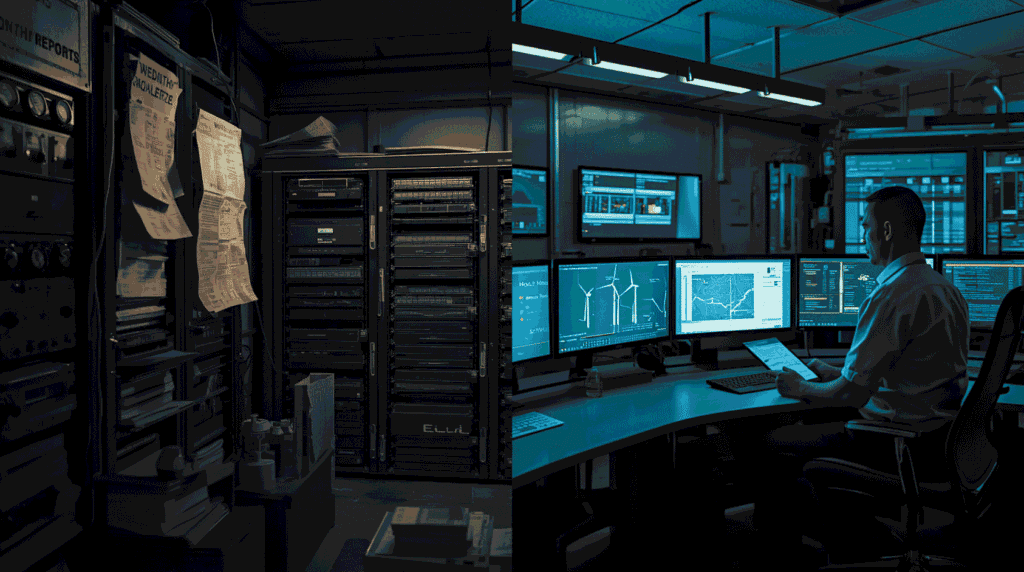
Our team built a custom cloud-based renewable energy monitoring platform for a solar and wind developer managing 14 generation sites across the Middle East and Southeast Asia. They needed unified visibility across all 14 sites — different equipment manufacturers, different monitoring protocols, different data formats — in one operational dashboard. We built a cloud-native IoT integration layer that normalized data from six different sensor formats, fed it into a real-time cloud dashboard, and connected generation data directly to their sustainability reporting pipeline. Site performance deviations that previously went undetected for days were now flagged within 15 minutes. Generation efficiency improved 8% in the first six months through early anomaly detection alone.
Is AI Replacing Cloud Computing? Which Is Better — Cloud or AI?
This is one of the most common questions energy technology teams are asking in 2026 — and it reflects a fundamental misunderstanding.
Which is better — cloud or AI? That framing misunderstands both. AI and cloud are not competing technologies. AI runs on cloud infrastructure. Every large-scale AI application in the energy sector — predictive maintenance models, generation forecasting algorithms, demand response optimization — requires cloud compute power to train and cloud infrastructure to deploy at scale.
The more accurate question is: how much of energy operations will be AI-automated, running on cloud infrastructure, versus operated manually? The answer is increasingly: the majority of routine operational decisions.
Is cloud computing declining? No. Global cloud spending is climbing toward $900 billion annually. [Source: datastackhub.com] The energy sector’s cloud adoption is accelerating, not reversing. Are people moving away from cloud storage? Also no — the question reflects concerns about specific vendor lock-in, not a reversal of cloud adoption. Multi-cloud strategies are growing, which distributes workloads across providers rather than abandoning cloud entirely.
Will we ever run out of cloud storage? The major providers — AWS, Azure, GCP — continue to expand data center capacity aggressively. Cloud storage is elastic by design. The constraint in energy cloud deployments is not storage capacity but bandwidth and latency at the edge — which is why hybrid cloud and edge computing architectures are becoming the dominant deployment model for utilities with geographically distributed assets.
What Are the Risks of Using Cloud Services in Energy?
Cloud adoption in the energy sector carries specific risks that on-premise deployments handle differently:
Cybersecurity Nearly 32% of energy firms report security breaches linked to legacy SCADA-connected systems and cloud integration gaps. Ransomware and state-sponsored campaigns targeted 47 major North American utilities and pipelines in 2024 alone, a 38% increase from the prior year. [Source: mordorintelligence.com/industry-reports/cloud-security-in-energy-sector-industry] Cloud deployments need zero-trust architecture, network segmentation between OT and IT systems, and continuous threat monitoring.
Data Sovereignty Regulations in the EU, Middle East, and parts of Asia require energy operational data to be stored within national borders. Public cloud providers offer sovereign cloud options, but this adds cost and sometimes limits feature availability compared to standard cloud regions.
Connectivity Dependency Cloud-dependent systems require reliable internet connectivity. For remote renewable energy sites in regions with unreliable connectivity, edge computing and offline-capable system design are essential components of any cloud architecture.
Vendor Lock-in Proprietary data formats and APIs can make it expensive to migrate from one cloud provider to another. Multi-cloud and cloud-agnostic architecture strategies mitigate this risk — worth building into the design phase, not retrofitting after deployment.
Multi-Region Considerations for Cloud Energy Solutions
United States
The US is the largest single market for cloud solutions in the energy sector, driven by smart grid modernization funded by the Infrastructure Investment and Jobs Act and accelerating renewable integration. NERC CIP (Critical Infrastructure Protection) standards govern cybersecurity requirements for cloud deployments touching bulk power system operations. FERC Order 881 requires utilities to use ambient-adjusted transmission ratings — a data-intensive requirement that favors cloud-based analytics infrastructure. Over 500 US utility companies are projected to deploy energy cloud technologies by 2027, handling more than 1.2 billion smart meter data points annually. [Source: industryresearch.biz]
European Union
The EU Green Deal and the CSRD are the primary regulatory drivers of cloud adoption for European energy and environmental businesses. GDPR applies to all customer energy data. The EU AI Act classifies AI systems used in critical infrastructure as high-risk, requiring additional governance for AI-powered grid monitoring and predictive maintenance tools. Germany and the UK lead European cloud adoption in the energy sector, accounting for approximately 32% of the EU’s total energy cloud market share.
Middle East and Asia
The UAE’s Clean Energy Strategy 2050 and Saudi Vision 2030 both prioritize digital infrastructure for energy management — creating significant demand for cloud-based grid monitoring and sustainability reporting platforms. The Asia-Pacific region is the fastest-growing market for cloud computing in energy, with India recording particularly rapid adoption driven by smart grid investment and aggressive renewable capacity additions. Regional data residency requirements vary significantly — organizations deploying across multiple Asian markets should architect for country-specific cloud regions from day one.
For organizations building green cloud computing solutions — workloads powered by renewable energy or designed to minimize carbon intensity — major providers have committed to 100% renewable energy on aggressive timelines. Carbon-aware scheduling, which places workloads in cloud regions powered by cleaner grid electricity, can reduce compute-related emissions by double-digit percentages without performance trade-offs. [Source: datastackhub.com]
Our custom AI and cloud development services cover end-to-end cloud architecture for energy and environmental businesses — from IoT integration and grid monitoring dashboards to predictive maintenance platforms and automated sustainability reporting pipelines, built with the compliance requirements of each target region as a foundation.
Frequently Asked Questions: Cloud Solutions for Energy and Environmental Businesses
What is a cloud solution in the context of energy businesses?
A cloud solution for energy businesses is a software platform or infrastructure service — delivered over the internet — that replaces or supplements on-premise systems for grid monitoring, asset management, predictive maintenance, sustainability reporting, and energy analytics. Examples include cloud-based SCADA alternatives, energy management cloud platforms, carbon footprint tracking software, and IoT-integrated renewable energy monitoring systems.
What are examples of cloud solutions used in the energy sector?
Examples include: AWS IoT Greengrass for remote renewable asset monitoring, Microsoft Azure Energy for grid analytics, GE Vernova’s utility analytics platform on AWS, Hitachi Energy’s AI-driven asset management on AWS, Siemens Energy’s grid management system on Google Cloud, IBM Environmental Intelligence Suite for sustainability reporting, and custom-built cloud energy management platforms for organizations with proprietary workflows.
What are the top 5 cloud technologies used in energy?
In 2026: IoT data platforms (AWS IoT, Azure IoT Hub, GCP Cloud IoT), time-series databases (Amazon Timestream, InfluxDB on cloud), cloud-native machine learning (Azure ML, AWS SageMaker, Google Vertex AI), real-time streaming analytics (Apache Kafka on cloud, Azure Stream Analytics), and cloud-based SCADA/HMI alternatives for grid operations.
What are the five most common uses of cloud computing in energy?
Real-time grid monitoring and anomaly detection, predictive maintenance for generation and distribution assets, renewable energy forecasting and dispatch optimization, sustainability data management and automated ESG reporting, and customer energy management platforms for demand response programs.
Is AI replacing cloud computing in the energy sector?
No. AI runs on cloud infrastructure — the two are complementary, not competitive. Every AI-powered grid management or predictive maintenance system in the energy sector depends on cloud compute for training, deployment, and real-time inference. The correct framing is that AI is increasing the value that cloud infrastructure delivers, not replacing it.
Are people moving away from cloud storage?
Not away from cloud storage as a concept — but toward multi-cloud strategies that distribute workloads across AWS, Azure, and Google Cloud rather than concentrating on a single vendor. This reduces vendor lock-in risk and optimizes costs by matching workload types to the provider with the strongest capability or pricing for that specific use.
What are the risks of using cloud services for energy companies?
The primary risks are cybersecurity (SCADA-cloud integration gaps are the most commonly exploited attack surface), data sovereignty compliance (regulations requiring in-country data hosting), connectivity dependency for remote assets, and vendor lock-in through proprietary data formats. All four are manageable with proper architecture — but require intentional design from the start, not remediation after deployment.
What is green cloud computing for businesses?
Green cloud computing refers to deploying workloads on cloud infrastructure powered by renewable energy and designed to minimize compute-related carbon emissions. Major providers (AWS, Azure, GCP) have committed to 100% renewable energy targets. Carbon-aware scheduling — placing workloads in cloud regions operating on cleaner grid electricity — can reduce computing emissions by meaningful percentages without performance trade-offs. For sustainability-focused energy and environmental organizations, it directly aligns the IT infrastructure footprint with the organization’s own emissions targets.
Final Verdict: Should Energy and Environmental Businesses Move to Cloud in 2026?
The energy cloud market grew from $8.98 billion in 2025 to $12.68 billion in 2026 — that is not a market debating whether to adopt cloud. That is a market deep into execution.
The organizations still running fully on-premise energy management systems in 2026 are not avoiding risk. They are carrying the highest risk: the risk of data infrastructure that cannot handle the volume of distributed generation and smart grid data the energy transition produces, the risk of sustainability reporting that cannot satisfy regulatory requirements at the pace those requirements are tightening, and the risk of maintenance strategies that wait for failures instead of preventing them.
Cloud solutions for energy and environmental businesses are not a technology upgrade. They are the operational foundation that makes everything else — renewable integration, grid modernization, net-zero compliance, and competitive efficiency — possible at the scale 2026 demands.
For energy businesses, utilities, and environmental organizations ready to build or migrate, our custom software development and cloud integration services cover the full stack. For organizations that also need digital visibility and lead generation through organic search, our SEO services are designed for the specific competitive landscape of B2B energy technology buyers.
“The energy companies that will lead the next decade are not the ones with the most generation capacity. They are the ones with the best data infrastructure to manage it.”