
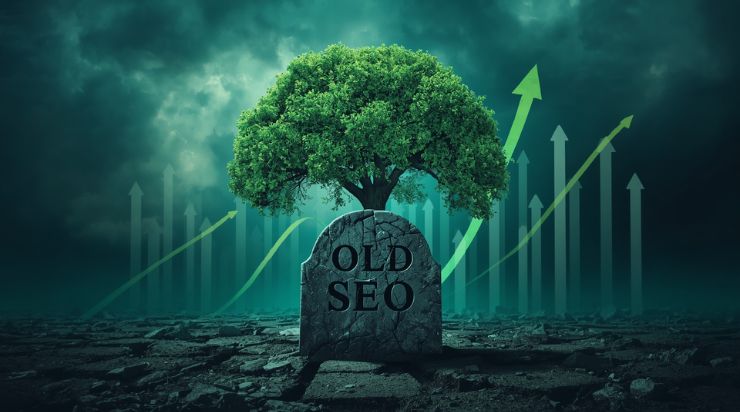
TL;DR: No, SEO is not dead. But the old way of doing it? That’s done. Organic search still drives 53% of all website traffic. Google still controls 89% of U.S. web searches. What’s changed is how you win. In 2026, SEO rewards real expertise, fast websites, and content built for humans — not algorithms. This guide breaks down exactly what’s working now.
Every few months, someone publishes a headline that SEO is finally, officially, completely dead.
It happened after Google’s Panda update. Then Penguin. Then RankBrain. Then BERT. Then Helpful Content. Now it’s AI Overviews and ChatGPT stealing clicks.
And every single time, the same thing happens.
The people who panicked lost traffic. The people who adapted grew.
So let’s cut through the noise with actual data. Is SEO dead in 2026, or just evolving?
What Does the Data Actually Say?
Let’s start with facts, not feelings.
A comprehensive analysis by Graphite and Similarweb — covering over 40,000 of the largest websites in the U.S. — found that organic search traffic declined by just 2.5% year-over-year in 2025. Not 25%. Not 60%. Two point five percent.
The doom headlines were wildly exaggerated.
Meanwhile, here’s what’s really happening:
- Organic search still delivers 53% of all website traffic — more than paid, social, and email combined
- The SEO services market hit $83.9 billion in 2026 and is growing at 12% per year
- The median ROI on SEO investment is 748% — roughly $22 back for every $1 spent
- Google still controlled 89% of all U.S. web traffic in 2025
That is not a dead industry. That’s one of the most profitable marketing channels on the planet.
So why does it feel like SEO is struggling?
Because one part of SEO is dying. And that part deserves to die.
What Part of SEO Is Actually Dead?
Here’s the honest answer: old-school, lazy SEO is dead.
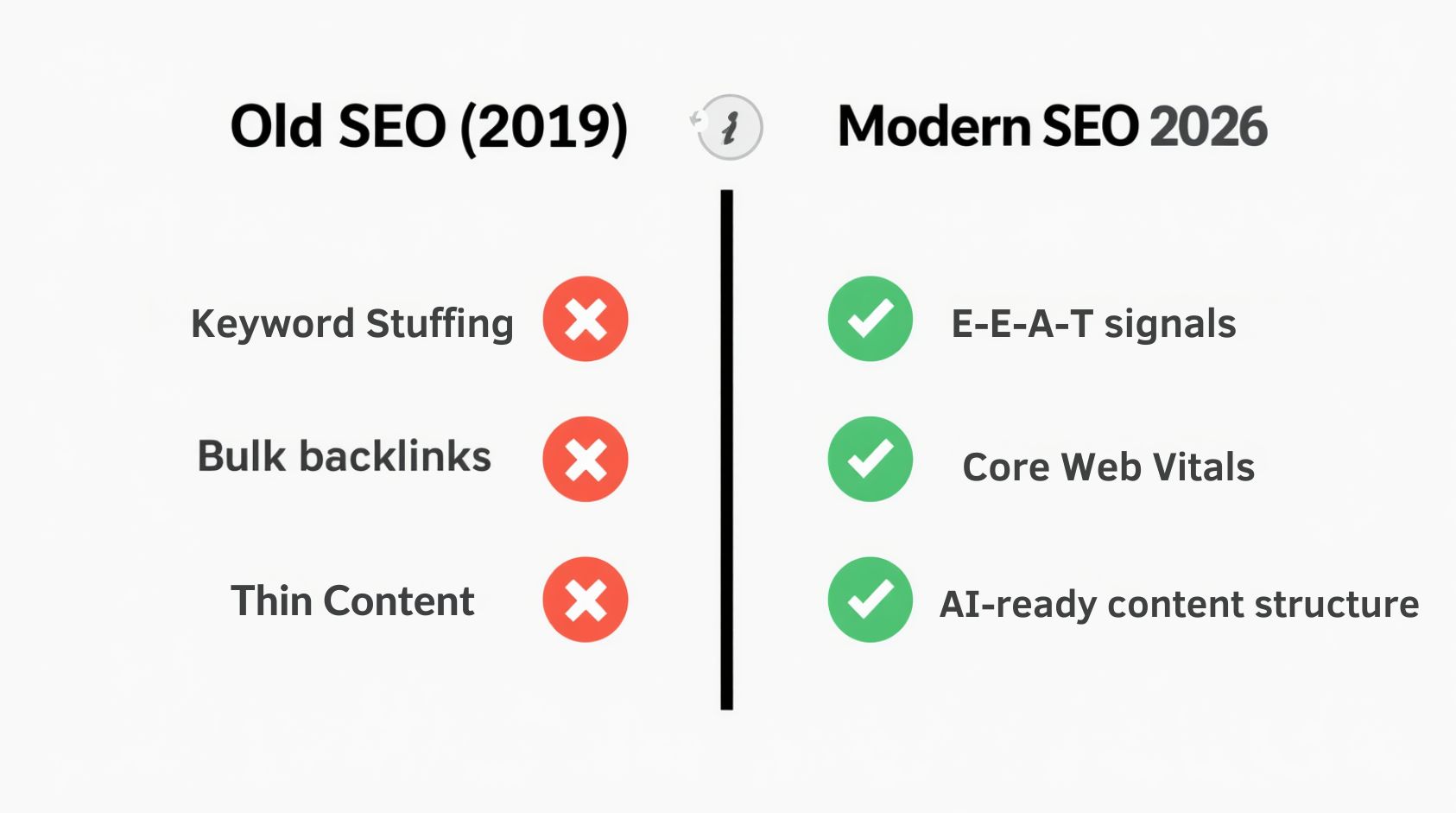
The tactics that used to work five years ago — keyword stuffing, thin content, buying backlinks in bulk, writing for crawlers instead of humans — those are finished.
Google’s algorithm now changes over 12 times per day. It’s gotten exceptionally good at detecting when content exists to game a ranking versus when it genuinely helps someone.
What no longer works:
- Publishing 500-word “articles” stuffed with a keyword 30 times
- Building hundreds of low-quality backlinks overnight
- Targeting broad, high-volume keywords with zero topical authority
- Copying competitor content and paraphrasing it slightly
- Ignoring Core Web Vitals and page speed
The businesses losing traffic right now are almost entirely running these outdated playbooks. They’re not victims of AI. They’re victims of not evolving.
Is Google Still Worth Optimizing For?
Yes. Absolutely yes.
Even with the rise of ChatGPT, Perplexity, and AI Overviews, Google processes an estimated 8.5 billion searches per day. That number has not dropped.
What changed is how some of those searches resolve. AI Overviews now appear on roughly 13.14% of queries. For informational, top-of-funnel questions, these AI answers reduce clicks. That’s real.
But for transactional and commercial queries — the ones that actually drive business — organic results still dominate.
According to Ahrefs, organic search leads convert at 14.6%, nearly four times the rate of paid search at 3.75%. And the average cost per lead from organic is $14 versus $44 from PPC.
So not only is SEO still working. It’s still cheaper and converting better than paid ads.
In my experience working on client sites, the businesses panicking about AI Overviews were mostly publishing generic informational content. The ones growing were focusing on commercial intent, building genuine topical authority, and creating content that AI tools actually cite as a source.
How Has Google's Algorithm Changed in 2026?
Google’s current algorithm is more sophisticated than anything we’ve seen before.
The key pillars Google is now evaluating:
1. E-E-A-T (Experience, Expertise, Authoritativeness, Trustworthiness)
This is Google’s framework for determining if your content is worth ranking. After the 2024 Helpful Content system became fully integrated into core ranking, E-E-A-T signals became the deciding factor for competitive keywords.
What this means practically:
- Who wrote the content matters (author bio, credentials, social proof)
- First-hand experience beats third-hand aggregation
- Your site’s overall topical authority affects individual page rankings
- Trust signals (HTTPS, accurate contact info, clear policies) carry real weight
2. User Signals and Engagement
Google tracks how users interact with your page after clicking. High bounce rates, short dwell time, and users immediately going back to search are negative signals.
This means your content quality and UX directly impact your rankings — not just on-page optimization.
3. Core Web Vitals
Page speed, visual stability, and interactivity are now ranking factors. A technically broken site with great content can still get outranked by a faster, better-built competitor.
4. Helpful Content at Scale
Google’s Helpful Content system now evaluates your entire site, not just individual pages. If you have a lot of thin, low-value content, it drags down your quality site scores overall.
Traditional SEO vs. Modern SEO: What's Changed?
Here’s a direct comparison of old versus new SEO practices. Use this as your checklist:
| Factor | Traditional SEO (Pre-2023) | Modern SEO (2026) |
|---|---|---|
| Content Goal | Rank for keywords | Satisfy user intent completely |
| Content Length | Word count targets (e.g., 2,000 words) | Whatever fully answers the query |
| Keyword Use | Exact-match density focus | Natural, semantic, topical clusters |
| Backlinks | Volume of links | Quality, relevance, and authority of links |
| Author | Anonymous or generic byline | Verified expert with credentials and bio |
| Technical SEO | Meta tags and sitemaps | Core Web Vitals, structured data, crawl efficiency |
| Content Freshness | Publish and forget | Regular updates and content audits |
| Success Metric | Keyword rankings and traffic | Rankings + conversions + revenue attribution |
| AI Readiness | Not a consideration | Optimize for AI Overviews and LLM citations |
| Topical Authority | Target individual keywords | Build full topic clusters and content hubs |
What Is "Search Everywhere Optimization" and Why It Matters?
This is the phrase Neil Patel and most senior SEO strategists are using in 2026. It captures a real shift.
Google is no longer the only search engine people use.
- ChatGPT has over 800 million weekly active users and now surfaces web results
- TikTok functions as a search engine for Gen Z
- Amazon is a product search engine used for purchase intent
- YouTube is the world’s second-largest search engine
- Perplexity AI is growing rapidly as an alternative to Google for research queries
A survey from Mango Thrive found that around 3 in 4 American respondents search with AI weekly. Another study by NN Group found that people use AI to explore and synthesize information — but they still go to traditional search to fact-check.
The takeaway? Users are everywhere. Your strategy needs to be everywhere too.
This doesn’t mean abandoning Google SEO. It means layering on:
- YouTube content with optimized titles and descriptions
- Building brand presence so AI tools cite you as a source
- Creating content structures (FAQs, data, original research) that AI Overviews pull from
- Optimizing your Google Business Profile for local intent
- Building authority on LinkedIn for B2B keyword discovery
For businesses like IT service companies and software development agencies, this multi-platform presence is now a competitive advantage, not a nice-to-have. We cover this in more depth in our guide to professional SEO services in 2026.
A Personal Look at What Actually Changed
When I look back at client sites we’ve worked on at Zatiq Sol, the pattern is clear.
In early 2024, we had a service-based client ranking on page 2 for their primary commercial keyword. Traffic was stagnant. They were doing everything the old checklist said: keyword-optimized meta tags, decent content, some backlinks.
We shifted strategy completely. We built a full content cluster around their service topic — a pillar page, five supporting posts, internal linking across all of them, and author bios with genuine credentials. We also improved their page speed score from 54 to 89 on mobile.
Within four months, they moved from position 14 to position 4 for their primary keyword. Organic enquiries went up 63%.
Nothing about that success came from a meta description tweak or keyword stuffing. It came from building real topical authority and making Google trust the site.
That’s the new SEO.
Pro Tip: If your SEO strategy hasn’t changed since 2022, it’s not just outdated — it’s actively working against you. Google now penalizes what it used to reward.
Does AI Kill SEO Traffic?
Partially, yes. But not in the way most people think.
AI Overviews are associated with a 58% lower average click-through rate for the top-ranking organic page when they appear. That’s a big number.
But they only appear on 13.14% of all queries. And they don’t appear much on transactional, local, or high-intent commercial searches.
Here’s the real breakdown of how AI affects different query types:
- Informational queries (how-to, what is, definitions): High AI Overview impact. Clicks down 30–61%
- Navigational queries (brand searches, specific sites): Minimal AI impact
- Transactional queries (buy, hire, get a quote, best service for X): Low AI impact. Google still sends organic traffic here
- Local queries (near me, in [city]): Almost zero AI impact on clicks
For Zatiq Sol, most of our target searches fall into the transactional or commercial category — web development services, SEO services, IT outsourcing. These are exactly the searches where traditional Google SEO still delivers strong results.
Common Mistake: Panicking about AI Overviews hurting traffic when your target queries aren’t even affected by them.
Is SEO Worth Investing in Right Now?
Yes — and the math is straightforward.
Average Google Ads cost-per-click increased for 87% of industries in 2025. PPC is getting more expensive every year.
A business paying $8 per click for a competitive service keyword spends $800 for every 100 visitors. An SEO campaign generating the same 100 monthly organic visitors costs a fraction of that — and those results compound over time.
SEO is a long game. But the ROI curve on a well-executed strategy outperforms almost every other digital channel at the 12–24 month mark.
The businesses that are winning now are the ones who started 18 months ago and didn’t stop.
If you’re evaluating SEO for your business, our guide on SEO services for service-based businesses gives you a practical breakdown of what to expect and budget for.
What SEO Strategies Actually Work in 2026?
Here’s what’s producing results right now, based on data and real client work:
✅ Build Topical Authority First
Stop targeting individual keywords. Build content clusters. Write a pillar page, then create 5–10 supporting articles that link back to it. Google’s algorithm rewards sites that own a topic.
✅ Invest in Technical SEO
Core Web Vitals directly impact rankings. Run your site through Google PageSpeed Insights. Fix anything scoring below 70 on mobile. A fast, stable, crawlable site is the foundation everything else sits on.
✅ Make Your Content Cite-able
AI tools and Google AI Overviews pull from content that is structured, accurate, and authoritative. Use clear headings, include original data or statistics, and format content with FAQs and lists.
✅ Earn Real Backlinks
Guest posting on relevant publications, getting featured in industry roundups, and building partnerships with complementary businesses — these still move the needle. What’s dead is buying bulk links from link farms.
✅ Update Old Content Regularly
A content audit every 6 months and refreshing underperforming posts with new data, better structure, and updated internal links can recover rankings faster than writing new content.
✅ Optimize for Branded Search
Build your brand presence so people search for you by name. Brand searches are a positive signal to Google. They also protect your business from algorithm changes targeting anonymous, generic content sites.
More on where SEO fits alongside emerging channels in our deep dive on AEO vs GEO vs SEO.
Pros and Cons of SEO in 2026
Pros:
- Delivers 53% of all website traffic
- Long-term compounding returns on investment
- Cost-per-lead significantly lower than PPC
- Builds brand authority and trust simultaneously
- Algorithm changes reward quality — sustainable if done right
Cons:
- Takes 3–6 months minimum to see meaningful results
- Requires ongoing investment in content, links, and technical upkeep
- AI Overviews reduce clicks on certain informational queries
- Highly competitive in saturated niches without domain authority
Conclusion: SEO Is Not Dead. Your Old Strategy Might Be.
Here’s the simple truth.
SEO is not dead. It’s more competitive, more sophisticated, and more demanding than ever. But it’s still one of the highest-ROI channels in digital marketing.
The businesses declaring “SEO is dead” in 2026 are mostly the ones who never adapted past 2019 tactics. The businesses quietly growing their organic traffic are the ones who treat SEO as a discipline — not a checkbox.
The shift is real: from keyword manipulation to genuine authority. From thin content to real expertise. From gaming algorithms to building brands.
If you’re a service business trying to grow online, now is actually a great time to invest in SEO — because your slower-moving competitors are busy writing panic headlines about AI instead of building content that ranks.
Ready to build an SEO strategy that actually works in 2026? Talk to our team at Zatiq Sol and we’ll show you exactly where your site sits and what it would take to move the needle.
Frequently Asked Questions
Is SEO dead in 2026?
No. Organic search still drives 53% of all website traffic. The SEO market is worth $83.9 billion and growing at 12% annually. What’s changed is the strategy — lazy, low-quality SEO is dying, but data-driven, authority-focused SEO is thriving.
Did AI kill SEO?
Not exactly. AI tools like ChatGPT and Google’s AI Overviews have changed how some searches resolve, but they’ve reduced clicks mainly on informational queries. Transactional and commercial searches — the ones that drive business revenue — are largely unaffected.
How much did organic traffic actually drop?
According to a Graphite and Similarweb analysis of 40,000+ major U.S. websites, organic search traffic declined just 2.5% year-over-year in 2025. Far less than the 25–60% drops many headlines claimed.
Is Google still the most important search engine?
Yes. Google controlled 89% of all U.S. web traffic in 2025. However, users are increasingly also searching on TikTok, YouTube, Amazon, ChatGPT, and Perplexity. A modern strategy accounts for all of these.
What is "Search Everywhere Optimization"?
It’s the evolution of traditional SEO — optimizing your brand’s presence across all platforms where people search, not just Google. This includes YouTube, AI tools, social platforms, and app stores.
Does SEO still provide good ROI?
Yes. The median ROI on SEO is 748%, or roughly $22 for every $1 spent. Organic leads also convert at 14.6%, compared to 3.75% for paid search. It remains one of the most cost-effective marketing channels available.
How long does SEO take to work in 2026?
Typically 3–6 months for initial traction, 6–12 months for meaningful traffic growth, and 12–24 months for compounding returns. Competitive niches may take longer. Topical authority strategies tend to accelerate timelines.
What SEO tactics are dead in 2026?
Keyword stuffing, buying bulk backlinks, publishing thin content, ignoring Core Web Vitals, and targeting keywords without topical authority. Google’s algorithm has become extremely good at identifying and downranking these tactics.
Should service businesses invest in SEO?
Absolutely. Service businesses benefit enormously from local and commercial intent searches. These query types are among the least affected by AI Overviews and still deliver strong organic clicks and leads.
How do I get my content cited in AI Overviews?
Publish structured, authoritative content with clear headings, factual accuracy, and cited data. Include FAQ sections and definitive answers to specific questions. Being cited by reputable sites and having strong E-E-A-T signals increases your chances of being included in AI-generated answers.