

Introduction: The Hiring Problem No One Talks About Honestly
Let’s be real. Hiring is broken for most businesses.
You post a job, wait weeks for applications, interview a dozen candidates, make an offer — and then half the time, the person leaves within six months. Meanwhile, your product roadmap is stalled, your competitors are shipping features, and your engineering budget is bleeding out.
Sound familiar?
This is exactly why forward-thinking companies — from fast-moving startups in Austin to established SaaS businesses in London and scaling agencies in Dubai — are choosing to hire remote teams instead of battling the traditional hiring treadmill.
In 2026, building a remote development team isn’t a fallback plan. It’s a strategic advantage.
This guide covers everything you need to know: what a remote team actually looks like, why businesses are doubling down on this model, how much it costs by region, the step-by-step process to get started, and the most common mistakes that derail even well-intentioned companies.
Whether you’re a founder trying to build your MVP or a CTO looking to scale your engineering capacity fast — this is the guide you’ve been waiting for.
What Is a Remote Development Team?
A remote development team is a group of skilled software professionals — developers, designers, QA engineers, project managers — who work for your business from a different location, typically coordinated through digital tools and structured workflows.
Unlike hiring a random freelancer off a platform, a remote team functions as an extension of your in-house operations. They follow your processes, use your project management tools, attend your standups, and are accountable to your deadlines.
Who Uses Remote Development Teams?
- Startups that need to move fast without burning runway on expensive local hires
- Digital agencies that want to expand capacity without expanding headcount on the books
- SaaS companies that need continuous product development across time zones
- Enterprises running digital transformation projects that require surge capacity
- E-commerce brands scaling their tech stack during peak growth phases
The model is flexible. Some companies hire a single dedicated developer. Others build entire offshore squads — frontend, backend, mobile, DevOps — that run alongside their internal team seamlessly.
Why Businesses Hire Remote Teams in 2026
The reasons have evolved significantly over the past few years. This is no longer just about cutting costs (though that’s still a massive factor). Here’s what’s really driving the decision in 2026.
1. The Cost Advantage Is Still Undeniable
Hiring a senior software developer in the United States costs anywhere from $120,000 to $180,000 per year in base salary alone — before you factor in benefits, payroll taxes, office space, equipment, and recruitment fees. In the UK and Western Europe, the numbers aren’t much better.
When you hire remote developers from South Asia, Eastern Europe, or Latin America, you can access equivalent talent at 40–70% lower cost. That’s not a rounding error — it’s the difference between being able to hire two developers or six.
For a startup, that cost delta could mean the difference between reaching product-market fit or running out of runway.
2. Speed to Hire Has Transformed
Traditional hiring takes an average of 42 days from job posting to offer acceptance in the tech industry. Then add onboarding. You’re looking at 60–90 days before someone is genuinely productive.
The best remote team outsourcing companies can place vetted, role-ready developers within 48–72 hours. Not unvetted warm bodies — developers who have been pre-screened for technical skill, communication ability, and professional reliability.
When a product launch is on the line, that speed matters enormously.
3. The Global Talent Pool Is Deep
There is genuinely exceptional engineering talent in Karachi, Lahore, Warsaw, Kyiv, Medellín, and dozens of other cities that don’t show up in your LinkedIn recruiter feed. These are developers with CS degrees from strong universities, years of experience on complex projects, and portfolios that rival anything you’d find in Silicon Valley.
By limiting yourself to local hires, you’re fishing in a small pond. A dedicated development team built from a global talent pool gives you access to specialists — React Native developers, machine learning engineers, Solidity developers — that would be nearly impossible to find locally.
4. Scalability Without the Overhead
Business needs change. A project you need six developers for today might need twelve in three months — or three in six months. Traditional employment makes that kind of elasticity painful and expensive.
Remote teams are inherently scalable. You can ramp up capacity during product sprints, scale back during quieter phases, and pivot your team’s composition as your tech stack evolves. No severance packages. No awkward layoffs.
5. Round-the-Clock Development Becomes Possible
With a strategically assembled offshore development team spanning multiple time zones, your product can be in active development 16–20 hours a day. Your team in Pakistan finishes their sprint while your team in the UK sleeps. You wake up to committed code. It’s a genuine competitive advantage.
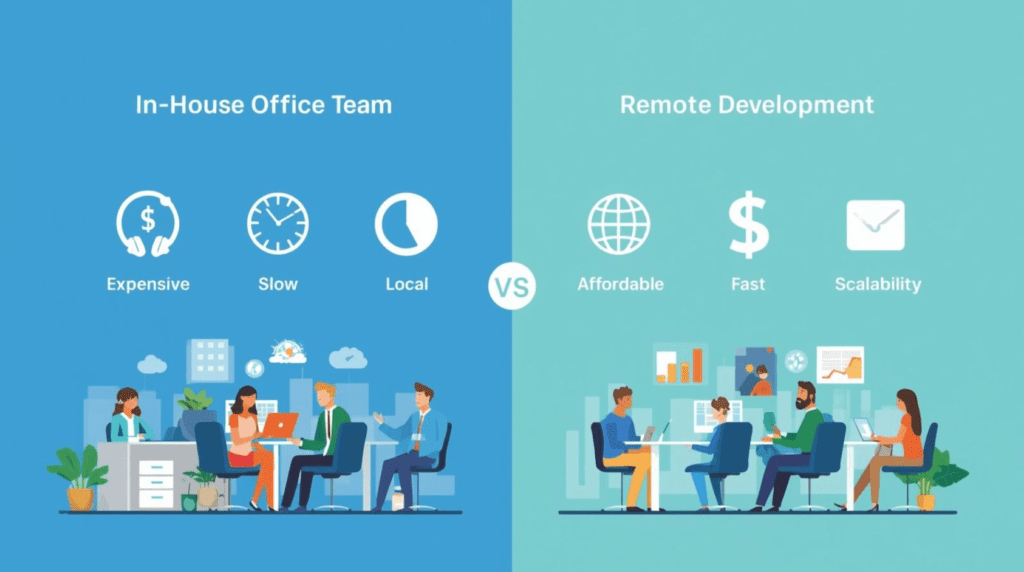
Remote Development Team vs. In-House Team
This is the question every business leader asks before making the move. Here’s an honest, side-by-side look:
Factor
Cost
Hiring Speed
Talent Access
Scalability
Control
Culture Fit
Communication
Long-term Reliability
Remote Development Team
40–70% lower overall
48–72 hours with the right partner
Global pool of specialists
Highly flexible, fast to adjust
High with proper processes
Requires intentional effort
Async-first, requires discipline
Strong with the right partner
In-House Team
High — salary, benefits, office, equipment
6–12 weeks average
Limited to local market
Slow, expensive to scale up or down
High
Easier naturally
Real-time by default
Strong but costly
The honest takeaway? For most growing businesses, a hybrid model works best — a small core in-house team for strategy and stakeholder management, and a remote team handling development execution at scale.
Offshore Development Team vs. Freelancers: Why It's Not Even Close
Many businesses make the mistake of conflating offshore software development services with hiring freelancers. They’re fundamentally different.
Freelancers are individuals. They have competing clients, inconsistent availability, no accountability structure, and zero continuity if they disappear mid-project (which happens more than anyone admits).
An offshore development team through a proper outsourcing partner gives you:
- Consistency — the same developers, day after day, embedded in your workflow
- Accountability — an agency layer that manages performance and replaces team members if needed
- Communication — structured daily standups, sprint reviews, Slack integration
- Legal and IP protection — proper contracts, NDAs, IP assignment clauses
- Scalability — adding or removing team members without renegotiating relationships from scratch
For anything beyond a small, one-off task, a remote development team through a reputable IT outsourcing services company will outperform a collection of freelancers every single time. The coordination overhead alone of managing five separate freelancers will eat up whatever cost savings you thought you were getting.
Cost of Hiring Remote Developers in 2026: A Global Breakdown
Let’s get specific. Here are realistic monthly cost ranges for a mid-level software developer (3–6 years experience) across key regions:
United States / Canada
- Hourly Rate: $80–$150/hour
- Monthly Cost: $13,000–$25,000+
- Best for: Local compliance requirements, client-facing roles
Western Europe (UK, Germany, Netherlands)
- Hourly Rate: $60–$120/hour
- Monthly Cost: $10,000–$20,000
- Best for: EU-based clients, GDPR-sensitive projects
Eastern Europe (Poland, Ukraine, Romania)
- Hourly Rate: $35–$65/hour
- Monthly Cost: $5,500–$10,500
- Best for: Strong technical talent, near-shore time zones for European clients
South Asia (Pakistan, India, Bangladesh)
- Hourly Rate: $15–$40/hour
- Monthly Cost: $2,400–$6,500
- Best for: Highest cost efficiency, large developer pools, strong English proficiency
Latin America (Colombia, Argentina, Brazil)
- Hourly Rate: $30–$60/hour
- Monthly Cost: $4,800–$9,500
- Best for: US time zone alignment, strong frontend and mobile talent
The math is simple. If you need a team of four developers, hiring locally in the US costs $60,000–$100,000 per month. The same caliber team through an offshore partner in South Asia or Eastern Europe costs $10,000–$25,000 per month. That’s real money back into product, marketing, or runway.
Step-by-Step Process to Hire a Remote Team
Building a high-functioning remote software development team doesn’t happen by accident. Here’s the process that actually works.
Step 1: Define Your Needs Clearly
Before approaching any outsourcing partner, get specific. What technology stack? What roles? What seniority level? What’s your timeline and budget? The clearer your brief, the better the match.
Step 2: Choose the Right Outsourcing Partner
Not all IT outsourcing services companies are created equal. Look for:
- A strong portfolio of similar projects
- Transparent pricing with no hidden fees
- Clear communication protocols
- Client testimonials from businesses in your industry
- Contracts that include IP ownership and NDAs
Step 3: Technical Vetting
Before anyone joins your team, they should pass your technical screening — not just the agency’s. Ask to review code samples, conduct a short technical test, and run a video interview. Any credible partner will support this.
Step 4: Structured Onboarding
Treat remote onboarding as seriously as in-house onboarding. Share your codebase documentation, introduce the team to your project management tools (Jira, Linear, Notion), set up communication channels, and define sprint cadence from day one.
Step 5: Establish Communication Rhythms
Daily async standups, weekly sprint planning, bi-weekly retrospectives. These aren’t optional — they’re the backbone of a remote team that actually functions as a team.
Step 6: Measure, Adjust, Scale
After the first 30–60 days, review output quality, velocity, and communication. This is your inflection point — double down on what works, address gaps, and begin scaling the team as your roadmap demands.
Common Mistakes to Avoid When You Hire Remote Developers
Even experienced companies make these errors. Learn from them before they cost you.
Mistake 1: Optimizing for the Lowest Price
The cheapest developer is almost never the best value. An under-skilled developer who bills $10/hour but produces buggy code, misses deadlines, and requires constant supervision will cost you far more than a $30/hour developer who delivers clean, scalable work independently. Pay for quality. It compounds.
Mistake 2: Skipping the Vetting Process
Trusting a partner’s word alone about developer quality is a risk. Always conduct your own technical assessment before someone joins your team. This applies even to reputable agencies.
Mistake 3: No Clear Communication Framework
Remote work doesn’t fail because of time zones. It fails because of ambiguity. If your remote developers don’t know what’s expected daily, what the priorities are, and who to escalate to — performance will suffer. Build the framework first, then hire.
Mistake 4: Treating Remote Teams as Vendors, Not Partners
The companies that get the best results from their remote development teams treat them like extended employees — sharing company vision, including them in planning sessions, recognizing achievements. Transactional relationships produce transactional output.
Mistake 5: Ignoring Legal and IP Protections
Especially for startups and SaaS companies — make sure your outsourcing agreement includes clear intellectual property assignment, source code ownership, and confidentiality provisions. This is non-negotiable.
Why Choose Zatiq Solution for Remote Team Outsourcing
If you’ve read this far, you’re serious about building a remote team the right way. Here’s why companies across the USA, UK, UAE, Canada, and Europe trust Zatiq Solution as their remote team outsourcing company.
Fast Onboarding, Not the Usual Wait Zatiq’s pre-vetted developer pool means you can have skilled engineers integrated into your team within 48–72 hours of finalizing your requirements. No months-long recruitment process. No agency delays. Just ready-to-work talent.
Technically Vetted Developers Every developer in the Zatiq network has passed rigorous technical assessments, communication evaluations, and professional background checks. You’re not getting developers who look good on paper — you’re getting people who can deliver.
Transparent, Scalable Pricing No hidden fees, no surprise invoices. Zatiq offers clear monthly pricing that scales with your team. Add developers during product sprints, scale back during lighter phases — your contract flexes with your business.
Communication That Actually Works Zatiq teams operate in your tools — Slack, Jira, GitHub, Notion — and align with your working hours for daily overlap. You won’t be chasing updates or waiting for replies. Communication is proactive, not reactive.
Global Track Record From early-stage startups building their first product to established SaaS companies expanding their engineering capacity, Zatiq has delivered across industries and geographies. The results speak for themselves.
Real-World Use Cases: How Companies Win with Remote Teams
The Startup That Hit Launch in 90 Days
A fintech startup based in London needed a full-stack team — backend, frontend, and mobile — to build their MVP. Local hiring quotes came back at £180,000+ for a team of four for six months. Through a dedicated offshore development team, they assembled the same caliber of talent for under £40,000, launched on schedule, and closed their seed round two weeks after launch.
The Agency That Doubled Its Capacity
A digital marketing agency in Toronto was turning down web development projects because they didn’t have the engineering bandwidth. Rather than hiring in-house, they partnered with a remote software development team to handle overflow work. Within three months, they had doubled their project intake and increased annual revenue by 35% without adding a single local employee.
The SaaS Company That Scaled Its Engineering Team Fast
A B2B SaaS company in Dubai needed to build a new integrations layer for their platform — a project requiring three backend specialists they couldn’t find locally. Through offshore software development services, they onboarded three mid-senior developers within a week, completed the project in seven weeks, and kept two of the developers on for ongoing product work.
Conclusion: The Smart Move Is Clear
The companies winning in 2026 aren’t necessarily the ones with the biggest budgets or the most prestigious office addresses. They’re the ones making smarter decisions about how they build — and who they build with.
When you hire a remote team through the right partner, you unlock cost savings that fund your growth, speed that keeps you competitive, and access to global talent that your local market simply can’t match.
The model works. The data supports it. The businesses doing it are scaling faster and spending smarter.
The only question is: are you ready to build your team?
[Book a Free Consultation with Zatiq Solution Today →]
Tell us what you’re building, what you need, and we’ll put a dedicated team in front of you within 72 hours. No commitment. Just a straight conversation about what’s possible.
FAQ's
What does it cost to hire a remote development team in 2026?
Costs vary significantly by region. South Asian remote teams typically cost $2,400–$6,500/month per developer, Eastern European teams $5,500–$10,500/month, and US-based remote developers $13,000–$25,000/month. Most businesses find South Asian and Eastern European teams offer the best cost-to-quality ratio.
How quickly can I hire a remote development team?
With a reputable outsourcing partner, you can have vetted developers onboarded within 48–72 hours. This compares favorably to traditional in-house hiring, which averages 6–12 weeks from posting to productivity.
What's the difference between a remote team and a freelancer?
Freelancers are individuals with competing clients and no accountability structure. A remote development team is a dedicated group embedded in your workflow, managed by a partner agency, with consistent availability and proper legal protections including NDAs and IP assignment.
Is it safe to share my source code with an offshore development team?
Yes, provided you work with a reputable IT outsourcing services company that offers proper legal contracts including IP ownership clauses, NDAs, and data protection agreements. Always verify these protections before engagement.
How do I manage a remote development team effectively?
Success requires clear communication frameworks: daily async standups, weekly sprint planning, and shared project management tools (Jira, Linear, GitHub). Treat remote developers as extended team members, not vendors.
What roles can I hire through a remote development team?
You can hire virtually any technical role remotely — frontend and backend developers, mobile developers (iOS/Android/React Native), DevOps engineers, QA engineers, UX/UI designers, data engineers, and project managers.
Is hiring remote developers better than outsourcing to a software agency?
It depends on your needs. A dedicated remote team gives you more control, continuity, and cultural alignment. A software agency is better for defined, project-scoped work. For ongoing product development, a dedicated remote team typically delivers better long-term value.
Can a remote development team work in my time zone?
Yes. Many remote teams, particularly in South Asia (Pakistan, India) and Eastern Europe, offer significant daily overlap with US, UK, and UAE business hours. The best partners align their team’s working hours to maximize real-time collaboration.
What tech stacks do remote development teams typically cover?
Most established outsourcing partners cover the full spectrum: React, Next.js, Node.js, Python, Django, Laravel, Flutter, React Native, AWS, GCP, Azure, and more. Always confirm specific expertise during the evaluation phase.
How is a dedicated development team different from staff augmentation?
Staff augmentation adds individual contractors to your existing team. A dedicated development team is a fully assembled, managed unit built specifically around your project needs — with built-in coordination and accountability structures.
What industries benefit most from remote development teams?
SaaS companies, fintech startups, e-commerce businesses, digital agencies, healthcare tech, and edtech platforms are among the most frequent users. Essentially any business that relies on software can benefit.
How do I ensure code quality from a remote development team?
Establish clear quality standards upfront, implement code review processes, use automated testing pipelines, conduct regular sprint reviews, and choose a partner that supports technical assessments during the hiring phase.